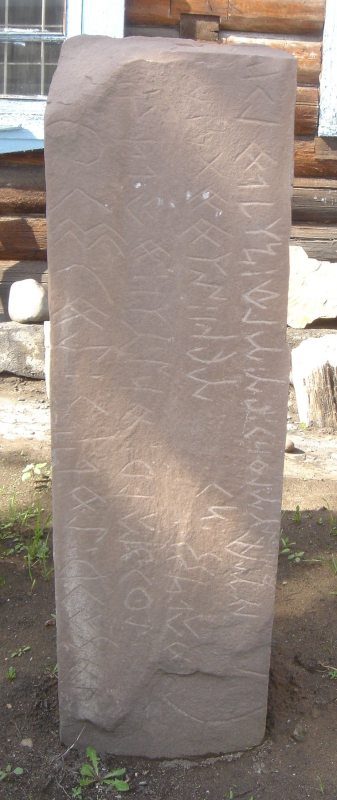
Photo: Philipp Roelli · CC BY-SA 3.0 · Wikimedia Commons
Orkhon Inscriptions is a Göktürk inscriptions dating to the 8th century. It is near Tsetserleg, Mongolia. Kul Tigin died in 731; his stele followed in 732. The free Lokali audio guide runs 7 minutes.
✓ Published October 2026 · how we write these guides
Visitor facts
| Lokali audio guide | 7 min · free |
|---|---|
| Type | Monument |
| Location | Tsetserleg, Mongolia |
| Coordinates | 47.5606, 102.8411 |
| Languages | 50+, in the Lokali app |
The story
Listen first. Out here the wind rarely stops. It moves across the steppe grass with a dry, steady hiss, and it carries the smell of earth, horses, and woodsmoke from distant camps. The sky looks enormous. The land rolls away in soft green and gold folds toward low hills. Then the stones appear. Tall, grey, carved slabs stand upright in the open valley. They look patient, as if they have been waiting a very long time for someone to read them.
These are the Orkhon inscriptions. They stand in the valley of the Orkhon River, in central Mongolia, in the region whose provincial capital is Tsetserleg. The best-known stones belong to a site called Khöshöö Tsaidam. They were carved in the early eighth century, during the period historians call the Second Turkic Khaganate. A khaganate was a steppe empire ruled by a khagan, a supreme ruler above lesser chiefs. For a time, this empire controlled a huge stretch of Inner Asia.
Here is the first surprise. These stones carry some of the oldest known long texts written in a Turkic language. That makes this quiet valley important to millions of people far from Mongolia. Speakers of Turkish, Kazakh, Uzbek, Kyrgyz, Azerbaijani and many related languages can trace an early written form of their linguistic family to inscriptions like these. Visitors from Turkey and Central Asia often arrive here with real emotion. For them, this valley can feel like a family archive set in stone.
The two most famous monuments honour two brothers. One stele commemorates Kul Tigin, a celebrated military commander. He died in 731, and his memorial stone was raised the following year. The other honours his elder brother, Bilge Khagan, the ruler of the empire, whose stele followed a few years later. The texts are written partly in the voice of the khagan himself. They speak about the history of the Turkic people, their victories and defeats, and their relations with neighbours.
Look closely at the script. It does not look like Chinese characters, and it does not look like Mongolian writing. The letters are angular, made of straight cuts and sharp points. That shape makes sense, because the script was suited to carving into stone and wood. Scholars call it Old Turkic script, and it is sometimes called runic because it resembles the runes of Scandinavia. The two systems are not related. The resemblance comes from the same practical need to cut letters with simple strokes.
The script also runs in an unfamiliar direction. Old Turkic is generally read from right to left, and on these stelae the lines run in vertical columns. If you try to follow the carving, imagine your eye starting at the top and moving down. The craftsmen who cut these letters worked with great care. Even after so many centuries of wind, frost and summer sun, many signs are still sharp enough to trace with your eyes.
Now walk around the stone. On one face you will find something completely different — Chinese characters. The Kul Tigin monument is bilingual. Its Chinese text was written in the name of the Tang emperor of China, as a mark of diplomatic respect toward the Turkic court. So one slab of stone holds two voices. One is the formal language of the great Chinese empire to the south. The other is the steppe empire speaking about itself, in its own words.
The Turkic text has a tone that surprises many readers. It is not only a list of glories. It warns the people against losing their identity. It criticises those who were tempted by Chinese silks and sweet words, and it says this temptation led to disaster in earlier times. It is political writing, carved to last. Historians value these lines because they show how a steppe ruler wanted his own people to understand their past.
For more than a thousand years, the meaning of these letters was lost. In 1889, the Russian explorer Nikolai Yadrintsev reported the stones to the scholarly world. Expeditions followed, and copies of the texts travelled to European universities. In 1893, the Danish linguist Vilhelm Thomsen announced that he had deciphered the script. The Chinese side helped researchers identify names and context. Within a short time, a forgotten literature returned to life.
Notice the bases of the monuments. Steles of this kind traditionally stood on stone pedestals carved in the shape of a tortoise. In Chinese tradition, the tortoise is a symbol of long life and endurance, so it was a fitting foundation for a memorial. Originally, these stones were part of larger memorial complexes. Archaeologists have found remains of enclosures, statues and offering structures around them. Today you see only parts of that arrangement, scattered across the grass.
The Orkhon Valley holds far more than these stones. The wider valley is protected as a UNESCO World Heritage cultural landscape. Across many centuries, different steppe powers chose this place as a centre. Later, the Uighurs built a capital in the valley. Later still, the Mongol Empire built Karakorum not far away, near the modern town of Kharkhorin. The good grazing, the river water and the open plain made this area valuable to nomadic rulers again and again.
That continuity is the second surprise. When you stand here, you are not in a single ruined city. You are in a landscape that many empires used for the same reasons. Herders still move their animals across this land. You may see white felt gers, the round tents of Mongolian nomads, on the hillsides. You may hear the low call of a yak or the quick hoofbeats of a horse. Daily life here continues around these ancient words.
Before you leave, stand still for a moment and look at the stones against the open sky. Notice how small they appear in such a wide valley, and how strong they still look. Feel the wind on your face and listen to the grass. The people who raised these monuments wanted their story to survive. As you walk back across the steppe, you carry a small part of that wish with you.
Key facts
What to look for
Practical tips
Common questions
Is there a free audio guide to Orkhon Inscriptions?
Yes — the Lokali app narrates Orkhon Inscriptions free of charge in 50+ languages. The guide runs about 7 minutes, covers the history, what to look for on site and practical tips, and works offline once downloaded.
Where is Orkhon Inscriptions?
Orkhon Inscriptions is near Tsetserleg, Mongolia, at 47.5606, 102.8411. Tap the map link on this page for directions from where you are.
What is Orkhon Inscriptions known for?
Kul Tigin died in 731; his stele followed in 732. Among the oldest known long texts in a Turkic language.
What should you look for at Orkhon Inscriptions?
Angular Old Turkic letters cut in vertical columns. Chinese characters on one face of the Kul Tigin stele. Tortoise-shaped stone pedestals beneath the memorial slabs.
What should you know before visiting Orkhon Inscriptions?
Bring a windproof layer even on sunny summer days. Visit the site museum to see stones out of the weather.
When is the best time to visit Orkhon Inscriptions?
Bring a windproof layer even on sunny summer days.
On the map
Opens directions to Orkhon Inscriptions from your location.
Hear Orkhon Inscriptions in your language
The full story, narrated, in 50+ languages. Download it before you go and it plays offline, at your own pace, with no ticket and no tour group.