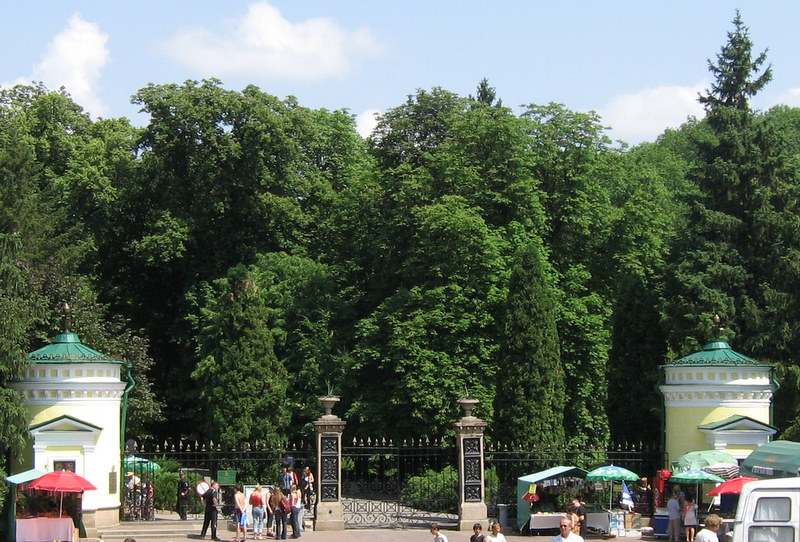
Sofiyivka Park
48.7631° N · 30.2225° E · Botanical Garden
Photo: Uk-Kamelot · CC BY-SA 3.0 · Wikimedia Commons
Sofiyivka Park is an arboretum in Cherkasy Oblast, Ukraine. Founded in the late 1790s by Count Stanisław Szczęsny Potocki. The free Lokali audio guide runs 7 minutes.
✓ Published October 2026 · how we write these guides
Visitor facts
| Lokali audio guide | 7 min · free |
|---|---|
| Type | Botanical Garden |
| Location | Uman, Ukraine |
| Coordinates | 48.7631, 30.2225 |
| Official website | sofievka.org |
| Languages | 50+, in the Lokali app |
The story
Listen first. Water is moving somewhere close by. It falls over stone, gathers in still ponds, and slips away under rock. The air in this valley is cooler than the town above it, and it smells of wet moss and old trees. Under your feet the path is uneven: granite, earth and roots. You are walking through a landscape that people built by hand, yet almost every part of it was designed to look as though nature made it.
This is Sofiyivka Park, on the edge of Uman in central Ukraine. Its story begins in the late 1790s with a Polish magnate, Count Stanisław Szczęsny Potocki. He was one of the richest landowners of his time. He named the park after his wife, Sofia. The project was a gift, and probably also a statement. Here was a man who could turn a rocky ravine into a poem in stone and water.
Sofia herself was an unusual figure. She was born into a Greek family in the Ottoman world and rose from obscure beginnings to the highest circles of European society. Her life became the subject of gossip, letters and later novels. Many of the stories about her are exaggerated or uncertain. Still, one thing is clear: her name has stayed on this valley for more than two centuries, long after the family that built it lost the land.
The park was designed by Ludwik Metzel, a military engineer in Potocki's service. This detail is easy to miss, but it explains a lot. An engineer understands gradients, dams, tunnels and drainage. Metzel used the small Kamianka River as his raw material. He held it back with dams, sent it through channels, and dropped it over cliffs. The waterfalls and ponds you see around you are the result of careful hydraulic planning.
The labour was not romantic. Serfs did the work: peasants bound to the land who had no choice in the matter. They moved enormous granite boulders, dug the ponds and carved the grottoes. Keep that in mind as you admire the rocks. Many of them look wild and ancient. In fact, a large number were placed here on purpose, by people whose names were never recorded.
The idea behind the park comes from classical Greek myth. Metzel and Potocki filled the valley with references to Homer's epics, the Odyssey and the Iliad, and to ancient legends. Paths lead to places named after the underworld, after sea nymphs, after cliffs from Greek stories. For an educated visitor of that time, a walk here was like reading a book. Each turn in the path opened a new chapter.
Here is the first surprise for most visitors. Somewhere in this park a river runs underground. It is named Acheron, after a river of the dead in Greek myth. The channel was cut through rock, and it connects two parts of the water system. Visitors who travelled through it in the dark felt a small taste of a mythical journey into the underworld. Depending on the season, boats sometimes carry visitors along this route, so ask at the park.
Near the ponds you will find grottoes, cool stone chambers with names from myth. One is dedicated to Thetis, the sea nymph who was the mother of Achilles. Another is called the Grotto of Fear and Doubt. Stand inside one of them for a moment. Notice how the sound changes. The water outside becomes softer, and your own voice comes back to you from the rock. This was part of the design.
On one of the ponds sits a small island, often called the Island of Love, with a pink pavilion. It is one of the most photographed places in the park. Look at how the pavilion is reflected in the water on a calm day. The garden designers of that period loved this kind of effect: a building, a mirror of water, and a frame of trees. Everything is arranged to be seen from a particular point on the path.
The second surprise is political. In 1830 and 1831, Poles in the Russian Empire rose up against Russian rule. A member of the Potocki family took part in that uprising. After it failed, the Russian authorities confiscated the estate. The park was given to the empress and renamed the Tsaritsyn Garden, meaning the Empress's Garden. For a period of time, Sofia's name was officially erased from her own park.
Later in the nineteenth century the park found a new role. A school of gardening was established here, and the valley became a place of study and not only of pleasure. That tradition continues today. Sofiyivka is now a dendrological park, which means a living collection of trees and shrubs, under the National Academy of Sciences of Ukraine. Scientists work here, and the trees around you include both local species and plants brought from far away.
Spend a little time with the trees themselves. Some of them are very old, with thick bark and wide crowns that shade the paths. In spring the park fills with blossom. In autumn the ponds collect red and gold leaves. Uman is also known for another reason: every year many Jewish pilgrims come to the town to visit the grave of Rabbi Nachman of Breslov. The park and the pilgrimage are two different worlds that share the same small city.
The park is large, and the paths go up and down. Good shoes make a real difference here, especially near the wet rocks by the waterfalls. Do not try to see every corner in a hurry. The design of Sofiyivka works best when you walk slowly and let each view arrive. Stop at bridges, sit near the ponds, and look back the way you came. Often the best view is behind you.
Before you leave, stand still once more and listen. The water is still moving, just as Metzel planned it. The rocks carry the work of hundreds of hands. The trees hold the patience of gardeners across many generations. A count built this place for his wife, an empire took it away, and scientists now care for it. And today, for a few hours, it belongs to you.
Key facts
What to look for
Practical tips
Common questions
Is there a free audio guide to Sofiyivka Park?
Yes — the Lokali app narrates Sofiyivka Park free of charge in 50+ languages. The guide runs about 7 minutes, covers the history, what to look for on site and practical tips, and works offline once downloaded.
Where is Sofiyivka Park?
Sofiyivka Park is near Uman, Ukraine, at 48.7631, 30.2225. Tap the map link on this page for directions from where you are.
What is Sofiyivka Park known for?
Founded in the late 1790s by Count Stanisław Szczęsny Potocki. Named after Potocki's wife, Sofia Potocka.
What should you look for at Sofiyivka Park?
The pink pavilion reflected in the pond on calm days. The dark entrance where the underground Acheron river runs. Echoing stone chambers of the Grotto of Thetis.
What should you know before visiting Sofiyivka Park?
Wear sturdy shoes for steep paths and slippery wet rocks. Ask at the park whether underground river boat rides operate.
When is the best time to visit Sofiyivka Park?
Come early morning for calm water and fewer crowds.
On the map
Opens directions to Sofiyivka Park from your location.
Hear Sofiyivka Park in your language
The full story, narrated, in 50+ languages. Download it before you go and it plays offline, at your own pace, with no ticket and no tour group.