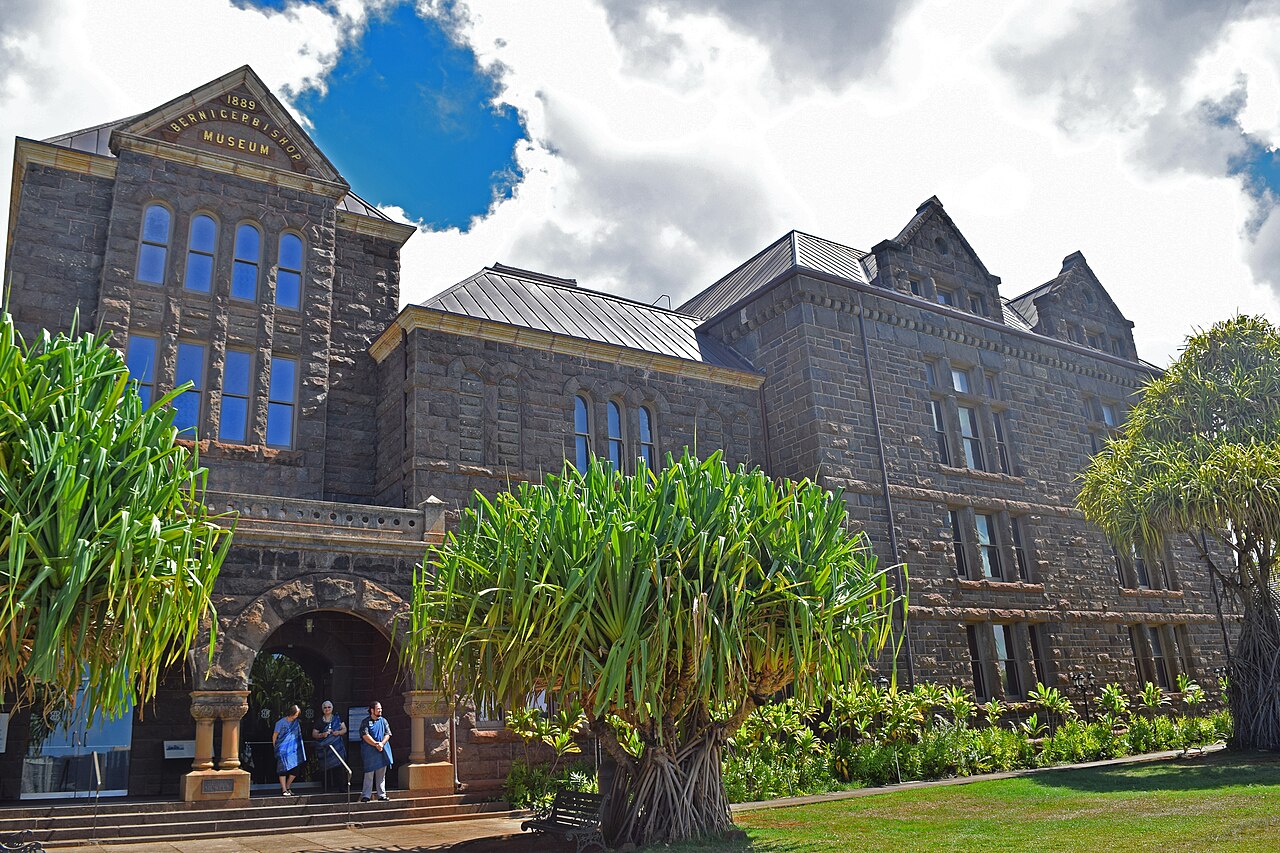
Bishop Museum is a museum in Honolulu, United States. Founded in 1889 by Charles Reed Bishop. Built in memory of Princess Bernice Pauahi Bishop. Most visitors spend 2-4 hours here. The free Lokali audio guide runs 6 minutes.
✓ Verified October 2026 · how we write these guides
Visitor facts
| Time needed | 2-4 hours |
|---|---|
| Lokali audio guide | 6 min · free |
| Type | Museum |
| Best for | Editors’ pick |
| Location | Honolulu, United States |
| Coordinates | 21.3433, -157.8617 |
| Languages | 45, in the Lokali app |
The story
The air inside changes the moment you step through the doors. It is cool and still, a relief from the bright island sun outside. Above you rises a great hall of dark wood, three floors tall, lined with carved railings. Light falls from high windows onto long rows of glass cases. Your footsteps echo softly on the floor. This is the Bishop Museum, the largest museum in the state of Hawaii.
The museum began with both a love and a loss. Charles Reed Bishop founded it in 1889. He built it in memory of his wife, Princess Bernice Pauahi Bishop. She was the last direct descendant of the royal Kamehameha line, the family that had first united these islands. When she died, she left behind the treasures, the heirlooms, and the lands of her people.
Charles wanted a home for everything she had inherited. He wanted the objects of her ancestors kept safe, and shown with honor to her people. So he created a museum, and he gave it her name. The collection started with royal heirlooms passed down through the Hawaiian monarchy. Over the years it grew far beyond what either of them could have imagined.
The main building is made of dark volcanic stone. Workers cut the heavy lava rock by hand. The style is solid and strong, with rounded arches above the doors and thick walls that hold the cool air. It has stood for more than a century. Run your eyes along the stone, and you sense that the building is made from the island itself.
Step into Hawaiian Hall and look up. Three levels of galleries surround a tall open center. The wood is koa, a tree that grows only in Hawaii, dark and warm in color. Each floor tells part of a story. The lower floor speaks of the gods and the natural world. The middle floor shows the work of daily life. The top floor honors the chiefs and the royalty.
Hanging in the center of the great hall is a sperm whale. Its long skeleton stretches across the open space high above your head. Beside it hangs a full model of the whale's dark body. For the people of these islands, the sea gave food, travel, and life itself. The museum keeps that truth hanging in plain view, where no visitor can miss it.
Among the most precious objects are the feather capes and cloaks. Hawaiian artisans tied tiny feathers, one by one, onto fine woven nets. A single cloak could take the feathers of many thousands of birds, gathered over years of patient work. These garments belonged only to the highest chiefs. They were worn as signs of rank, of power, and of the sacred.
You will also find carved wooden images of gods, called ki'i. Some are tall and fierce, with wide mouths and staring eyes. They once stood in temples across the islands. Nearby lie fishhooks of bone, bowls of polished wood, and sharp tools of stone. Each object carried a clear purpose in a world that had no metal and wasted nothing.
In time the museum grew beyond Hawaii alone. It became a center for the study of the whole Pacific. Pacific Hall holds objects from many island cultures, from Tahiti to New Zealand to Fiji and beyond. Together they show how brave seafaring peoples spread across the largest ocean on earth, island by island, over many long centuries.
This is also a place of science. Researchers here study insects, plants, shells, and the long natural history of the islands. Behind the public galleries lie millions of specimens, kept in careful drawers and jars and records. Scholars travel from around the world to study this collection. Much of the museum's true work happens far from the eyes of visitors.
On the grounds you may find a planetarium. Under its dark dome, the staff show how Polynesian navigators once read the night sky. These wayfinders crossed thousands of miles of open ocean without maps or instruments. They steered by the stars, the swell of the waves, the flight of birds, and the color of the water. The museum keeps that knowledge alive.
Take your time as you move from hall to hall. The museum rewards a slow and patient eye. Notice how the light shifts through the day, how the wood glows, how each case holds a piece of a larger story. There is far more here than one visit can hold. So let yourself linger over the things that quietly draw you in.
Then, before you leave, rest your eyes on a single feather, or a single carved face. Each was made by hands that believed these islands held something sacred. The museum does not only store the past. It keeps a promise made by one man to one woman, and through her, to her people. Stand a moment in the quiet, and listen.
Key facts
What to look for
Practical tips
Common questions
How long do you need at Bishop Museum?
Plan 2-4 hours. That is the time most visitors spend at Bishop Museum. The free Lokali audio guide runs 6 minutes and is made to listen to while you walk.
Is there a free audio guide to Bishop Museum?
Yes — the Lokali app narrates Bishop Museum free of charge in 50+ languages. No ticket, tour group or subscription, and it works offline once downloaded.
Where is Bishop Museum?
Bishop Museum is in Honolulu, United States, at 21.3433, -157.8617. Tap the map link on this page for directions.
What should you know before visiting Bishop Museum?
Allow at least two hours to see everything
What is Bishop Museum known for?
Founded in 1889 by Charles Reed Bishop
On the map
Opens directions to Bishop Museum from your location.
Hear Bishop Museum in your language
The full story, narrated, in 50+ languages. Download it before you go and it plays offline, at your own pace, with no ticket and no tour group.