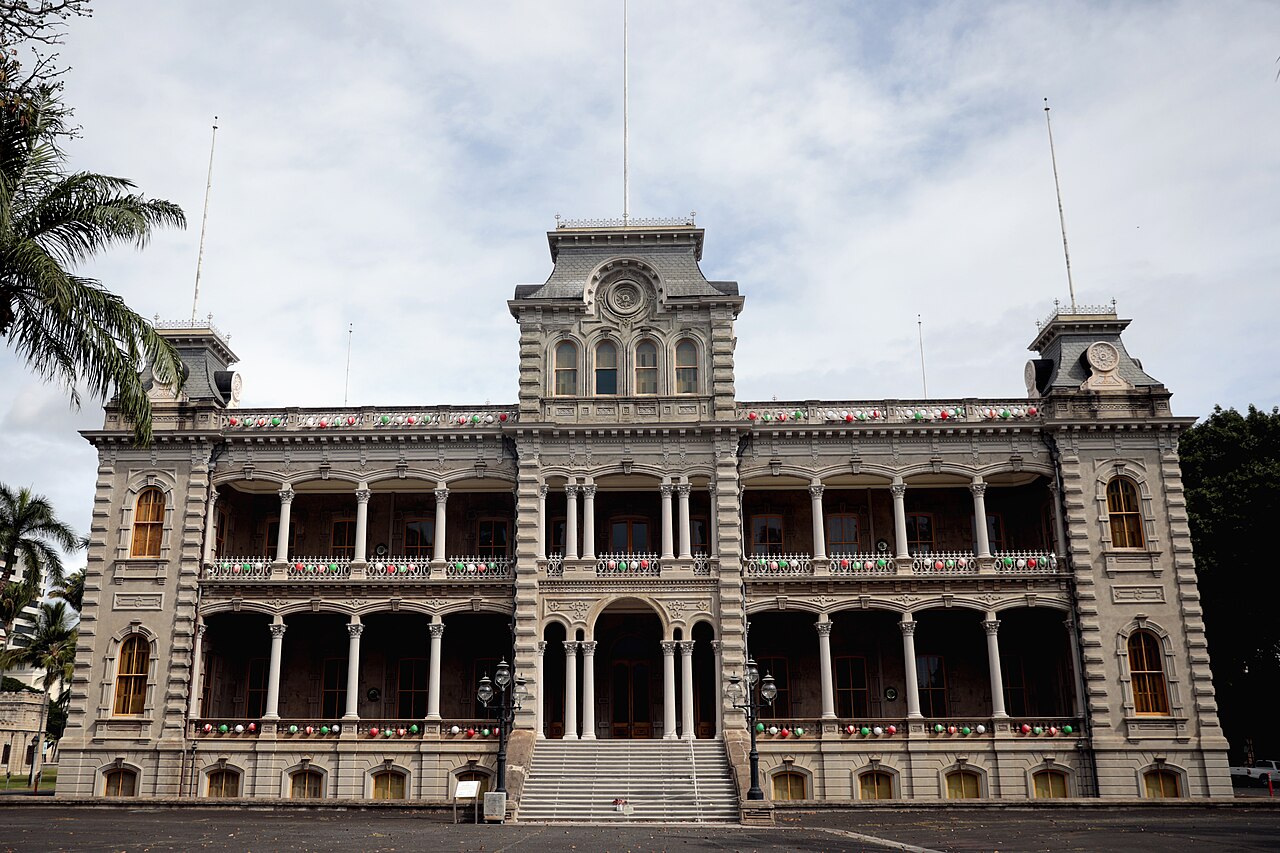
Iolani Palace is a palace in Honolulu, United States. Built between 1879 and 1882 by King Kalakaua. The only royal palace on United States soil. Most visitors spend 1-2 hours here. The free Lokali audio guide runs 5 minutes.
✓ Verified October 2026 · how we write these guides
Visitor facts
| Time needed | 1-2 hours |
|---|---|
| Lokali audio guide | 5 min · free |
| Type | Palace |
| Best for | History |
| Location | Honolulu, United States |
| Coordinates | 21.3091, -157.8599 |
| Languages | 45, in the Lokali app |
The story
You walk up a wide staircase of dark, polished wood. Your hand rests on a carved railing worn smooth by many years of touch. Light pours through the tall windows and falls in long shapes across the floor. The rooms around you are grand and very still. This is Iolani Palace, the only true royal palace on American soil.
Kings and queens once lived within these walls. They ruled the Hawaiian Kingdom, an independent nation set in the middle of the Pacific Ocean. For a short and brilliant time, this building was the beating center of their power. Today it stands quietly as a memory of that kingdom, a kingdom that is now lost to history.
King Kalakaua built the palace. Work began in 1879 and was finished in 1882. He had traveled widely around the world, and had met other kings and queens in their own courts. He wanted a palace that could stand proudly beside theirs. He wanted to show the world that Hawaii was equal among the nations of the earth.
The style of the building mixes many ideas. Tall columns line the front entrance. Wide covered porches, called lanai, wrap around each floor to catch the cool ocean breeze. The design has been called American Florentine. It is grand and formal, yet it was also shaped with real care for the warm island air outside. The wide porches still invite the breeze indoors today.
Inside, the rooms are rich with detail. The grand hall rises through the center of the house, open and bright. Portraits of Hawaiian rulers hang along the walls in heavy gilded frames. There is a throne room dressed in deep red and gold. There are formal rooms for receiving guests and ambassadors from around the world.
The palace held many wonders for its time. It had electric lights strung through its rooms before many great houses of Europe, and even before the White House in Washington. It had flush toilets, running water, and a telephone. King Kalakaua loved new ideas and machines. He filled his home with the bright inventions of the age.
But the kingdom was under great pressure. Foreign businessmen, many of them wealthy sugar planters, wanted control of the islands and their trade. In 1887 they forced the king to sign a new constitution under armed threat. It stripped away much of his power and his voice. The people came to call it the Bayonet Constitution.
After Kalakaua died, his sister became queen. Her name was Liliuokalani. She was strong and proud, and she tried to restore the rights of her people. She prepared a new constitution that would return power to the throne and to the native Hawaiians who had lost their voice. Her enemies watched her closely, and with growing fear.
In 1893 those enemies struck against her. With the help of armed American troops landed from a warship, they overthrew the queen. The Hawaiian Kingdom fell. The royal flag came down from the palace tower. Liliuokalani gave up her throne to avoid the spilling of blood, still hoping that justice would one day be done for her people.
Then came a deeper wound. In 1895, after some of her loyal supporters tried to fight back, the new government arrested the queen herself. They held her as a prisoner inside her own former palace. She lived for long months in a single upstairs room, watched, alone, and cut off from the people she loved.
In that quiet room she sewed a great quilt by hand. Each section of cloth marked a part of her long captivity, stitched like the pages of a diary. She also wrote music during those months. Her songs are still sung across Hawaii today. She turned her deep sorrow into lasting beauty, even as a prisoner in her own home.
As you move from room to room, listen to the silence. The fine furniture, the portraits, and the polished floors all seem to wait, as if the court might return at any moment. Guides speak softly here, and visitors lower their voices without being asked. The building still carries the heavy weight of all that happened within it.
Walk through these rooms slowly before you go. Behind the gold and the fine dark wood lies a story of pride and of loss. A kingdom rose here, and here it also fell. The palace asks you to remember the queen who loved her people and lost her throne. Stand a moment in her room, and let the quiet speak.
Key facts
What to look for
Practical tips
Common questions
How long do you need at Iolani Palace?
Plan 1-2 hours. That is the time most visitors spend at Iolani Palace. The free Lokali audio guide runs 5 minutes and is made to listen to while you walk.
Is there a free audio guide to Iolani Palace?
Yes — the Lokali app narrates Iolani Palace free of charge in 50+ languages. No ticket, tour group or subscription, and it works offline once downloaded.
Where is Iolani Palace?
Iolani Palace is in Honolulu, United States, at 21.3091, -157.8599. Tap the map link on this page for directions.
What should you know before visiting Iolani Palace?
Book a guided or self-led tour in advance
What is Iolani Palace known for?
Built between 1879 and 1882 by King Kalakaua
On the map
Opens directions to Iolani Palace from your location.
Hear Iolani Palace in your language
The full story, narrated, in 50+ languages. Download it before you go and it plays offline, at your own pace, with no ticket and no tour group.