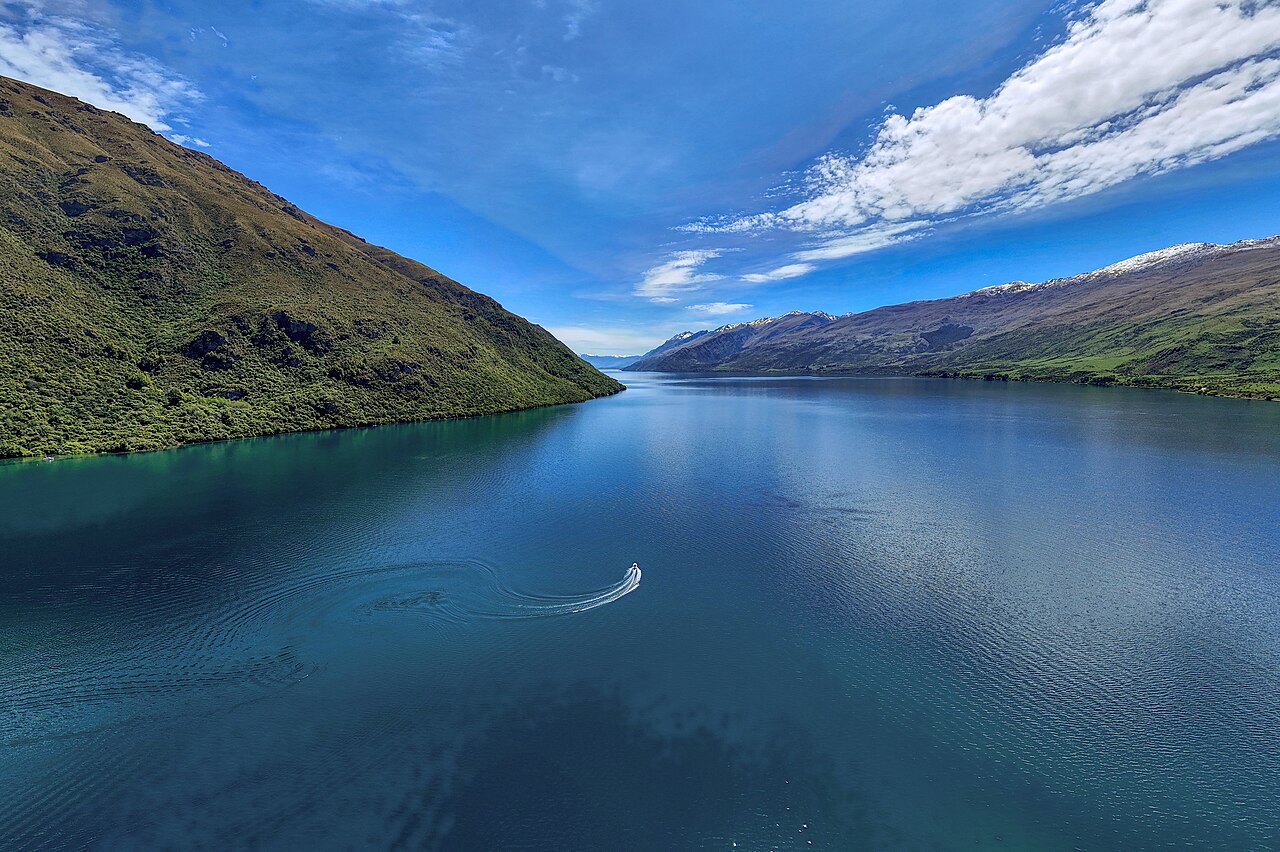
Lake Wakatipu is a viewpoint in Queenstown, New Zealand. Lake Wakatipu is New Zealand's longest lake, about eighty kilometres. The surface rises and falls roughly every twenty-five minutes. Most visitors spend 1-3 hours here. The free Lokali audio guide runs 6 minutes.
✓ Verified October 2026 · how we write these guides
Visitor facts
| Time needed | 1-3 hours |
|---|---|
| Lokali audio guide | 6 min · free |
| Type | Viewpoint |
| Best for | Photography |
| Location | Queenstown, New Zealand |
| Coordinates | -45.05, 168.5 |
| Languages | 45, in the Lokali app |
The story
Stand at the edge of the water and look down. The lake is clear, and it is very cold. It is also far deeper than it looks. Beneath your feet the floor drops below the level of the sea. This is Lake Wakatipu. It stretches away in a long, bent line, held on every side by mountains. Few lakes in the world sit in a setting quite like this.
Lake Wakatipu is the longest lake in New Zealand. It runs for about eighty kilometres through the high country of the South Island. Seen from above, its shape bends twice, like a flash of lightning frozen on the map. Three long arms meet at sharp corners. The town of Queenstown sits on the inside of one of those bends, where the water turns.
The lake was carved by ice. Many thousands of years ago, a slow river of glacier ground its way down this valley. It cut a deep trench through solid rock. When the climate warmed, the ice melted, and water filled the long hollow that remained. The same ice shaped the steep mountains around you. You can read its work in the smooth, sweeping walls of the valley.
There is something unusual about this water. It rises and falls on its own, with no tide and no river to explain it. About every twenty-five minutes, the surface lifts a little, then sinks back down. Scientists call this motion a seiche. It is a slow standing wave that tips back and forth across the whole lake, like water rocking gently in a bowl.
The Maori people of this land, the Ngai Tahu, hold an older story. They tell of a giant named Matau who lay sleeping in the valley. A young man set fire to the giant to free a woman he had carried off. The great body burned and sank deep into the earth. The deep curved hollow of the lake was left behind in its place.
In that story, the heart of the giant was never destroyed. It still beats, far below the surface. The slow rise and fall of the water is the rhythm of that heartbeat. This is a legend, not a record of fact. Yet when you watch the lake breathe on a calm day, you can feel how such a story first came to be told.
The water here is known for being clean and clear. On a still morning you can look far down through it. Its colour changes with the sky, from deep blue to slate grey, to near black below the cliffs. In some light it holds a faint green where fine rock dust drifts in it. People swim here, but the cold is sharp, even in summer.
Listen, and you may hear a steam whistle. A coal-fired ship, the TSS Earnslaw, has worked these waters since 1912. People call her the Lady of the Lake. Her white hull and trail of dark smoke are easy to pick out against the water. More than a hundred years on, she still carries passengers across to the far shore and back again.
For the first European settlers, the lake itself was the main road. Few paths crossed the steep and broken land. Small boats carried wool, food, tools, and people between the scattered farms and towns along the shore. Without the lake, this corner of the country would have stayed cut off for far longer. Even now, boats reach quiet bays that roads never found.
Look across to the far shore. A long wall of bare peaks lifts straight up from the water. That range is called The Remarkables. As the sun drops in the evening, the last light moves slowly along the rock. The grey stone turns to gold, and then to a deep, quiet red, before the colour drains away into shadow.
The air at this height is thin and clean, and it carries sound a long way. You might hear the low note of a boat engine far out on the lake. You might hear a single bird, or the soft slap of small waves against the stones at your feet. Across the water, a far-off voice can sound surprisingly close. Then the quiet returns.
People have gathered at this shore for a very long time. Maori travelled here in search of food and the hard green stone called pounamu, prized for tools and ornaments. Miners came later, chasing gold in the rivers nearby. Today visitors come simply to look at the water and the peaks. The reasons change, but the pull of the place stays the same.
Find a quiet spot on the shore before you leave. Rest your eyes on the surface for a while. Slowly, gently, the water lifts and settles again. Heartbeat or wave, the lake keeps its own steady time. It has done so since long before anyone arrived to watch it, and it will go on long after you walk away.
Key facts
What to look for
Practical tips
Common questions
How long do you need at Lake Wakatipu?
Plan 1-3 hours. That is the time most visitors spend at Lake Wakatipu. The free Lokali audio guide runs 6 minutes and is made to listen to while you walk.
Is there a free audio guide to Lake Wakatipu?
Yes — the Lokali app narrates Lake Wakatipu free of charge in 50+ languages. No ticket, tour group or subscription, and it works offline once downloaded.
Where is Lake Wakatipu?
Lake Wakatipu is in Queenstown, New Zealand, at -45.05, 168.5. Tap the map link on this page for directions.
What should you know before visiting Lake Wakatipu?
Watch the water level closely for a few quiet minutes.
What is Lake Wakatipu known for?
Lake Wakatipu is New Zealand's longest lake, about eighty kilometres.
What is the best time to visit Lake Wakatipu?
Visit the shore at sunset to see peaks glow.
On the map
Opens directions to Lake Wakatipu from your location.
Hear Lake Wakatipu in your language
The full story, narrated, in 50+ languages. Download it before you go and it plays offline, at your own pace, with no ticket and no tour group.