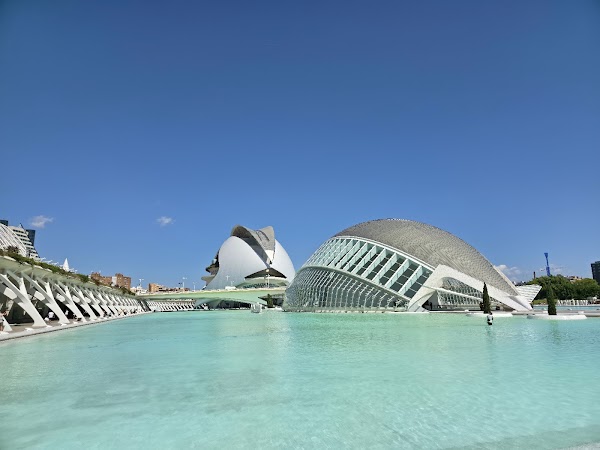
City of Arts and Sciences
39.3606° N · 0.3554° W · Complex
City of Arts and Sciences is a complex in Valencia, Spain. Futuristic architectural ensemble of white buildings housing museums, planetarium, and aquarium. Most visitors spend 2–4 hours here. The free Lokali audio guide runs 5 minutes.
✓ Verified August 2026 · how we write these guides
Visitor facts
| Time needed | 2–4 hours |
|---|---|
| Lokali audio guide | 5 min · free |
| Type | Complex |
| Best for | Editors' pick |
| Location | Valencia, Spain |
| Coordinates | 39.3606, -0.3554 |
| Languages | 45, in the Lokali app |
The story
At the end of a long green park, a cluster of vast white structures rises like the bones of some future creature, all sweeping curves, glass, and water, reflected in long blue pools. This is the City of Arts and Sciences, Valencia's futuristic complex of museums and halls, and the boldest piece of modern architecture in the city.
The complex was built from the late 1990s onward in the bed of a diverted river, a series of huge buildings designed mostly by a famous local architect known for white, skeletal, organic forms. Together they turned a flood-prone riverbed into the city's modern showpiece.
The buildings each have a purpose. There is a science museum shaped like a giant whale skeleton, a domed cinema and planetarium that looks like a vast eye, an opera house and arts palace under a sweeping shell, a landscaped walkway of arches, and a great aquarium.
The aquarium, set slightly apart, is one of the largest in Europe, with tunnels, tanks, and a dolphin pool recreating the seas and oceans of the world. It is the single most popular part of the complex, and a major draw for families.
The science museum is built for hands-on learning, with interactive exhibits aimed at curiosity rather than quiet looking, while the eye-shaped hall shows films on a huge curved screen and projects the night sky.
Even without entering any building, the complex is a spectacle. The white forms, the reflecting pools, and the play of light and water make it one of the most photographed places in the country, especially in the calm of early morning or at night when it is lit.
The opera house and arts palace, a soaring shell of white, hosts performances and gives the complex a cultural heart beyond the science and the aquarium, and its dramatic profile dominates the skyline of the modern district.
The whole complex sits at the seaward end of the long park that runs through the city, so you can walk or cycle down the old riverbed straight to it, the green leading you to the white.
It is, frankly, a place of modern spectacle rather than old history, and some find it cold or theme-park-like; but as a statement of ambition and a feast for the eye, it has put Valencia firmly on the map.
The buildings are best appreciated with time to walk among them, around the pools and under the arches, rather than rushing between ticketed attractions, so allow space simply to look as well as to visit.
A few practical notes. The aquarium, science museum, and cinema are each ticketed, sometimes with combined tickets; the outdoor areas and views are free. Come early or at dusk for the light and fewer crowds, and wear sun cover, as the white plazas are exposed.
Walk among the white shells and blue pools as the light shifts across them, and the City of Arts and Sciences feels like stepping into a vision of the future dropped into an old Spanish city. When you walk back up the green river park, the modern dream gives way to the old town once more.
Key facts
What to look for
Practical tips
Common questions
How long do you need at City of Arts and Sciences?
Plan 2–4 hours. That is the time most visitors spend at City of Arts and Sciences. The free Lokali audio guide adds about 5 minutes of narration you can listen to as you walk, so it fits inside your visit rather than adding to it.
Is there a free audio guide to City of Arts and Sciences?
Yes — the Lokali app narrates City of Arts and Sciences free of charge in 50+ languages. It covers the history, what to look for on site and practical tips, and it works offline once downloaded.
Where is City of Arts and Sciences?
City of Arts and Sciences is in Valencia, Spain, at 39.3606, -0.3554. Tap the map link on this page for directions from where you are.
What should you know before visiting City of Arts and Sciences?
Come early or at dusk for the light.
What is City of Arts and Sciences known for?
Valencia's futuristic museum and arts complex.
What is the best time to visit City of Arts and Sciences?
Visit at dusk when the buildings glow white against the darkening sky and reflect in the surrounding pools.
On the map
Opens directions to City of Arts and Sciences from your location.
More to see in Valencia


Hear City of Arts and Sciences in your language
The full story, narrated, in 50+ languages. Download it before you go and it plays offline, at your own pace, with no ticket and no tour group.