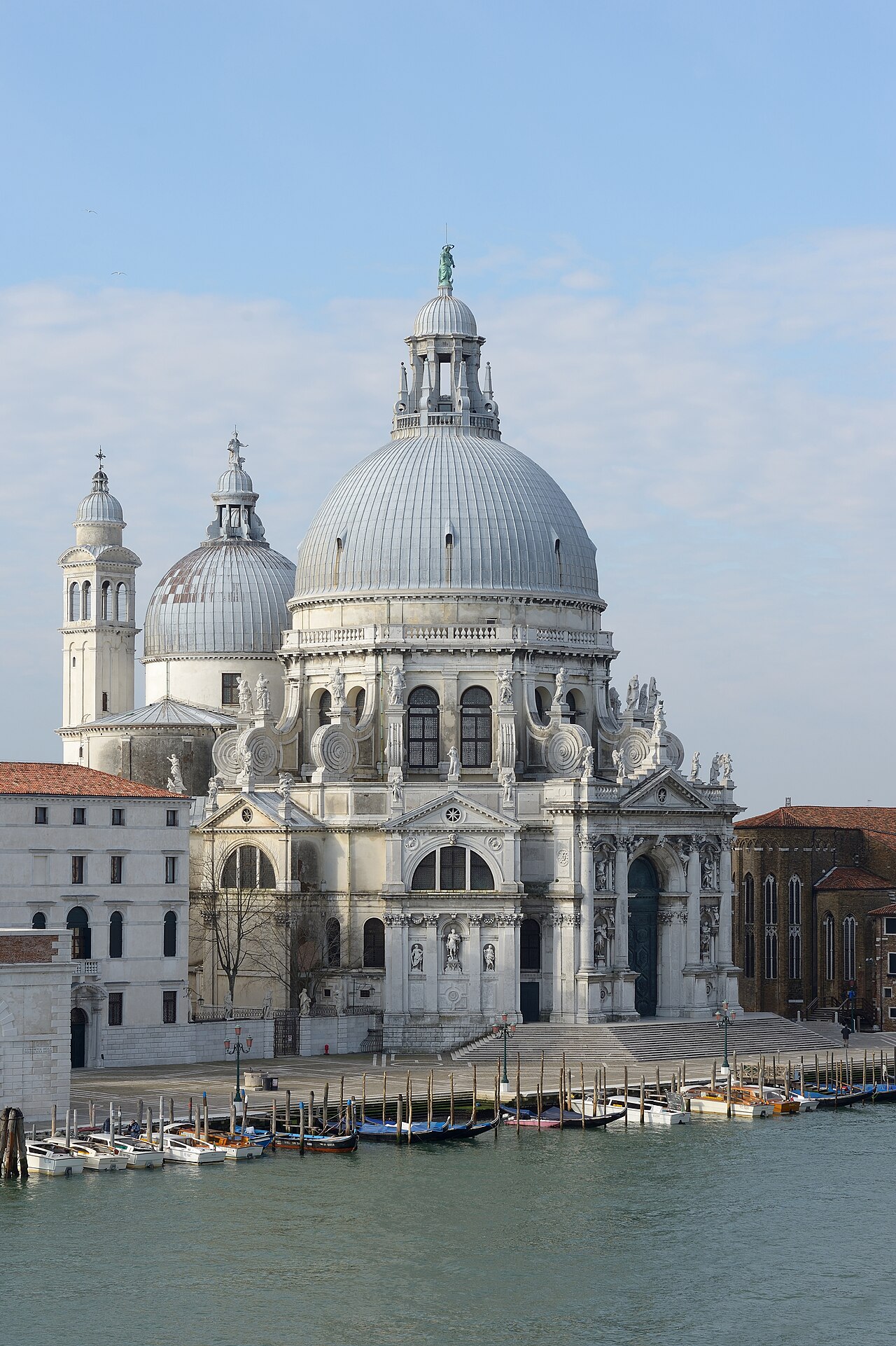
Basilica di Santa Maria della Salute
45.4314° N · 12.3298° E · Cathedral
Basilica di Santa Maria della Salute is a cathedral in Venice, Italy. This iconic octagonal basilica, completed in 1681, sits at the entrance of the Grand Canal. Most visitors spend 45–60 min here. The free Lokali audio guide runs 5 minutes.
✓ Verified August 2026 · how we write these guides
Visitor facts
| Time needed | 45–60 min |
|---|---|
| Lokali audio guide | 5 min · free |
| Type | Cathedral |
| Best for | Photography |
| Location | Venice, Italy |
| Coordinates | 45.4314, 12.3298 |
| Languages | 45, in the Lokali app |
The story
A white crown of stone rises where the Grand Canal meets the open water. Great scrolls curl beneath a wide dome, and statues stand against the sky. This is the Basilica di Santa Maria della Salute. Venetians call it simply the Salute. The word means health, and health is the reason it exists.
In 1630, plague reached Venice. It spread through the crowded parishes for more than a year. By the time it faded, tens of thousands of people had died, close to a third of the city. The government made a vow. If the Virgin Mary delivered Venice, the city would build her a new church.
Venice had made such a promise before. After an earlier plague in the 1570s, the city built the Redentore church on the island of Giudecca. That vow worked, people believed, so the Senate repeated it in 1630. Faith, in this city, was also public policy.
A competition was held for the design. The winner was Baldassare Longhena, a Venetian architect in his twenties. He proposed a church in the round, shaped like a crown for the Virgin. Construction began in 1631. Longhena worked on his church for half a century and died in 1682, five years before it was consecrated in 1687.
The site is soft mud at the tip of the Dorsoduro district. To hold the enormous weight, workers drove hundreds of thousands of timber piles deep into the lagoon floor. Old records count more than a million stakes. On that hidden wooden forest, the white church has stood for over three centuries.
Walk around the outside before you enter. The plan is an octagon, a shape with eight sides, rare for a church of this size. Great stone scrolls, called orecchioni or big ears, curl against the base of the dome and carry its weight outward. Statues of saints and prophets stand on every ledge. At the very top, the Virgin Mary stands on the lantern of the dome. She is dressed as a sea captain, guarding the harbor mouth below. A second, smaller dome and a pair of bell towers rise behind the main one. From the water, the whole building reads as one great offering.
Step inside. The space is round, calm, and filled with gray and white light. Light falls from windows high in the drum of the dome. Eight chapels open from the central octagon. The floor spreads in circles of colored marble toward the center. An inscription there recalls the plague and the vow. The center of the floor is the heart of the promise.
The high altar holds the church's treasure. It is a Byzantine icon of the Virgin and Child, dark with age, known as the Madonna della Salute. Venetian forces brought it from the island of Crete in 1670. Above it, marble figures show the Virgin driving the plague away from a kneeling Venice.
To the left of the altar, a door leads to the Great Sacristy. It is a small room with major paintings. Titian's Saint Mark Enthroned hangs here, painted after an earlier plague. His ceiling canvases show David and Goliath, Cain and Abel, and the sacrifice of Isaac. Tintoretto's Wedding at Cana fills one wall with light and faces.
Next to the church stands the old customs house of Venice, the Dogana da Mar. Ships once stopped there to declare their cargo before entering the city. On its corner tower, two bronze giants hold up a golden ball, and the figure of Fortune turns above it with the wind.
The church still keeps its birthday. Every year on November 21, Venetians celebrate the Festa della Salute. Engineers lay a temporary bridge of boats across the Grand Canal, and families walk over the water to light candles. Stalls outside sell candles and sweets to the crowds. It has happened nearly every year since the seventeenth century. It is a feast of the city itself.
Painters have loved this building for centuries. Canaletto painted it in clear daylight. Turner dissolved it in gold mist. Monet painted it from across the water. The dome appears in countless photographs at sunset, when the white stone turns rose and the lagoon goes still.
Before you leave, stand on the steps that run down to the water. Boats pass the point, bells ring across the canal, and the city goes about its day behind you. This church was built by survivors as a thank-you note in marble. Nearly four centuries later, Venice is still saying it.
Key facts
What to look for
Practical tips
Common questions
How long do you need at Basilica di Santa Maria della Salute?
Plan 45–60 min. That is the time most visitors spend at Basilica di Santa Maria della Salute. The free Lokali audio guide adds about 5 minutes of narration you can listen to as you walk, so it fits inside your visit rather than adding to it.
Is there a free audio guide to Basilica di Santa Maria della Salute?
Yes — the Lokali app narrates Basilica di Santa Maria della Salute free of charge in 50+ languages. It covers the history, what to look for on site and practical tips, and it works offline once downloaded.
Where is Basilica di Santa Maria della Salute?
Basilica di Santa Maria della Salute is in Venice, Italy, at 45.4314, 12.3298. Tap the map link on this page for directions from where you are.
What should you know before visiting Basilica di Santa Maria della Salute?
Come at sunset for the best light on the dome.
What is Basilica di Santa Maria della Salute known for?
Built after the plague of 1630 killed about one-third of Venice.
What is the best time to visit Basilica di Santa Maria della Salute?
The interior holds paintings by Titian and Tintoretto.
On the map
Opens directions to Basilica di Santa Maria della Salute from your location.
Reference
More to see in Venice


Hear Basilica di Santa Maria della Salute in your language
The full story, narrated, in 50+ languages. Download it before you go and it plays offline, at your own pace, with no ticket and no tour group.