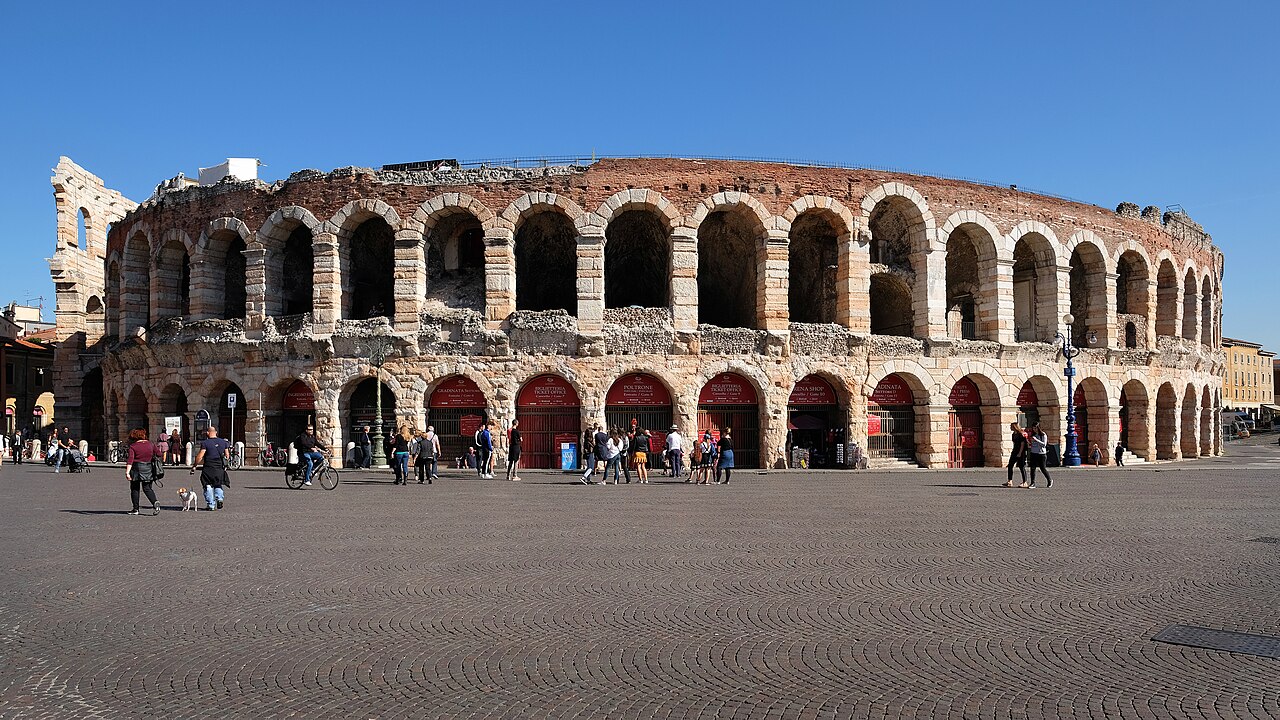
Arena di Verona is a remarkably preserved Roman amphitheater from the 1st century, third-largest in Italy. It is in Verona, Italy. Most visitors spend 45–90 min here. The free Lokali audio guide runs 5 minutes.
✓ Verified August 2026 · how we write these guides
Visitor facts
| Time needed | 45–90 min |
|---|---|
| Lokali audio guide | 5 min · free |
| Type | Amphitheater |
| Best for | Editors' pick |
| Location | Verona, Italy |
| Coordinates | 45.4408, 10.9933 |
| Languages | 45, in the Lokali app |
The story
The stone under your hand is almost two thousand years old. In front of you rises a great oval of pink and white limestone, arch upon arch, standing in the open middle of Piazza Bra. Morning light warms the stone. Swifts cut across the sky above the rim. This is the Arena di Verona. Romans built it, and Verona has never stopped using it.
Work on the amphitheatre began around 30 AD, in the first century. At that time the building stood outside the city walls. Travelers arriving on the Roman roads saw its arches long before they saw the city itself. Scholars count it among the largest Roman amphitheatres ever built. Only the Colosseum in Rome and the amphitheatre of Capua were clearly larger. Today it is one of the best preserved in the world.
The builders used limestone from the Valpolicella hills, just north of the city. The stone carries a soft pink and cream color, and in the low evening sun the whole building seems to glow. Inside, tiers of stone steps rise in a steep oval around the central floor. In Roman times, the Arena could hold about 30,000 spectators.
Walk around the outside and look for a tall fragment of wall that rises above everything else. Locals call it the Ala, which means the wing. It preserves four spans of the original outer wall, standing three levels high. A powerful earthquake in 1117 brought most of that outer ring down. The long double row of arches you see today was once the inner shell of an even larger building.
In Roman times, the floor below was covered with sand. Gladiators fought on it. Hunters faced wild animals in staged spectacles. Spectators entered through the numbered arches and found their seats through a network of stairways and inner corridors. The system moved huge crowds quickly and calmly, and it still works today. Modern visitors and opera audiences use the same passages the Romans planned.
When the Roman world faded, the games ended, but the Arena did not fall silent for long. Over the centuries Verona used the building for tournaments, festivals, fairs, and public gatherings of every kind. From the Renaissance onward, the city repaired the structure with steady care, generation after generation. This long habit of maintenance explains why the steps are still safe to climb today.
Then came the night that changed the building's life again. On 10 August 1913, the Arena staged Verdi's opera Aida, to honor the composer born 100 years earlier, in 1813. The tenor Giovanni Zenatello was among the organizers. The evening was a triumph, and people spoke of it across Europe. From that single performance grew the summer opera festival that has made the Arena a place of pilgrimage for lovers of music.
The festival now fills the Arena on summer nights. There is no roof, and by long tradition the singers' voices carry with little help from technology. A single soprano must reach listeners on the far side of the oval, and she does. The stone bowl gathers and carries sound with surprising ease. Performers often say the silence of this place has its own weight.
One custom belongs to this Arena alone. As darkness falls and the orchestra prepares, people on the stone steps light small candles. Thousands of little flames tremble around the dark oval, answering the first stars overhead. Seen from the highest rows, the amphitheatre becomes a quiet bowl of light, held together by twenty centuries of stone.
Today the Arena admits up to about 15,000 people for performances, roughly half of its ancient capacity, for reasons of safety and comfort. Opera shares the calendar with rock and pop concerts. Many artists describe this stage as the most moving of their careers, because the audience wraps around them like a single living presence.
By day, you can visit the building on its own terms. Walk the arcades and touch the worn stone. Climb to the top tier, where the steps are polished smooth by centuries of feet. From up there you see the pale roofs and towers of Verona, the hills at the horizon, and below you the wide curve of Piazza Bra with its cafes and plane trees. In summer, huge painted set pieces for the opera stand beside the building, waiting for the night.
Verona's historic center is a UNESCO World Heritage Site, and the Arena is its oldest layer still fully alive. Buildings this ancient usually survive as ruins or museums. This one still performs the task it was built for: gathering thousands of people to share strong emotions under an open sky. When the lights sink and the first note rises, you sit where Romans sat, beneath the same stars.
Key facts
What to look for
Practical tips
Common questions
How long do you need at Arena di Verona?
Plan 45–90 min. That is the time most visitors spend at Arena di Verona. The free Lokali audio guide adds about 5 minutes of narration you can listen to as you walk, so it fits inside your visit rather than adding to it.
Is there a free audio guide to Arena di Verona?
Yes — the Lokali app narrates Arena di Verona free of charge in 50+ languages. It covers the history, what to look for on site and practical tips, and it works offline once downloaded.
Where is Arena di Verona?
Arena di Verona is in Verona, Italy, at 45.4408, 10.9933. Tap the map link on this page for directions from where you are.
What should you know before visiting Arena di Verona?
Book opera tickets months ahead for popular summer performances.
What is Arena di Verona known for?
Built around 30 AD from pink Valpolicella limestone.
What is the best time to visit Arena di Verona?
Climb to the upper tiers for a view across the city rooftops.
On the map
Opens directions to Arena di Verona from your location.
Reference
More to see in Verona


Hear Arena di Verona in your language
The full story, narrated, in 50+ languages. Download it before you go and it plays offline, at your own pace, with no ticket and no tour group.