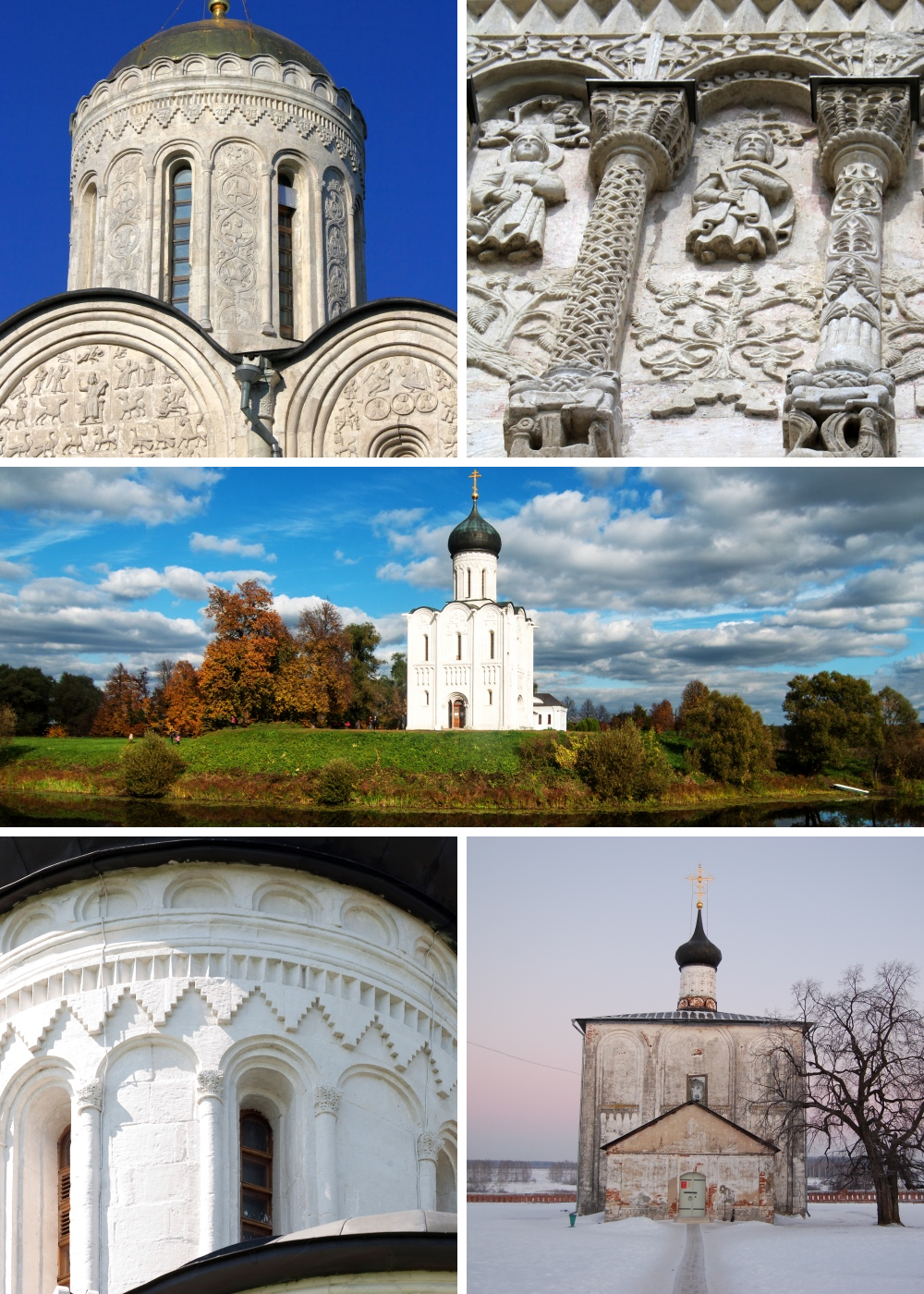
White Monuments of Vladimir and Suzdal
56.1500° N · 40.4167° E · World Heritage Site
Photo: Trasprd · CC BY-SA 4.0 · Wikimedia Commons
White Monuments of Vladimir and Suzdal is a group of buildings in Russia. Inscribed on the UNESCO World Heritage List in 1992. The free Lokali audio guide runs 7 minutes.
✓ Published October 2026 · how we write these guides
Visitor facts
| Lokali audio guide | 7 min · free |
|---|---|
| Type | World Heritage Site |
| Location | Vladimir, Russia |
| Coordinates | 56.1500, 40.4167 |
| Languages | 50+, in the Lokali app |
The story
Lay your hand against the wall in front of you. The stone is pale and slightly chalky. In the sun it feels faintly warm, and in shade it stays cool, almost damp. This is white limestone, cut and carved more than eight hundred years ago. Run your fingers along the edge of a block and you may feel the soft wear of centuries of rain, frost and human touch.
You are standing among the White Monuments of Vladimir and Suzdal. They are a group of churches, cathedrals, a city gate and palace remains. Together they were added to the UNESCO World Heritage List in 1992. Most of them date from the twelfth and early thirteenth centuries. That is the era before the Mongol invasion, when this region was one of the most powerful centres of the Russian lands.
To understand why these buildings exist, start with one man, Prince Andrei Bogolyubsky. In the middle of the twelfth century, the old political heart of the eastern Slavs was Kiev, far to the south. Andrei turned his back on it. He made Vladimir, then a modest town on a high bank above the Klyazma River, his capital. He wanted a city that could compete with Kiev, and even with Constantinople. And he chose stone to say so.
That choice matters more than it seems. In this forested region, almost everything was built of wood. Houses, walls and most churches burned, rotted and were rebuilt again and again. White limestone was expensive and slow to work. It was a deliberate statement of permanence. Stand back and look at how few windows there are, how thick the walls look. These buildings were meant to last, and many of them have.
Begin with the Golden Gate, the old ceremonial entrance to the city. It was built in the 1160s as part of the defensive walls. The wooden walls are gone now, so the gate stands alone, like a doorway without a house. Its name came from gilded copper plates that once covered the great oak doors. The gate has been rebuilt and altered over the centuries, so not every stone you see is original. But the great arched passage still follows its medieval shape.
Now walk toward the edge of the hill, to the Dormition Cathedral, also called the Assumption Cathedral. Its golden domes rise above the river valley, and on a clear day you can see far across the flat meadows below. Andrei Bogolyubsky built the first version in the late 1150s. After a fire in the 1180s, his brother Vsevolod enlarged it, wrapping the older church inside new walls and adding more domes. For a long time it was the main cathedral of the whole region.
Here is the first surprise. In the fifteenth century, Moscow was rising, and its rulers wanted a grand new cathedral in their Kremlin. They brought an Italian architect, Aristotele Fioravanti. According to the chronicles, he was sent here to Vladimir to study this cathedral first. So the famous Dormition Cathedral inside the Moscow Kremlin is, in a real sense, a descendant of the building in front of you. Moscow learned its grandeur from Vladimir.
Inside, the cathedral holds something even more precious. In 1408, the icon painter Andrei Rublev and his companion Daniil Chorny painted frescoes here. Rublev is the most celebrated painter of medieval Russia. Fragments of their Last Judgement survive on the vaults and walls. Look for the calm, gentle faces of the apostles and angels. Even judgement here feels quiet rather than terrifying. The cathedral is still an active church, so services may be taking place when you visit.
A short walk away stands the Cathedral of Saint Demetrius. It is smaller, with a single dome, and it was built by Vsevolod in the 1190s as his palace church. What makes it special is the outside. The upper walls are covered with hundreds of carved stone reliefs. There are lions, griffins, birds, plants, saints and kings. From a distance the walls look like lace. Up close, each figure has its own character.
Here is the second surprise, and it rewards patience. Among the Christian saints, look for a scene from a very different world. One carving shows Alexander the Great rising into the sky in a basket carried by griffins. It is a medieval legend, not a Bible story. It travelled here through tales popular across Europe and the Byzantine world. Many scholars connect these carvings with the art of the Caucasus and Romanesque Europe — Romanesque being the heavy, round-arched style of Western churches in that era.
Now imagine leaving the city and walking east, out into the open meadows near the village of Bogolyubovo. That is where Andrei built his residence, and some remains of his palace survive there. Across the fields stands the small Church of the Intercession on the Nerl, built in the 1160s. It sits near the meeting of two rivers. In spring, flood water often surrounds it, and the white church seems to float above its own reflection. Many visitors walk there on foot across the grass.
The story of this place also carries a dark chapter. In 1238, the Mongol armies reached Vladimir and took the city. Chronicles describe fire and terrible loss of life, including people who sheltered in the Dormition Cathedral. The city never fully recovered its old political power. But the stone buildings survived, scorched and damaged, and they carried the memory of that earlier age into the centuries that followed.
The ensemble also reaches beyond Vladimir to Suzdal, a small town to the north. There, inside the old earthen walls of the Suzdal Kremlin, stands the Cathedral of the Nativity of the Virgin, with deep blue domes scattered with gold stars. Its lower walls keep fragments of early carved stone, and its doors carry rare golden images on dark copper. Suzdal is quieter than Vladimir. It feels like a place where the bells and the river set the pace of the day.
Before you move on, look once more at the stone nearest to you. Notice where the white has turned grey, where lichen has settled, where newer blocks sit beside older ones. Listen for the bells, the birds over the river, the traffic far below the hill. Eight centuries ago, people stood where you stand and looked at this same pale wall. As you walk away, glance back. In the changing light, the stone will look different every time.
Key facts
What to look for
Practical tips
Common questions
Is there a free audio guide to White Monuments of Vladimir and Suzdal?
Yes — the Lokali app narrates White Monuments of Vladimir and Suzdal free of charge in 50+ languages. The guide runs about 7 minutes, covers the history, what to look for on site and practical tips, and works offline once downloaded.
Where is White Monuments of Vladimir and Suzdal?
White Monuments of Vladimir and Suzdal is in Vladimir, Russia, at 56.1500, 40.4167. Tap the map link on this page for directions from where you are.
What is White Monuments of Vladimir and Suzdal known for?
Inscribed on the UNESCO World Heritage List in 1992. Most monuments date from the twelfth and early thirteenth centuries.
What should you look for at White Monuments of Vladimir and Suzdal?
Alexander the Great lifted skyward by griffins on Saint Demetrius. Calm apostle faces in Rublev's Last Judgement frescoes. Gilded star-covered blue domes of the Suzdal Nativity Cathedral.
What should you know before visiting White Monuments of Vladimir and Suzdal?
Allow at least one full day to see Vladimir and Suzdal. Walk to the Church on the Nerl across the meadows.
When is the best time to visit White Monuments of Vladimir and Suzdal?
Wear waterproof shoes for the Nerl meadows in spring.
On the map
Opens directions to White Monuments of Vladimir and Suzdal from your location.
More to see in Vladimir


Hear White Monuments of Vladimir and Suzdal in your language
The full story, narrated, in 50+ languages. Download it before you go and it plays offline, at your own pace, with no ticket and no tour group.