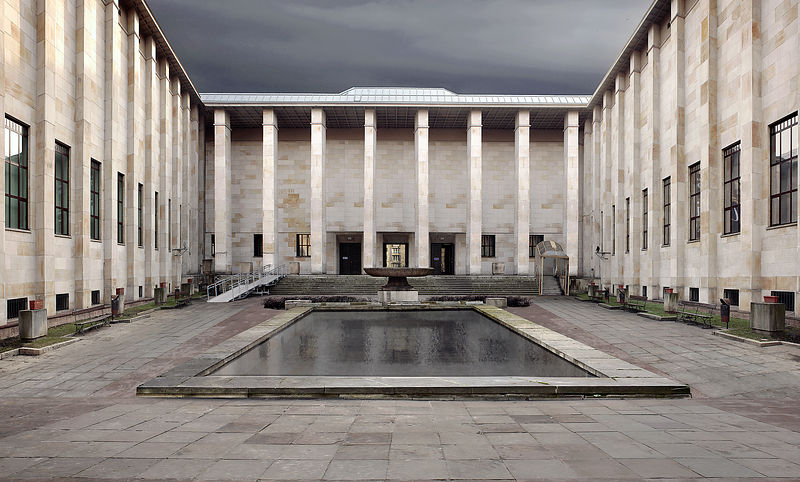
National Museum in Warsaw
52.2317° N · 21.0247° E · Museum
Photo: Muzeum Narodowe w Warszawie · CC BY-SA 4.0 · Wikimedia Commons
National Museum in Warsaw is a national museum in Warsaw, Poland. Founded in the 1860s as the Museum of Fine Arts. The free Lokali audio guide runs 7 minutes.
✓ Published October 2026 · how we write these guides
Visitor facts
| Lokali audio guide | 7 min · free |
|---|---|
| Type | Museum |
| Location | Warsaw, Poland |
| Coordinates | 52.2317, 21.0247 |
| Official website | mnw.art.pl |
| Languages | 50+, in the Lokali app |
The story
Stand for a moment on the wide pavement of Aleje Jerozolimskie, Jerusalem Avenue. Trams rattle past behind you, and the traffic hums toward the river. In front of you rises a long, pale facade with tall windows and a calm, symmetrical face. There is very little decoration here. The building does not shout. It waits. And behind those plain walls sits one of the largest art collections in Poland, from ancient Egypt to the twentieth century.
The museum's story begins long before this building existed. In the 1860s, Warsaw founded a Museum of Fine Arts, a modest start for a city then under Russian rule. Collecting art at that time carried a quiet political meaning. Poland did not exist as an independent state on the map. A museum of Polish and European art helped a divided nation remember who it was. Over the following decades, the collection grew through gifts, purchases and the work of dedicated curators.
The building you see now belongs to the interwar years, the short period of independence between the two world wars. It was designed by the architect Tadeusz Tołwiński and completed in the late 1930s. Look at the clean lines and the restrained stone surfaces. This is modernism with a classical spine — order, proportion and symmetry, but without columns and carved garlands. The building was meant to feel serious and permanent, a home for a nation's memory.
That permanence was tested almost immediately. In September 1939, German forces besieged Warsaw, and the museum was damaged. During the occupation that followed, the Germans looted large parts of the collection. Paintings, sculptures and decorative objects were taken out of the country. Some were recovered after the war. Many were not. Even today, the museum continues to search for lost works, and occasionally a missing painting appears at an auction somewhere in the world and begins its long journey home.
Here is something many visitors walk past without knowing. When much of Warsaw was destroyed, this building survived as a structure. Around it, the city lay in ruins. After the war, the museum became one of the anchors of rebuilding. It helped gather what remained of Polish heritage and gave homeless artworks a place. So as you walk through its halls, you are inside one of the few large public buildings that carried the city's culture through its darkest years.
Now, step inside. The first thing you notice is the quiet. The noise of the avenue drops away, and footsteps echo softly on the floors. The light changes too. Daylight falls in from the high windows and spreads across wide rooms. Take a breath here before choosing a direction. The museum is large, and it rewards a slow pace more than a rushed checklist.
One of the great surprises waits in the Faras Gallery. These are wall paintings from a Christian cathedral at Faras, in Nubia, in present-day Sudan. In the 1960s, the Aswan dam on the Nile was about to flood the region. An international rescue effort began, and Polish archaeologists led by Kazimierz Michałowski uncovered the cathedral under the sand. They removed painted saints, bishops and angels from its walls, and part of that treasure came here to Warsaw.
Look closely at the faces in these Nubian paintings. Large dark eyes look straight back at you. The colours are earthy — reds, ochres, soft whites — and some figures stand calm and frontal, like icons. These images were painted over several centuries in the medieval period. It is strange and moving to find them here, so far from the Nile. They show a chapter of Christian history that most Europeans never learn about at school.
From Africa, move to the Gothic world. The Gallery of Medieval Art holds carved and painted altarpieces, wooden sculptures of saints, and panels glowing with gold leaf. Many come from churches across the historical lands of Poland. Notice the folds of the carved robes, cut deep into the wood so they catch shadow. Notice also the faces. Some are gentle, some are sorrowful, and a few look almost like real people the carvers knew in their village.
Then comes the heart of the Polish collection — the art of the nineteenth century. This was the period when painters carried the weight of a nation without a state. History painting became a way to tell Poland's story when politics could not. The rooms here hold landscapes, portraits and scenes of village life, but also huge canvases filled with drama, armour and banners. You can feel the painters trying to hold a whole country together with paint.
The most famous of these is the Battle of Grunwald by Jan Matejko. It shows the great battle of 1410, when Polish and Lithuanian armies defeated the Teutonic Knights. The canvas is enormous. Stand back first, then step close. Up close, the scene breaks into a storm of faces, horses, weapons and twisted bodies. During the Second World War, this painting was a symbol the occupiers wanted to destroy. It was hidden away, and it survived.
Beyond the history paintings, the museum holds much more: ancient art from Egypt and the Mediterranean, European old masters, decorative arts, and Polish art of the twentieth century. You do not need to see everything. Pick two or three galleries and give them real time. Sit on a bench. Let one painting hold your attention for five minutes. Often the work that stays with you is not the famous one, but the quiet picture in the corner.
When you step back out onto Jerusalem Avenue, pause on the pavement again. The trams are still running. The city moves on around you, rebuilt and busy with ordinary life. Look once more at the plain pale facade. It held this collection through siege, looting and reconstruction. As you walk away, you carry a little of that memory with you — Nubian saints, Gothic angels and Matejko's knights, all kept safe behind these calm walls.
Key facts
What to look for
Practical tips
Common questions
Is there a free audio guide to National Museum in Warsaw?
Yes — the Lokali app narrates National Museum in Warsaw free of charge in 50+ languages. The guide runs about 7 minutes, covers the history, what to look for on site and practical tips, and works offline once downloaded.
Where is National Museum in Warsaw?
National Museum in Warsaw is in Warsaw, Poland, at 52.2317, 21.0247. Tap the map link on this page for directions from where you are.
What is National Museum in Warsaw known for?
Founded in the 1860s as the Museum of Fine Arts. Building designed by architect Tadeusz Tołwiński.
What should you look for at National Museum in Warsaw?
Large dark eyes of the Nubian saints from Faras. Deeply carved robe folds on Gothic wooden saints. Gold leaf glowing on medieval altarpiece panels.
What should you know before visiting National Museum in Warsaw?
Choose two or three galleries instead of rushing everything. Start with the Faras Gallery while your attention is fresh.
On the map
Opens directions to National Museum in Warsaw from your location.
More to see in Warsaw


Hear National Museum in Warsaw in your language
The full story, narrated, in 50+ languages. Download it before you go and it plays offline, at your own pace, with no ticket and no tour group.