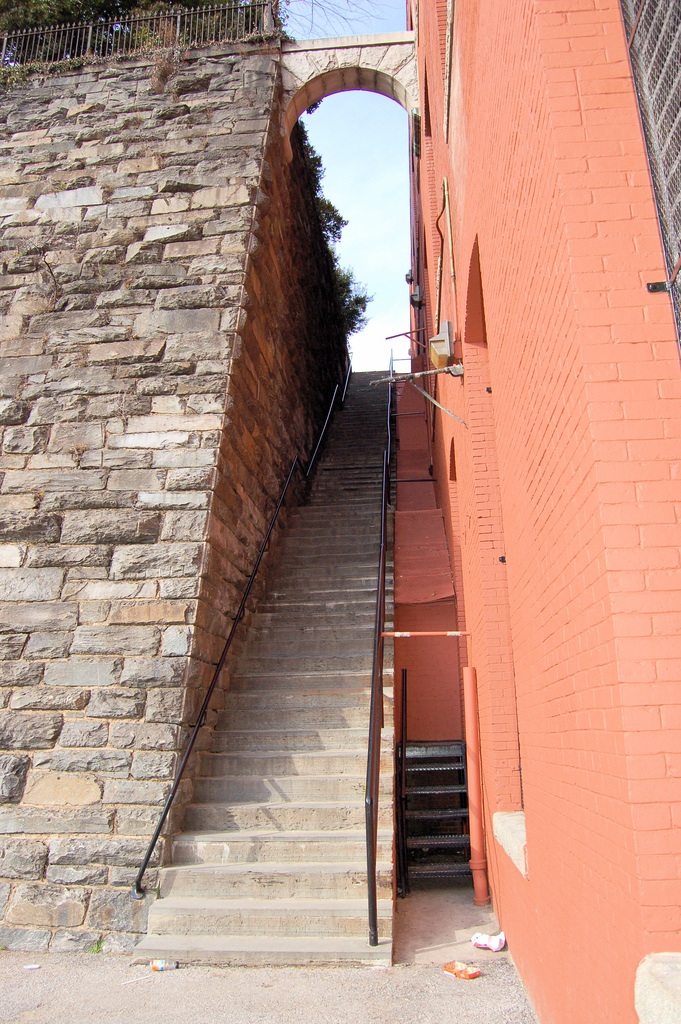
Photo: Dmitry K · CC BY 2.0 · Wikimedia Commons
Exorcist Stairs is a steep 75-step staircase descending from Prospect Street to M Street, famous as the location where a key scene from the 1973 horror film The Exorcist was filmed. It is in Washington, United States. Most visitors spend 10–15 min here. The free Lokali audio guide runs 5 minutes.
✓ Verified August 2026 · how we write these guides
Visitor facts
| Time needed | 10–15 min |
|---|---|
| Lokali audio guide | 5 min · free |
| Type | Landmark |
| Best for | Photography |
| Location | Washington, United States |
| Coordinates | 38.9057, -77.0726 |
| Languages | 45, in the Lokali app |
The story
Stand at the bottom and look up. A narrow flight of stone steps climbs steeply between a high brick wall and an old streetcar barn. The passage is dim even at noon. Ivy hangs over the edges. Cars rush past on the road behind you. Joggers pound up and down, breathing hard. Film fans stand quietly, photographing a staircase that once frightened the whole world.
These are the Exorcist Steps. In 1973, the horror film The Exorcist made this narrow stairway one of the most famous movie locations in America. The film tells the story of a girl possessed by a demon in a Georgetown house, and of the two priests who try to save her.
The steps are much older than the film. They were built in 1895, together with the large brick building beside them. That building is the Car Barn. Streetcars once rolled in and out of it, and the steps gave workers a shortcut between Prospect Street above and the waterfront below. Today the Car Barn holds university classrooms and offices.
The story behind the film began at the university up the street. William Peter Blatty studied at Georgetown and graduated in 1950. As a student, he heard about a reported exorcism case from 1949. Years later, he turned that memory into a novel. The Exorcist was published in 1971, stayed on best-seller lists for months, and sold millions of copies.
Hollywood came to Georgetown in 1972 to film the movie version. Director William Friedkin wanted real locations. The house at the top of the steps, on Prospect Street, played the home of the possessed girl. The crew even added a false extension to the house, so a bedroom window would hang close to the stairway.
The climax of the film happens right here. Father Karras, the tormented young priest, throws himself out of that window and falls down the full length of the steps. A stuntman performed the fall. The crew padded the stone steps with thick rubber, and he tumbled down them twice. Even padded, the fall looked brutal on screen.
Georgetown students saw a chance. During the filming, they charged onlookers a few dollars to watch the stunt from nearby rooftops. It became a favorite local story: even in 1972, the steps were already selling tickets.
The film opened in December 1973 and shocked audiences. People fainted in theaters. Lines wrapped around city blocks in the winter cold. The Exorcist earned ten Academy Award nominations, the first horror film ever nominated for Best Picture. It won two Oscars, including one for Blatty's screenplay, and it has returned to theaters again and again in the decades since.
In October 2015, the city made the connection official. Officials unveiled a plaque at the bottom of the steps. Both director William Friedkin and writer William Peter Blatty attended the ceremony, standing beside their staircase more than forty years after the film.
Today the steps live a double life. By day, they are exercise equipment. Runners from the university sprint up the long flight, touch the top, and jog back down. By night, especially near Halloween, film fans arrive. Ghost-tour groups stop here after dark. Some visitors recite lines. Others just stand at the bottom, where the shadows gather, and enjoy a small, safe chill.
Climb the steps yourself, if your legs agree. Count them as you go; visitors rarely agree on the same number. At the top, catch your breath on Prospect Street and look for the film house on your left. At the bottom, a gas station sits beside the steps today; the contrast with the film's dark mood amuses many visitors.
Horror stories work because ordinary places hold them. This is just a city staircase: stone, iron, moss, and shadow. Yet a writer's memory, a director's eye, and one terrible fall turned it into a landmark of fear. Stand here at dusk, when the street lamps come on, and the steps seem to climb a little higher than they did in daylight. Then the light warms the brick, and it is only Georgetown again.
Key facts
What to look for
Practical tips
Common questions
How long do you need at Exorcist Stairs?
Plan 10–15 min. That is the time most visitors spend at Exorcist Stairs. The free Lokali audio guide adds about 5 minutes of narration you can listen to as you walk, so it fits inside your visit rather than adding to it.
Is there a free audio guide to Exorcist Stairs?
Yes — the Lokali app narrates Exorcist Stairs free of charge in 50+ languages. It covers the history, what to look for on site and practical tips, and it works offline once downloaded.
Where is Exorcist Stairs?
Exorcist Stairs is in Washington, United States, at 38.9057, -77.0726. Tap the map link on this page for directions from where you are.
What should you know before visiting Exorcist Stairs?
Visit at dusk for atmosphere, daytime for easier photos.
What is Exorcist Stairs known for?
Steps built in 1895 beside the streetcar Car Barn.
What is the best time to visit Exorcist Stairs?
Locals jog these steps for fitness.
On the map
Opens directions to Exorcist Stairs from your location.
Reference
More to see in Washington




Hear Exorcist Stairs in your language
The full story, narrated, in 50+ languages. Download it before you go and it plays offline, at your own pace, with no ticket and no tour group.