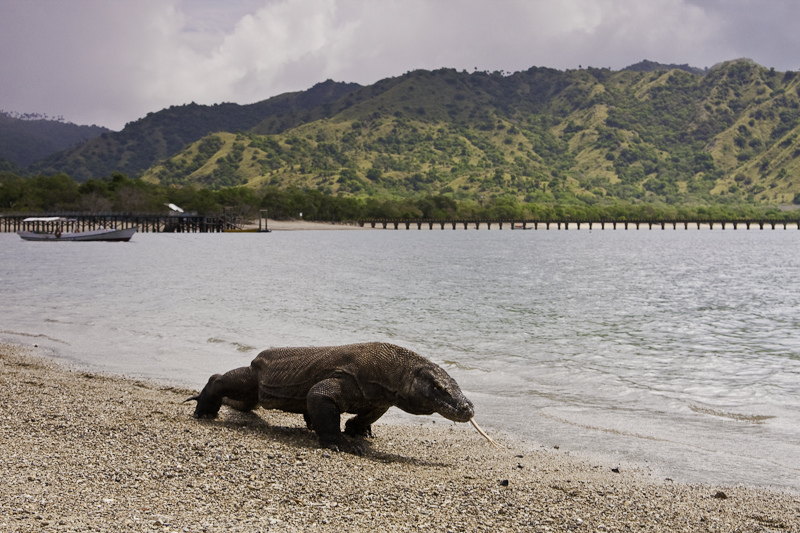
Komodo National Park
8.6516° S · 119.5766° E · National Park
Photo: Adhi Rachdian from Indonesia · CC BY 2.0 · Wikimedia Commons
Komodo National Park is a national park in Indonesia. Indonesia established the park in 1980. The free Lokali audio guide runs 7 minutes.
✓ Published October 2026 · how we write these guides
Visitor facts
| Lokali audio guide | 7 min · free |
|---|---|
| Type | National Park |
| Location | West Manggarai, Indonesia |
| Coordinates | -8.6516, 119.5766 |
| Official website | komodonationalpark.org |
| Languages | 50+, in the Lokali app |
The story
Listen first. Dry grass rustles in the wind, and the boat engine ticks as it cools. The air smells of salt, sun-baked earth and something faintly sour from the forest edge. Under your feet the trail is pale and dusty, cracked in places by the long dry season. The hills around you are gold and brown, not green. Below them the water is clear enough to see coral from the jetty. This is Komodo National Park, and the first thing it does is slow you down.
The park sits between the larger islands of Sumbawa and Flores, in the Indonesian province of East Nusa Tenggara. It covers three main islands. They are Komodo, Rinca and Padar, along with many smaller islets and a wide stretch of sea. Most visitors arrive from Labuan Bajo, the harbour town on the western tip of Flores. That town sits in the regency of West Manggarai. A few decades ago it was a quiet fishing settlement. Today it is the gateway for almost every boat heading into the park.
The reason most people come is the Komodo dragon. It is the largest living lizard on Earth. Large males can reach around three metres in length, and they are heavy, low and patient. In the wild they live only on a handful of islands in this region. When you see one for the first time, it may surprise you how still it is. A dragon can lie in the shade for a long time, tongue flicking, tasting the air for scent.
That tongue is the key to how it hunts. The forked tip collects scent particles and carries them to a sensory organ in the mouth. A dragon can pick up the smell of a carcass from a long distance. It hunts by ambush, waiting near game trails for deer, wild pigs or water buffalo. For many years, people believed bacteria in its saliva killed its prey. Research published in 2009 described venom glands in the lower jaw. Today, scientists still debate how much each factor matters.
Here is something many visitors miss. Female Komodo dragons can sometimes produce offspring without a male. This is called parthenogenesis, a form of reproduction from an unfertilised egg. Scientists documented it in dragons kept in European zoos in the 2000s. Young dragons also live a very different life from adults. They often climb trees and stay off the ground. This keeps them away from larger dragons, which will eat smaller ones. A dragon's first years are spent avoiding its own kind.
For most of history, these animals were known only to the people who lived beside them. Western scientists learned of them in the early twentieth century. Reports of giant land reptiles reached Dutch colonial officials on Flores. A scientific description followed in 1912. Within a few decades, expeditions and zoo collectors began arriving. The animals became famous far beyond Indonesia. Some writers have suggested they inspired stories of island monsters, but that link is a popular claim, not settled fact.
The people of Komodo village have their own story. The local community is often called the Ata Modo, the people of Komodo. Locals tell a legend about a woman who gave birth to twins. According to the tale, one twin was a human boy and the other was a dragon. The two grew up as siblings. Because of this, the story says, people and dragons should treat each other with respect. It is folklore, but it shapes how many villagers speak about the animals.
Indonesia created the park in 1980, mainly to protect the dragon and its habitat. In 1991, UNESCO listed it as a World Heritage Site. The listing recognised more than the lizards. It also recognised the rugged landscape and the surrounding marine life. The park is today managed with rules that change over time. Visitor numbers, access to certain islands and permit systems have all been debated in recent years. Check the current arrangements locally before you plan your day.
On the trail, you will walk with a park ranger. This is not optional, and there is a good reason. Rangers carry long wooden sticks with a forked end. They use these to keep a curious dragon at a safe distance. Listen to what your ranger tells you, and stay with the group. The rangers know where the animals rest and how they behave in the heat. Many of them grew up on these islands, so ask them questions.
Now look past the dragons to the land itself. The hills are mostly open savanna, with tall grass and scattered palms. The rain falls for only a few months each year. For the rest of the year, the slopes turn brown and dry. Down in the valleys, you will find patches of greener forest near water. Deer move between the two zones, and dragons follow them. The landscape looks empty at first. It is actually a careful balance between predator and prey.
Then there is the sea. The park lies within the Coral Triangle. This is a region of Southeast Asian ocean with some of the highest marine diversity on the planet. Divers and snorkellers come for reef fish, turtles, reef sharks and manta rays. The currents here can be very strong, because water moves between two oceans through these narrow straits. That movement brings nutrients and draws large animals. It also means you should only swim where your boat crew says it is safe.
One of the most photographed places is Padar Island. A steep trail climbs to a ridge above three curved bays. From the top, each bay shows a different colour of sand and water. Elsewhere in the park, some beaches carry a soft pink tint. The colour comes from tiny fragments of red coral and shell mixed into the white sand. In bright light the pink is clear. Under clouds it almost disappears, so the effect depends on the time of day.
Take a moment where you are standing. Feel the heat on the back of your neck and the grit of the trail on your shoes. Look at the shade under the nearest tree, and remember that a dragon may be resting in shade just like it. When you walk back to the jetty, watch the water by the boats. Small fish gather there in the clear shallows. The islands look quiet. They are not empty. They are simply living at their own pace.
Key facts
What to look for
Practical tips
Common questions
Is there a free audio guide to Komodo National Park?
Yes — the Lokali app narrates Komodo National Park free of charge in 50+ languages. The guide runs about 7 minutes, covers the history, what to look for on site and practical tips, and works offline once downloaded.
Where is Komodo National Park?
Komodo National Park is near West Manggarai, Indonesia, at -8.6516, 119.5766. Tap the map link on this page for directions from where you are.
What is Komodo National Park known for?
Indonesia established the park in 1980. UNESCO listed the park as World Heritage in 1991.
What should you look for at Komodo National Park?
Rangers' long wooden sticks with forked ends. Dragon tracks and tail drag marks in dust. Pink tint in sand from red coral fragments.
What should you know before visiting Komodo National Park?
Stay close to your ranger on every trail. Start the Padar ridge hike early to avoid heat.
When is the best time to visit Komodo National Park?
Start the Padar ridge hike early to avoid heat.
On the map
Opens directions to Komodo National Park from your location.
Hear Komodo National Park in your language
The full story, narrated, in 50+ languages. Download it before you go and it plays offline, at your own pace, with no ticket and no tour group.