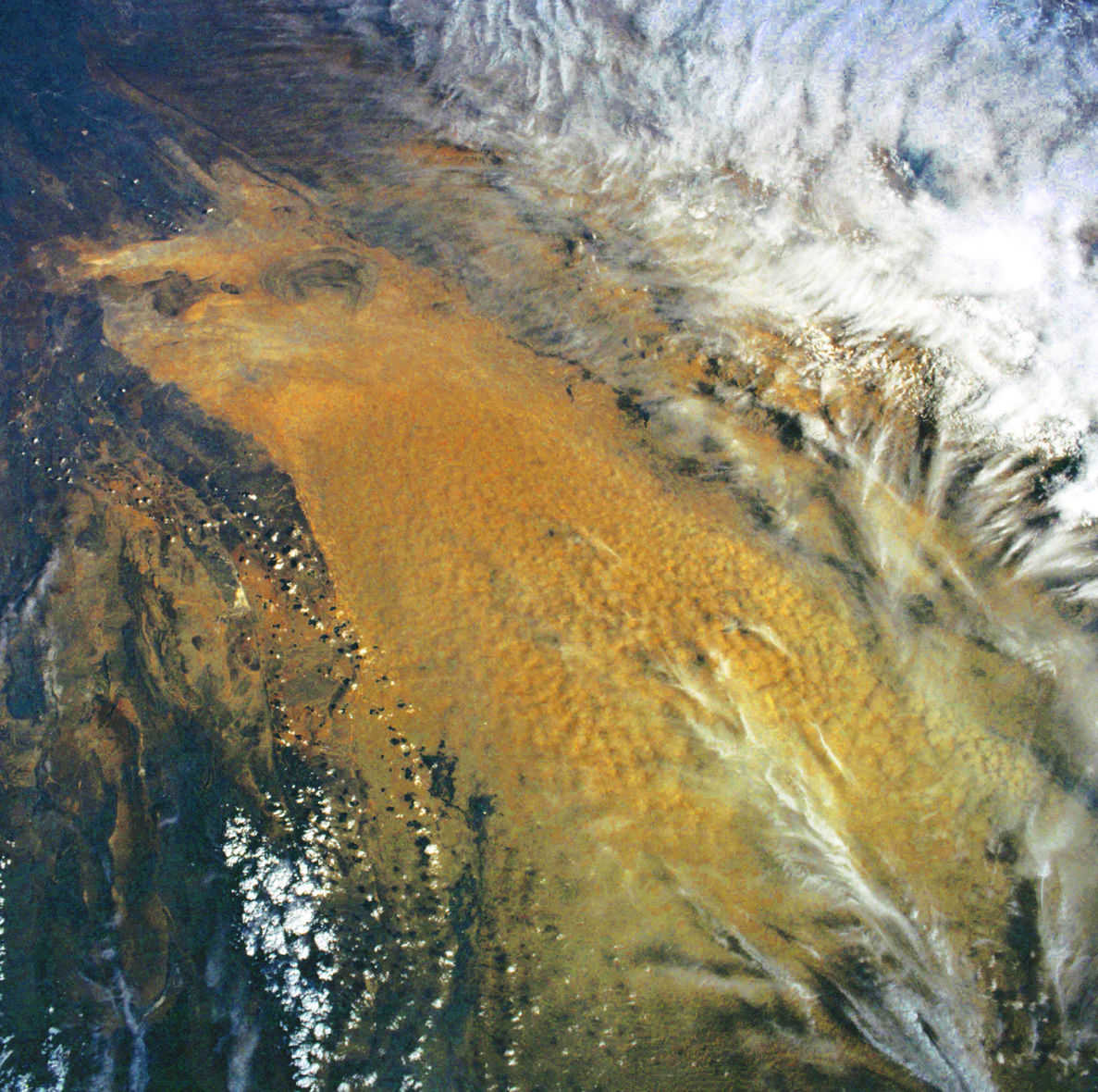
Photo: NASA. Image Science and Analysis Laboratory, NASA-Johnson Space Center. 25 Mar. 2005. "Ast · Public domain · Wikimedia Commons
Lop Desert is a desert in China. Lop Nur was a salt lake that dried up last century. The free Lokali audio guide runs 8 minutes.
✓ Published October 2026 · how we write these guides
Visitor facts
| Lokali audio guide | 8 min · free |
|---|---|
| Type | Archaeological Site |
| Location | Xinjiang, China |
| Coordinates | 40.1667, 90.5833 |
| Languages | 50+, in the Lokali app |
The story
Listen for a moment. Out here the silence has a texture. The wind moves grit across hard clay with a dry, hissing sound, like sand poured slowly onto paper. Underfoot, the ground is not soft dune but a crust of salt and silt, cracked into plates that crunch when you step. The light is flat and pale, and the horizon seems to have no clear edge. This is the Lop Desert, in the far east of the Tarim Basin, in China's Xinjiang region.
To understand where you are standing, picture a giant bowl. To the west lies the Taklamakan, one of the largest sand deserts on Earth. To the east and south lies the Kumtag, a sea of dunes. Between them sits this low, flat country. For thousands of years, rivers draining from the mountains ran down into this basin and pooled in a shallow salt lake called Lop Nur. Today that lake is gone. What remains is a vast, dry lakebed, white and grey, stretching further than the eye can follow.
It is hard to believe now, but this was once a place of reeds, fish, and water birds. The Tarim River and its branches carried snowmelt across the desert and spread it into marshes here. Over the twentieth century, people upstream diverted more and more of that water for farming. The rivers shrank. The lake retreated. By the later decades of the century, Lop Nur had dried almost completely. The salt crust you see is the floor of that vanished lake.
Long before the lake disappeared, people lived along its shores. The most famous of them belonged to the kingdom of Loulan, a small oasis state on the ancient Silk Road. Here is the first surprise. This empty land sat on one of the great trade routes of the ancient world. Caravans moving between China and Central Asia passed through Loulan, carrying silk, horses, and ideas. Chinese histories of the Han dynasty record Loulan as a strategic kingdom, caught between the Chinese empire and the nomadic powers to the north.
Travellers feared this stretch of the road more than almost any other. Around the year 400, a Chinese Buddhist monk named Faxian crossed this region on his way to India. In his written account, he described hot winds and evil spirits, and said that no birds flew above and no animals moved below. The only way to find the path, he wrote, was to follow the dried bones of those who had died before. It is one of the earliest first-hand descriptions of this desert to survive.
Centuries later, the Venetian traveller Marco Polo described a great desert he called the Desert of Lop. His book repeats a story told by travellers of the time. Anyone who fell behind the caravan at night, it was said, might hear voices calling his name, and wander off and be lost. This is folklore, not history. But the story says something true about this place. In wind like this, in emptiness like this, the mind starts to play tricks.
As the rivers shifted course, Loulan lost its water, and over time the city was abandoned. Sand covered its walls. For many centuries, almost no one knew exactly where it had stood. Then, around the turn of the twentieth century, the Swedish explorer Sven Hedin crossed the region and came upon ruins buried in the sand. Excavations by Hedin and later explorers recovered wooden documents, coins, textiles, and household objects that brought this lost kingdom back into view.
Hedin also became fascinated by the lake itself. Early maps did not agree on where Lop Nur actually was. Hedin argued that the lake moved over time, as rivers changed their paths across the flat basin floor. People began calling it the wandering lake. Scientists still debate the details, but the core idea holds. In a landscape this flat, a small change upstream can move water a great distance. The ground beneath you has been shoreline, marsh, and dry crust many times over.
Here is the second surprise. Some of the people of this region are still here, in a sense. The dry, salty ground preserved human remains remarkably well. In 1980, archaeologists found the body of a woman near the Loulan area, now known as the Loulan Beauty. She was buried thousands of years ago, wrapped in wool and wearing a felt hat. Her hair, skin, and clothing survived. Finds like hers show that this basin was a meeting place of peoples from very early times.
The twentieth century brought a very different chapter. From 1964, China used the area around Lop Nur as its main nuclear weapons testing ground. The country's first atomic test took place here that year. For decades, the region was closed and heavily guarded. This history is one reason access to parts of the desert remains restricted today. The emptiness you see is partly natural and partly the result of a landscape set apart for many years.
Look now at the shapes in the land. In many parts of this desert, the wind has carved the old lake sediments into long ridges and blocks, all lined up in the same direction. These are called yardangs, a word taken from a Turkic language of this region. They form when steady winds blow sand against soft ground for thousands of years, cutting grooves and leaving raised spines between them. Some look like ships, others like ruined walls. Their direction shows you which way the strongest winds blow.
Life has not left completely. This region holds one of the last refuges of the wild Bactrian camel, the two-humped camel of Central Asia. It is a separate wild animal, not simply a domestic camel gone feral, and it is critically endangered. A nature reserve here protects part of its range. These camels can survive on very little water, and they are said to tolerate brackish, salty water that would harm most animals. You are unlikely to see one, but they are out there.
The desert has also kept some of its mysteries. In 1980, the Chinese scientist Peng Jiamu walked out from his expedition camp in this region to look for water. He never came back, and searches did not find him. Stories like his remind every visitor that this is not a stage set. The heat, the cold nights, and the distances are real. Travel here only works with careful planning, local guides, and plenty of water.
Before you move on, stand still once more. Feel the salt crust under your shoes, the old floor of a lake that held fish and boats. Somewhere beyond the haze lie the buried streets of Loulan, and the route that monks, merchants, and explorers all followed through this silence. Notice the direction of the wind, and the ridges it has carved. When you walk away, the crunch of your steps will be the only sound. Let it stay with you for a while.
Key facts
What to look for
Practical tips
Common questions
Is there a free audio guide to Lop Desert?
Yes — the Lokali app narrates Lop Desert free of charge in 50+ languages. The guide runs about 8 minutes, covers the history, what to look for on site and practical tips, and works offline once downloaded.
Where is Lop Desert?
Lop Desert is near Xinjiang, China, at 40.1667, 90.5833. Tap the map link on this page for directions from where you are.
What is Lop Desert known for?
Lop Nur was a salt lake that dried up last century. Loulan was an oasis kingdom on the ancient Silk Road.
What should you look for at Lop Desert?
Cracked white salt crust marking the old lakebed. Yardang ridges all pointing in the same wind direction. Grit moving in thin streams low across the ground.
What should you know before visiting Lop Desert?
Travel only with an authorised local operator and required permits. Carry far more drinking water than you expect to need.
On the map
Opens directions to Lop Desert from your location.
Hear Lop Desert in your language
The full story, narrated, in 50+ languages. Download it before you go and it plays offline, at your own pace, with no ticket and no tour group.