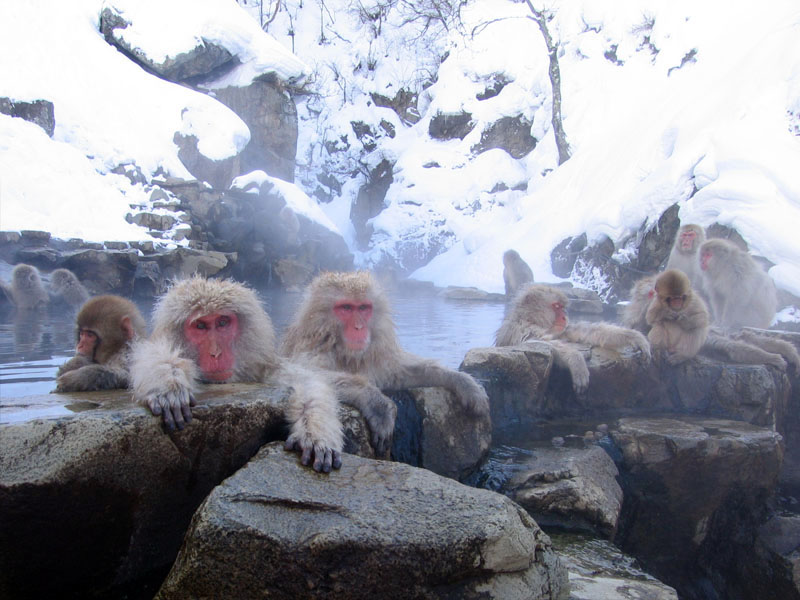
Photo: Yosemite · CC BY-SA 3.0 · Wikimedia Commons
Jigokudani Monkey Park is a hot springs area with large population of wild snow monkeys. It is near Yamanouchi, Japan. Jigokudani means "Hell's Valley" in Japanese. The free Lokali audio guide runs 7 minutes.
✓ Published October 2026 · how we write these guides
Visitor facts
| Lokali audio guide | 7 min · free |
|---|---|
| Type | Zoo |
| Location | Yamanouchi, Japan |
| Coordinates | 36.7328, 138.4627 |
| Official website | jigokudani-yaenkoen.co.jp |
| Languages | 50+, in the Lokali app |
The story
Listen first. Under the voices on the path, there is a low hiss of steam, the rush of a cold mountain river, and the soft crunch of snow or gravel underfoot. Warm, mineral air drifts across your face, carrying a faint smell of sulphur. Then you see them: small grey-brown figures with red faces, sitting in a steaming pool as if the whole valley belonged to them. In a way, it does. Welcome to Jigokudani Monkey Park.
The name sounds dramatic, and it is meant to. Jigokudani means "Hell's Valley" in Japanese. Early visitors saw steam rising from the ground, water bubbling out of the rock, and steep cliffs closing in on both sides. To them, it looked like a doorway to the underworld. Today the valley feels calm rather than frightening. But the heat that gave it that name is the same heat that brings the monkeys down to the water.
You are deep in the mountains of Nagano Prefecture, inside Joshinetsu Kogen National Park, in the valley of the Yokoyu River. The town of Yamanouchi sits below, with its old hot spring villages of Yudanaka and Shibu. This is volcanic country. Rain and snowmelt sink into the ground, warm up near hot rock, and return to the surface as springs. People have bathed in these waters for centuries. The monkeys simply joined them.
The animals here are Japanese macaques, often called snow monkeys. They are the most northern of all non-human primates. No other monkey lives naturally in a place this cold. Look closely at their fur — it is thick and dense, especially in winter, and it holds a layer of warm air against the body. Their faces and hands stay bare, which is why those pink and red faces stand out so sharply against the snow.
Here is the first surprise. The monkeys did not always bathe. For a long time they lived in these forests and ignored the hot water. Then, around the early 1960s, some members of the troop began to climb into the springs. Locals tell a popular story about a young monkey who went into an inn's outdoor bath to pick up scattered food, found the water pleasant, and stayed. Others copied her. Whether every detail is true, the habit spread through the group.
The park itself opened in 1964. At first, the monkeys were using baths meant for human guests, which caused obvious problems for the inn nearby. The solution was simple and practical. A separate pool was built just for the monkeys, fed by the same warm spring water. That stone pool in front of you is their bath, not yours. Humans stand at the edge and watch, and that arrangement has worked for decades.
So why do they bathe? Warmth is the clear answer, especially when snow covers the slopes. But there is more. Researchers who have studied this troop found that bathing in winter seems to lower stress levels in the females. Not every monkey gets equal access, though. Macaque society has a strict ranking order. Higher-ranking animals often hold the best spots in the water, while others wait on the rocks or move in when there is space.
Take a moment to watch the social life around the pool. Mothers carry infants on their bellies or backs. Young monkeys chase each other across the rocks and sometimes dive into the water with a splash. Adults sit close together and groom each other, picking carefully through fur. Grooming is not only about cleaning. It builds friendships and calms tension in the group. Some pairs groom for long stretches without moving, their eyes half closed in the steam.
Here is the second surprise. These are wild animals. They are not kept in cages, and no fence holds them in. The monkeys come down from the forest because staff provide some food in the area, and because the warm water is here. They choose to be near people. That is why the rules matter so much. Do not feed them, do not touch them, and do not stare directly into their eyes. For a macaque, a fixed stare can read as a challenge.
The park became known far beyond Japan over time. Images of monkeys sitting in steaming water, snow on their heads, appeared in documentaries and films. When Nagano hosted the Winter Olympic Games in 1998, visitors from around the world came to this region, and many made the trip up the valley. Since then, the snow monkeys have become one of the best-known wildlife scenes in the country. Yet the setting stays small and quiet.
Think back to the walk that brought you here. The path runs through a forest of tall cedars and mixed trees, with the river below and steep slopes above. In winter it can be packed with snow and ice. In summer it is green and shaded. There is no road for cars to the pool itself. Everyone arrives the same way — on foot. That slow approach is part of the experience. It gives you time to leave the town behind.
The seasons change the scene completely. Winter is the classic picture, with heavy snow and the most bathing. Spring brings newborn monkeys, small and dark, clinging to their mothers. In summer the monkeys bathe less and spend more time foraging along the river. Autumn colours the cliffs red and gold. Steam still rises from the vents along the riverbank in every season, a reminder that the ground beneath you stays warm all year.
Before you go, stand still for a minute. Notice the sound of the river and the soft hiss of the springs. Watch one monkey closely — the way its hands move, the way it shifts to stay warm. As you walk back through the trees, you may see a few more on the slopes or crossing the path. Give them room. They will return to this water long after you have left the valley.
Key facts
What to look for
Practical tips
Common questions
Is there a free audio guide to Jigokudani Monkey Park?
Yes — the Lokali app narrates Jigokudani Monkey Park free of charge in 50+ languages. The guide runs about 7 minutes, covers the history, what to look for on site and practical tips, and works offline once downloaded.
Where is Jigokudani Monkey Park?
Jigokudani Monkey Park is near Yamanouchi, Japan, at 36.7328, 138.4627. Tap the map link on this page for directions from where you are.
What is Jigokudani Monkey Park known for?
Jigokudani means "Hell's Valley" in Japanese. The park opened to visitors in 1964.
What should you look for at Jigokudani Monkey Park?
Steam rising from volcanic vents along the riverbank. The stone bathing pool built just for monkeys. Mothers carrying infants on their bellies or backs.
What should you know before visiting Jigokudani Monkey Park?
Wear shoes with grip; the forest trail can be icy. Allow time for the forest walk from the trailhead.
When is the best time to visit Jigokudani Monkey Park?
Visit in winter for the most bathing activity.
On the map
Opens directions to Jigokudani Monkey Park from your location.
Hear Jigokudani Monkey Park in your language
The full story, narrated, in 50+ languages. Download it before you go and it plays offline, at your own pace, with no ticket and no tour group.