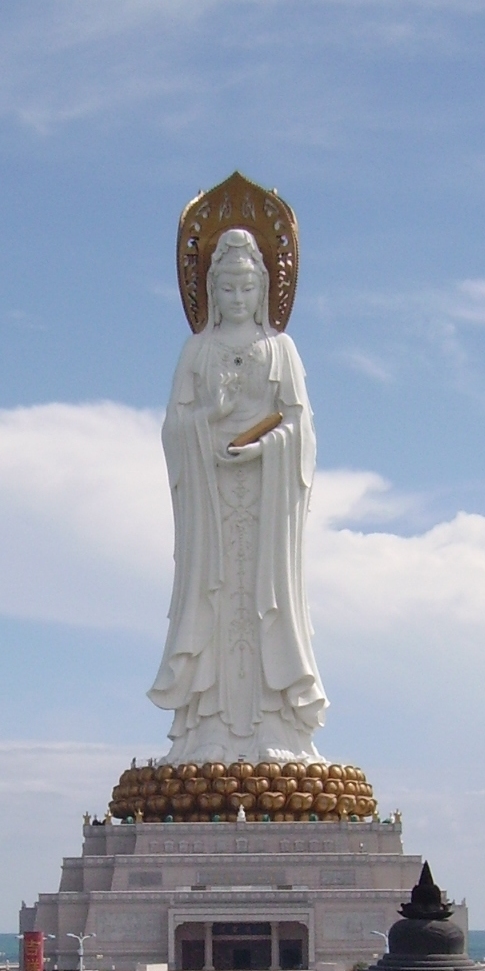
Photo: Jazon88 · CC BY-SA 3.0 · Wikimedia Commons
Guanyin of Nanshan is a statue in Sanya, Hainan, China. Height is usually given as 108 metres. The free Lokali audio guide runs 6 minutes.
✓ Published October 2026 · how we write these guides
Visitor facts
| Lokali audio guide | 6 min · free |
|---|---|
| Type | Monument |
| Location | Yazhou, China |
| Coordinates | 18.2922, 109.2083 |
| Languages | 50+, in the Lokali app |
The story
Start with the wind. Here on the southern edge of Hainan, it comes off the South China Sea warm and salty, and it carries the smell of seaweed and sun-heated stone. Under your feet, the pale paving is smooth and bright. Ahead of you, over the water, a white figure rises against the sky. It does not look like a building. It looks like a person standing very still, far out at sea.
This is the Guanyin of Nanshan, one of the tallest statues on Earth. Most published figures give its height as 108 metres. That number is not an accident. In Buddhist tradition, 108 is a sacred count. It matches the beads on a traditional prayer string, and it stands for the many worldly troubles a person hopes to leave behind. So the statue's height is also a small prayer.
Who is Guanyin? For listeners outside East Asia, she is a bodhisattva — a figure in Buddhism who reaches enlightenment but chooses to stay in the world to help others. Her full name is often translated as "the one who hears the cries of the world." In China she is loved across many generations and many kinds of belief. Fishing families along this coast have prayed to her for safe return from the sea for a very long time.
Now look closely at the statue. Here is the first surprise for many visitors. It has more than one face. The figure is three figures joined back to back. One face looks inland, towards the island of Hainan and mainland China beyond. The other two look out over the open sea. The idea is simple and kind. Guanyin watches over the land and the water at the same time, and blessings go in every direction.
Because of this design, the statue changes as you walk. From one angle you see a single calm face. A few steps further, a second face comes into view, and the outline becomes wider and more complex. Each figure holds a different object, and each one carries its own meaning. If you have time, walk slowly around the base. The three faces feel like three different moods of the same gentle presence.
Here is the second surprise. The statue does not stand on the shore. It stands on a man-made island, built in the sea for this purpose. You reach it on foot across a long causeway — a raised path over the water. Walking that path is part of the experience. The statue grows larger with every step. The sound of the city falls away, and soon there is only wind, water, and the soft slap of waves against stone.
The statue was completed and consecrated in 2005, after several years of work. It was made with a strong inner frame, covered by a white outer surface designed to survive this climate. And this climate is hard. There is salt in the air, strong tropical sun, heavy rain, and typhoons in some seasons. A statue this size in the open sea is a real feat of engineering, not only an act of faith.
The statue sits inside the Nanshan Cultural Tourism Zone, a large park of temples, gardens, and walkways that climbs the green slopes behind you. Nanshan simply means "South Mountain." In Chinese culture, the phrase carries a warm old meaning, linked to long life and good fortune. The Nanshan Temple, built in the late 1990s, sits on the hillside. Its roofs and halls follow the style of classic Chinese Buddhist architecture.
This place belongs to Yazhou, and the name Yazhou is very old. For many centuries, Yazhou was the seat of local government at the far southern edge of the Chinese empire. To officials in the distant capital, this coast felt like the end of the world. Several scholars and ministers were sent here in exile. Their journey south was long and hard, and many never went home. Today the same coast draws visitors by choice.
There is one more old story tied to this shore, and it is well recorded. In the eighth century, during the Tang dynasty, a respected monk named Jianzhen tried again and again to sail to Japan to teach Buddhism. On one failed voyage, storms drove his ship far south, and he landed in the Yazhou area. He stayed for a time, taught local people, and later continued his mission. In the end he reached Japan, where he is still honoured today.
So when you stand here, you stand in a place where faith has long crossed the sea. Monks came by ship. Fishing families prayed for calm water. Exiles looked north towards a home they had lost. The modern statue is new, but the hopes around it are old. That may be why so many visitors, believers or not, fall quiet when they reach the base.
If you visit the platform, notice the people around you. Some families light incense and bow. Some visitors walk around the base with their palms pressed together. Others simply sit and look at the water. You are welcome to watch, but move gently and keep your voice low. Near the statue, wear clothing that covers your shoulders, and follow any local signs about photographs or offerings.
Before you leave, stop for a moment on the causeway and turn back. Look at the three faces against the sky, and at the long line of blue water around them. Feel the wind again, the same wind you felt at the start. As you walk away, notice how the statue stays visible from far along the shore. It is still there, white and calm, watching over the land and the sea.
Key facts
What to look for
Practical tips
Common questions
Is there a free audio guide to Guanyin of Nanshan?
Yes — the Lokali app narrates Guanyin of Nanshan free of charge in 50+ languages. The guide runs about 6 minutes, covers the history, what to look for on site and practical tips, and works offline once downloaded.
Where is Guanyin of Nanshan?
Guanyin of Nanshan is near Yazhou, China, at 18.2922, 109.2083. Tap the map link on this page for directions from where you are.
What is Guanyin of Nanshan known for?
Height is usually given as 108 metres. 108 is a sacred number in Buddhism.
What should you look for at Guanyin of Nanshan?
One face turned inland toward Hainan. Two faces looking out over the sea. A different object held by each figure.
What should you know before visiting Guanyin of Nanshan?
Walk the causeway slowly to watch the statue grow. Bring a hat and water for the tropical sun.
When is the best time to visit Guanyin of Nanshan?
Visit early or late for softer, cooler light.
On the map
Opens directions to Guanyin of Nanshan from your location.
Hear Guanyin of Nanshan in your language
The full story, narrated, in 50+ languages. Download it before you go and it plays offline, at your own pace, with no ticket and no tour group.