Photo: Patrick Streule · CC BY 2.0 · Wikimedia Commons
Pagoda of Fogong Temple is a pagoda in China. Built in 1056 under the Khitan-ruled Liao dynasty. The free Lokali audio guide runs 7 minutes.
✓ Published October 2026 · how we write these guides
Visitor facts
| Lokali audio guide | 7 min · free |
|---|---|
| Type | Tower |
| Location | Ying County, China |
| Coordinates | 39.5653, 113.1819 |
| Languages | 50+, in the Lokali app |
The story
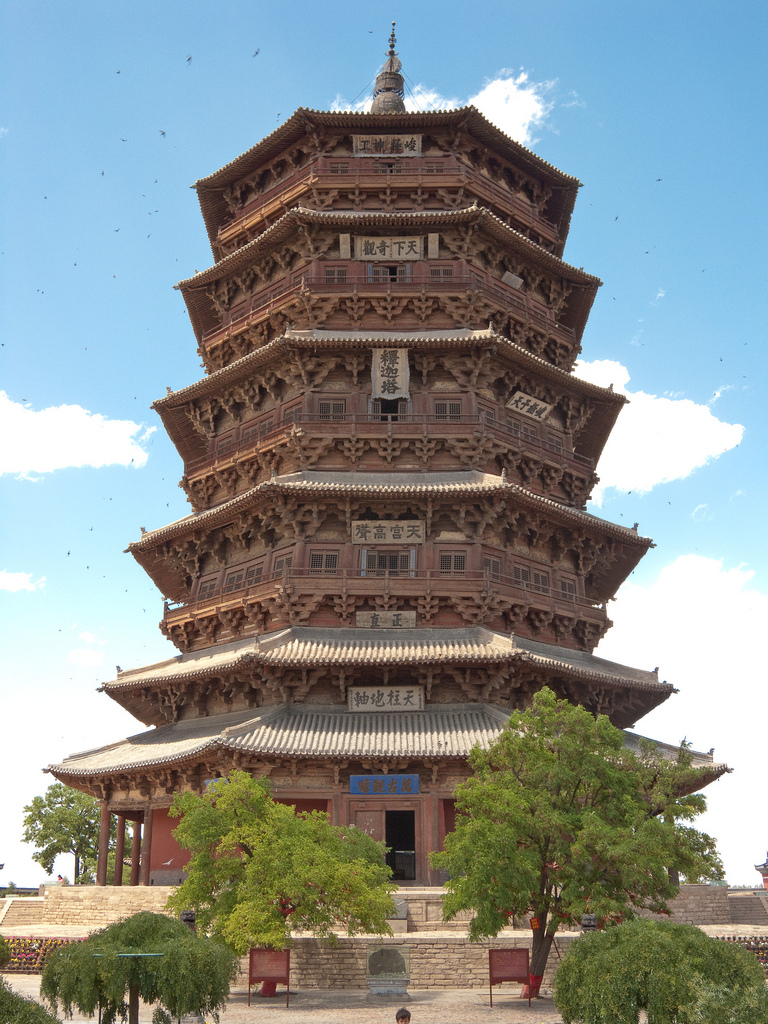
Listen first. Somewhere above you, small bells hang from the corners of the eaves, and when the wind crosses the plain they ring softly and out of rhythm. Below them, the air carries the dry smell of old timber and dust from the northern Shanxi plain. Now tilt your head back. The tower rises in layer after layer of dark wood and red-brown paint, and it keeps rising longer than your eyes expect.
This is the Pagoda of Fogong Temple, in Ying County, in the north of Shanxi Province. Many people in China simply call it the Wooden Pagoda of Yingxian. The name is plain, but the claim behind it is not. This is the oldest and tallest fully wooden pagoda known to survive anywhere. It stands close to seventy metres tall. Almost everything you see above the stone base is timber, joined by hand.
The tower was built in 1056. At that time, this part of northern China was not ruled by the Song emperors in the south. It belonged to the Liao dynasty, a state founded by the Khitan, a semi-nomadic people from the steppes to the north and east. The Khitan rulers adopted Buddhism with real devotion. They paid for temples and printed sacred texts. They also built pagodas — towers designed to hold relics and honour the Buddha — across their territory.
Walk slowly around the base and count the sides. There are eight. The octagonal plan was common in Liao pagodas, and it does a quiet job here. Eight faces spread the force of the wind more evenly than four would. From the outside, you can count five storeys, each with its own roof. But that count is wrong, and it is the first surprise of this building.
Between each visible storey sits a hidden level. There are four of these concealed mezzanines, so the tower has nine levels in total. From the street they look like solid bands under each roof. Inside, they work like a skeleton. Diagonal timbers and braces lock the structure together, and they stiffen the tower against the side-to-side push of wind and earthquakes. The builders placed the strength exactly where a visitor would never think to look.
Now look up at the place where each roof meets the wall. You will see clusters of interlocking wooden blocks and arms, stacked like folded hands. These are called dougong, or bracket sets. They carry the weight of the heavy eaves out and down into the columns. Scholars who studied this pagoda counted dozens of different bracket designs on the one building — more variety than almost any other surviving Chinese structure. It is a kind of catalogue in timber.
A story you will often hear is that not a single nail holds the tower together. The core idea is true. The frame depends on joinery, with pieces cut to fit and lock into each other, rather than on metal fasteners. That joinery matters for survival. A rigid building can crack in a strong earthquake. A jointed frame can shift slightly, absorb the shock, and settle again. Over more than nine centuries, this region has felt serious earthquakes, and the tower is still here.
It has also lived through war. Over the centuries, armies crossed this frontier zone many times, and the pagoda took damage in the twentieth century as well. Look closely at the timbers and you may see repairs, replaced pieces, and old scars. The tower also leans and twists a little now. Engineers have studied that movement for decades, and the debate about how best to protect it continues. Because of that fragility, visitors are generally not allowed to climb to the upper levels today.
Here is the second surprise. In the 1970s, during repair work, people found a small treasure inside one of the Buddha statues on an upper floor. It was a collection of Liao-era objects, including printed Buddhist scriptures and paintings on silk. Very little printed material from the Liao state survives anywhere, so these papers gave historians a rare look at Khitan Buddhist culture. A tower built to hold sacred things had kept them safe, quietly, for about nine hundred years.
On the ground floor, if the doors are open, you can see a large seated statue of the Buddha Shakyamuni, the historical founder of Buddhism. The figure fills the space, and the room around it feels tall and dim. Each upper storey also holds its own group of Buddhist figures, arranged in careful order around the central axis. The design leads the eye upward, level by level, from the human scale of the doorway toward the top of the spire.
Back outside, look at the boards hung on the front of the tower. These are inscribed plaques, written in large Chinese characters by different hands across the centuries. Over time, visitors and officials added their words of praise to the building. Many later Chinese temples carry plaques like this, but here they hang on a structure far older than most of the people who wrote them. They read almost like a guest book, written in wood.
The temple grounds around the pagoda are calm and open. Paved paths, low walls, and old trees frame the tower from different angles. Step back toward the far edge of the courtyard if you want to see the whole height in one view. From a distance, the curved roofs stack into one long shape, and the iron spire at the top becomes visible against the sky. Up close, the details take over. From far away, the proportion is clearer.
So stand still for one more moment. Feel the ground under you, and the open space of the plain around the town. Listen again for the bells on the eaves. Every board above you was shaped by people who lived nearly a thousand years ago, in a kingdom that no longer exists. As you walk away, turn back once. Watch how the tower stays tall on the skyline long after the temple gate is behind you.
Key facts
What to look for
Practical tips
Common questions
Is there a free audio guide to Pagoda of Fogong Temple?
Yes — the Lokali app narrates Pagoda of Fogong Temple free of charge in 50+ languages. The guide runs about 7 minutes, covers the history, what to look for on site and practical tips, and works offline once downloaded.
Where is Pagoda of Fogong Temple?
Pagoda of Fogong Temple is near Ying County, China, at 39.5653, 113.1819. Tap the map link on this page for directions from where you are.
What is Pagoda of Fogong Temple known for?
Built in 1056 under the Khitan-ruled Liao dynasty. Oldest and tallest fully wooden pagoda known to survive.
What should you look for at Pagoda of Fogong Temple?
Octagonal base with eight equal faces. Stacked wooden bracket clusters beneath every roof. Small bells hanging from the corners of the eaves.
What should you know before visiting Pagoda of Fogong Temple?
Walk around all eight sides before going in. Step back to the courtyard edge to frame the full height.
When is the best time to visit Pagoda of Fogong Temple?
Come early to hear the eave bells without crowds.
On the map
Opens directions to Pagoda of Fogong Temple from your location.
More to see near Pagoda of Fogong Temple

Hear Pagoda of Fogong Temple in your language
The full story, narrated, in 50+ languages. Download it before you go and it plays offline, at your own pace, with no ticket and no tour group.