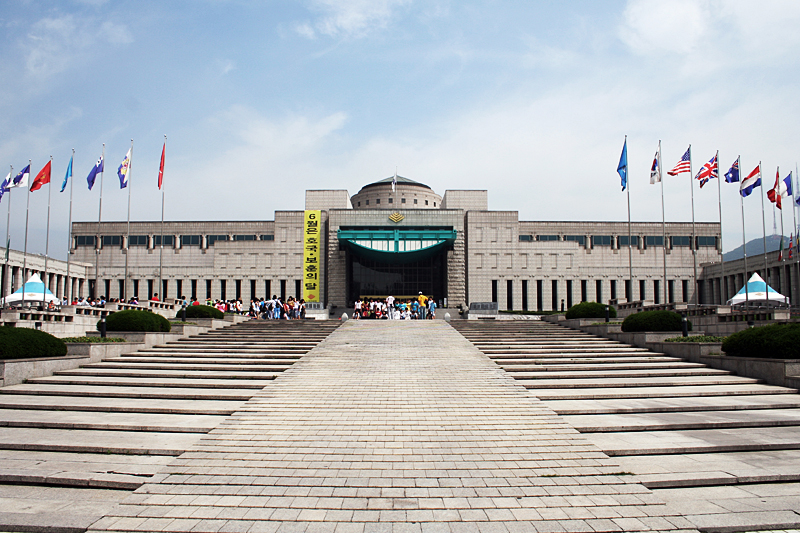
War Memorial of Korea
37.5365° N · 126.9771° E · Museum
Photo: d. FUKA · CC BY-SA 2.0 · Wikimedia Commons
War Memorial of Korea is a military museum. It is near Yongsan-dong, South Korea. The memorial opened in Seoul's Yongsan district in 1994. The free Lokali audio guide runs 7 minutes.
✓ Published October 2026 · how we write these guides
Visitor facts
| Lokali audio guide | 7 min · free |
|---|---|
| Type | Museum |
| Location | Yongsan-dong, South Korea |
| Coordinates | 37.5365, 126.9771 |
| Official website | warmemo.or.kr |
| Languages | 50+, in the Lokali app |
The story
Listen first. Traffic hums along the wide avenues of Yongsan, but the plaza in front of the War Memorial of Korea feels oddly still. Stone paving stretches out under an open sky. Water moves somewhere nearby. Families walk slowly, schoolchildren gather in neat lines, and older visitors stop for a long moment at the names. This is a place built for remembering, and it asks you to slow your pace to match it.
The memorial sits in central Seoul, in the Yongsan district, close to Samgakji Station. The ground has its own military past. The museum stands on land once used by the army, and for much of the twentieth century this part of the city was shaped by soldiers and bases. The memorial opened in 1994. It was built to honour the people who fought for Korea and to explain, in one place, how war has shaped this peninsula over many centuries.
Before you go inside, look at the long galleries that run along the sides of the plaza. Their walls hold black plaques carved with names. These are the names of the fallen — Korean soldiers and police, and also service members from the many nations that fought under the United Nations flag during the Korean War. The lists continue for a long way. Many visitors walk the whole length in silence, and some search for a single family name.
That international element surprises many people. When war broke out in June 1950, sixteen countries sent combat troops to support South Korea. Others sent medical teams and supplies. Soldiers came from as far away as Ethiopia, Colombia, Turkey and the Netherlands. Their names stand here beside Korean names. For many foreign visitors, this is the moment the memorial becomes personal. You may find a name from your own country on these walls.
Now turn your attention to one of the most moving sculptures in the grounds — the Statue of Brothers. It shows two soldiers in an embrace. The older brother wears the uniform of a South Korean officer. The younger brother wears the uniform of the North Korean army. The statue is based on an account of two brothers who met on the battlefield, fighting on opposite sides. It is a simple image, and it carries the central tragedy of this war: one people, divided against itself.
Look closely at the base of the statue. Its dome-shaped mound is split by a crack down the middle. The two figures stand above that split, holding on to each other. The design asks a direct question. Can a broken family be made whole again? Many Koreans still have relatives they lost contact with when the peninsula was divided. For them, this sculpture is not abstract. It describes their own grandparents, parents and cousins.
Inside, the museum is large, and it covers far more than one war. The halls trace conflict on the peninsula from ancient kingdoms through the Joseon era, when Korea was ruled by a long royal dynasty, and into the modern age. One of the most popular displays is a model of a turtle ship. These were armoured warships with a covered deck, linked to the admiral Yi Sun-sin, who defended Korea against invasion from Japan in the late sixteenth century.
The turtle ship model is worth a careful look. Its roof was covered with iron spikes to stop enemy sailors from climbing aboard. A dragon head at the bow could release smoke to hide the ship's movement. Children love this display, and so do adults. It shows a side of Korean history that many foreign visitors do not know: a long story of defence, invention and survival on a small peninsula between larger powers.
The Korean War galleries form the emotional centre of the museum. They follow the conflict from the first invasion across the thirty-eighth parallel in 1950, through the retreat to the southern port of Busan, the landing at Incheon, and the long, grinding fighting in the mountains. The war ended in 1953 with an armistice, not a peace treaty. Technically, the two Koreas have never signed a formal peace. That fact gives these rooms a quiet tension.
As you move through the exhibits, notice the personal objects. There are letters, uniforms, helmets and small belongings carried by soldiers and civilians. Photographs show refugees walking south with everything they owned on their backs. These small things often stay with visitors longer than maps or battle plans. They remind you that most of the people caught in this war were ordinary families trying to stay alive through hard winters.
Later galleries describe Korea's role in other conflicts, including the deployment of Korean troops to Vietnam, and the country's work in United Nations peacekeeping missions. These rooms show how South Korea changed during the second half of the twentieth century. A nation that was once devastated by war became a country that sends its own forces abroad to help others. The arc is easy to miss if you rush, so give it time.
When you step back outside, walk to the open-air exhibition area. Here, real military equipment sits on the lawns — tanks, artillery, helicopters and aircraft, some of them very large. Children climb the viewing platforms and adults pose for photographs beside steel hulls. The contrast is striking. Inside, the museum speaks of loss. Outside, the machines of war sit quietly in the sunlight, painted, polished and still.
The memorial is also a working space for Korean life. Schools bring classes here to learn about the war. Veterans return with their grandchildren. Diplomats and visiting leaders lay wreaths. On an ordinary afternoon, you may see couples resting on benches, runners passing the edge of the grounds, and families eating snacks near the fountains. It is a solemn place, but it is not cut off from the city around it.
Before you leave, stand for a moment in the main plaza and look back toward the building. Notice the long lines of the galleries, the open sky above the stone, the names on the walls. Listen to the voices of children, the footsteps of other visitors, the distant traffic of Seoul. The war these halls describe is not fully over. But here, on this quiet ground, people keep coming back to remember it together.
Key facts
What to look for
Practical tips
Common questions
Is there a free audio guide to War Memorial of Korea?
Yes — the Lokali app narrates War Memorial of Korea free of charge in 50+ languages. The guide runs about 7 minutes, covers the history, what to look for on site and practical tips, and works offline once downloaded.
Where is War Memorial of Korea?
War Memorial of Korea is near Yongsan-dong, South Korea, at 37.5365, 126.9771. Tap the map link on this page for directions from where you are.
What is War Memorial of Korea known for?
The memorial opened in Seoul's Yongsan district in 1994. Sixteen nations sent combat troops to aid South Korea.
What should you look for at War Memorial of Korea?
The cracked dome beneath the Statue of Brothers. Black plaques carved with names of the fallen. Iron spikes on the roof of the turtle ship model.
What should you know before visiting War Memorial of Korea?
Plan at least half a day for the indoor galleries. Take Seoul Metro to Samgakji Station for the closest access.
When is the best time to visit War Memorial of Korea?
Visit the outdoor equipment area early on hot summer days.
On the map
Opens directions to War Memorial of Korea from your location.
More to see near War Memorial of Korea


Hear War Memorial of Korea in your language
The full story, narrated, in 50+ languages. Download it before you go and it plays offline, at your own pace, with no ticket and no tour group.