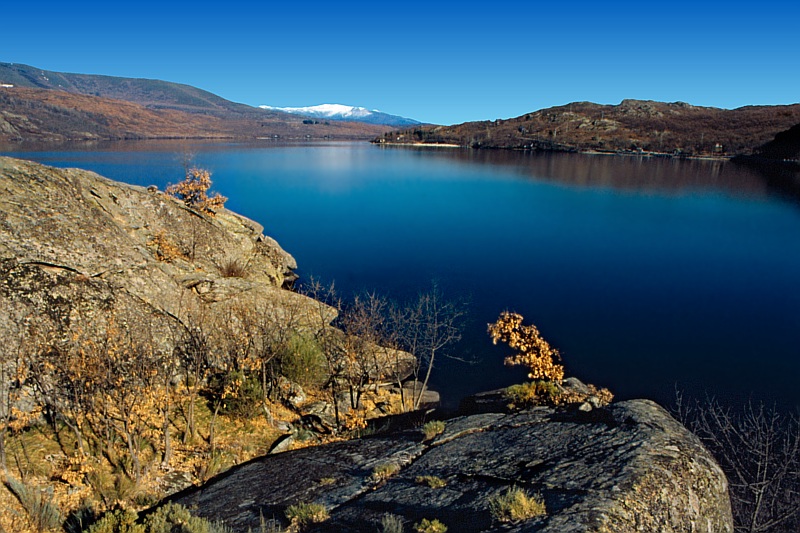
Photo: Stegop · CC BY 3.0 · Wikimedia Commons
Sanabria Lake is a lake in Zamora Province, Castile and León, Spain. Largest lake of glacial origin on the Iberian Peninsula. The free Lokali audio guide runs 6 minutes.
✓ Published October 2026 · how we write these guides
Visitor facts
| Lokali audio guide | 6 min · free |
|---|---|
| Type | Historic Site |
| Location | Zamora, Spain |
| Coordinates | 42.1225, -6.7192 |
| Languages | 50+, in the Lokali app |
The story
Listen first. Water laps against coarse granite sand, and the wind moves through oak and birch on the slopes above. The air is cool, even in summer. It smells of pine resin, damp stone and wet grass. Ahead of you lies a long sheet of dark water, held in a bowl of mountains. This is Sanabria Lake, in the far northwest of Zamora Province, close to the borders of Galicia and Portugal.
What you are looking at is the largest lake of glacial origin on the Iberian Peninsula. That phrase matters. Most lakes in Spain are reservoirs, made by dams in the twentieth century. This one is natural, and very old. It was shaped during the last Ice Age, when a great tongue of ice slid down from the high plateau of the Sierra Segundera, the mountain range to the west. The ice carved the valley deeper as it moved.
When the climate warmed, the glacier melted and retreated. It left behind ridges of rock and gravel that it had pushed ahead of it. Geologists call these ridges moraines. Look along the shore and the low hills around the eastern end — some of those curved, wooded rises are moraines. They act like a natural dam. The meltwater gathered behind them, and the lake was born. In a sense, the whole landscape here is a footprint of ice.
The river Tera runs into the lake from the mountains and runs out again on the other side. So the water is always moving, even when the surface looks still. In its deepest parts the lake reaches roughly fifty metres. That depth keeps the water cold. Swimmers who wade in on a hot August afternoon often gasp at the first touch — and then stay, because the water is so clear.
The lake sits inside a protected natural park, created at the end of the 1970s. The park covers far more than this one body of water. Up on the granite plateau above, there are dozens of smaller glacial lakes and ponds, scattered across a bare, rocky landscape. Hikers climb up to see them. Down here, the shores are gentler, with beaches of pale sand, picnic areas and small coves where families spread towels under the trees.
Now, a surprise. Many people believe that a village lies at the bottom of this lake. Legend has it that a town called Villaverde de Lucerna once stood here. One night, Christ came to the village disguised as a poor beggar and asked for bread. Everyone refused him except a group of women baking in an oven. In punishment, the story says, a spring burst from the ground and drowned the town.
The women who showed kindness were spared, and the legend gives them a small island of safety. Locals say that on Saint John's Night, in late June, you can still hear the church bells ringing under the water. There is no evidence for any drowned village. But the tale has been told around kitchen fires in Sanabria for generations, and it gives the dark water a quiet, watchful character.
That legend reached one of Spain's great writers. Miguel de Unamuno, the philosopher and novelist from the early twentieth century, visited this lake and was moved by it. He later wrote a short novel called San Manuel Bueno, Martyr. It tells of a village priest who has lost his faith but keeps serving his people. Unamuno set the story in a village named Valverde de Lucerna, beside a mountain lake. The echo of the old legend is clear.
The lake also carries a real and painful memory. In January 1959, a dam high on the river Tera, upstream of the lake, gave way during the night. A wall of water rushed down the valley and struck the village of Ribadelago, at the western end of the lake. Around 144 people died. It remains one of the worst dam disasters in Spanish history. A new village was later built nearby, and the event is still remembered in the area.
Look up at the hillside on the northern shore. There you may see the village of San Martín de Castañeda, with its old stone church. It once belonged to a medieval monastery. Today part of the old monastic buildings holds a visitor centre for the natural park. From the village, the view drops straight down to the lake. On a calm day, the mountains and clouds appear twice — once in the sky, and once in the water.
The nature here changes with the seasons. In spring, broom and heather turn the slopes yellow and purple. In autumn, the oaks and chestnuts go copper and gold, and mist often lies on the water in the early morning. Winter can bring snow to the high plateau. The wider region is also known as wolf country. The Iberian wolf still lives in these mountains, though visitors almost never see one.
The human landscape is part of the story too. The villages of Sanabria are built of dark granite and slate. Many houses have wooden balconies and heavy roofs designed to carry snow. Chestnut trees were once essential here, for food and timber. A short drive away, the hilltop town of Puebla de Sanabria keeps its castle and narrow cobbled streets. Life in this corner of Spain was isolated and hard for centuries, and that feeling still lingers.
Before you leave, take a moment at the water's edge. Notice how the colour of the lake changes as clouds pass — from steel grey to deep green to almost black. Listen to the small waves on the sand. This water has been gathering here since the ice withdrew, long before any village, legend or novel. As you walk away, glance back once. The mountains will close around the lake again, just as they have for thousands of years.
Key facts
What to look for
Practical tips
Common questions
Is there a free audio guide to Sanabria Lake?
Yes — the Lokali app narrates Sanabria Lake free of charge in 50+ languages. The guide runs about 6 minutes, covers the history, what to look for on site and practical tips, and works offline once downloaded.
Where is Sanabria Lake?
Sanabria Lake is in Zamora, Spain, at 42.1225, -6.7192. Tap the map link on this page for directions from where you are.
What is Sanabria Lake known for?
Largest lake of glacial origin on the Iberian Peninsula. Formed by a glacier from the Sierra Segundera.
What should you look for at Sanabria Lake?
Curved wooded ridges marking the ancient glacial moraines. Pale granite sand on the lakeside beaches. Stone church of San Martín de Castañeda above the shore.
What should you know before visiting Sanabria Lake?
Bring a swimsuit, but expect very cold water. Visit early morning in autumn for mist on the water.
When is the best time to visit Sanabria Lake?
Visit early morning in autumn for mist on the water.
On the map
Opens directions to Sanabria Lake from your location.
Hear Sanabria Lake in your language
The full story, narrated, in 50+ languages. Download it before you go and it plays offline, at your own pace, with no ticket and no tour group.