Audio guide for famous landmarks, used well
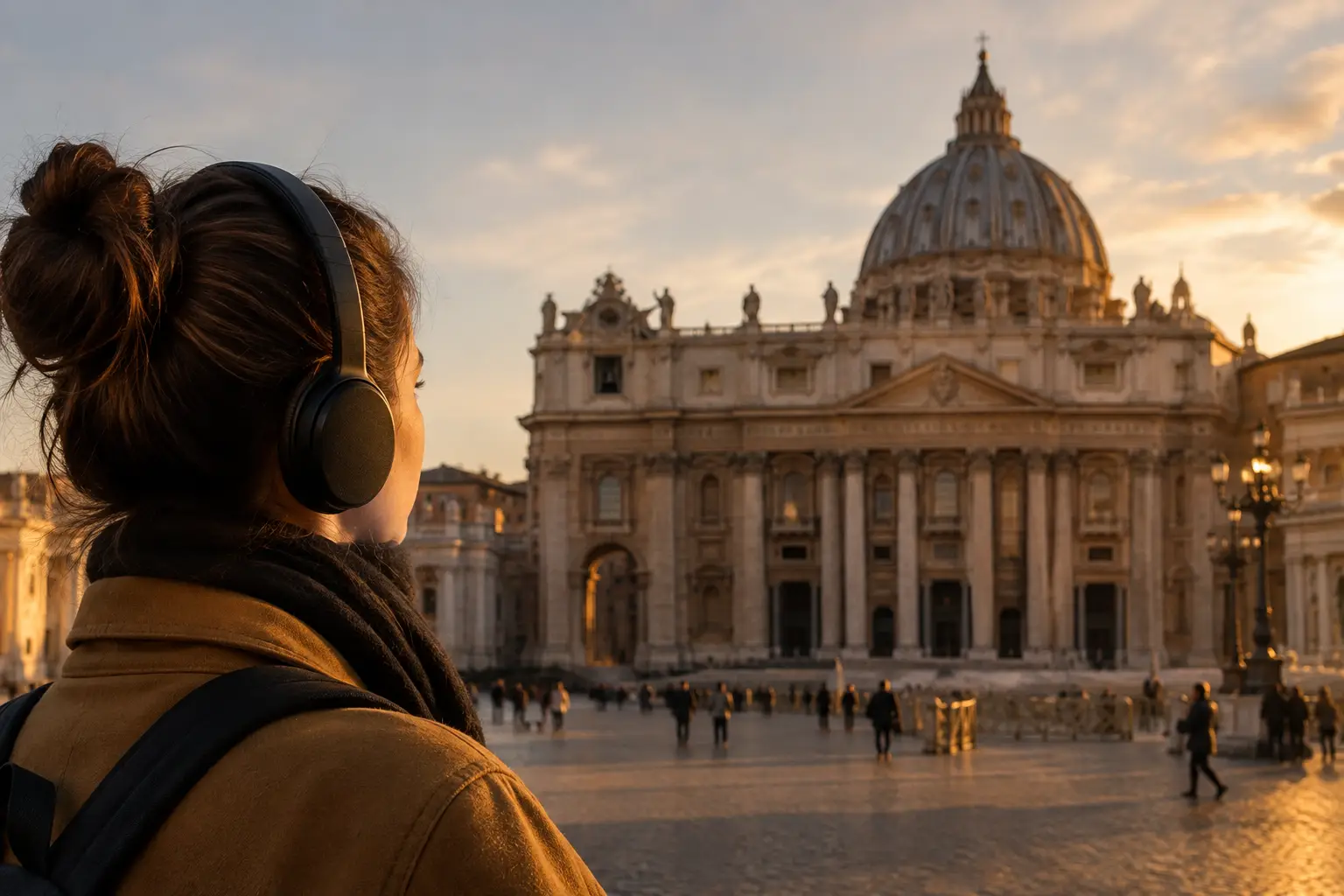
An audio guide for famous landmarks gives you history at your pace. Learn what to choose, when to listen, and when a human guide is worth paying extra for.
At the Prado, the difference between seeing Las Meninas and understanding it can be ten minutes in your headphones. At Prague Castle, it can be the difference between walking through a vast courtyard and noticing how each gate, tower and cathedral marks a change in power. A good audio guide for famous landmarks gives you that second layer without fixing you to a group, a timetable or a guide’s umbrella.
But not every landmark needs one. Some places explain themselves through scale: the first sight of the Pyramids of Giza, the long white sweep of the Taj Mahal, the iron lattice of the Eiffel Tower from the Champ de Mars. Others are confusing unless someone puts the stones, rooms and objects in order. The useful question is not whether an audio guide is worth having. It is what you need it to do.
What an audio guide should give you
A landmark guide earns its place when it answers three things clearly: what you are looking at, why it exists, and where to go next. The first is simple. You need to know that the dark, worn steps beneath your feet are part of the Roman Forum’s Via Sacra, not just another piece of paving.
The second is where a short recording can change a visit. A view from the Acropolis becomes sharper when you understand that the Parthenon has been a temple, a church, a mosque and an ammunition store. At Angkor Wat, the long galleries stop being decorative corridors when you know to look for battles, processions and scenes from Hindu mythology carved across the walls.
The third is practical. Large sites waste time when you enter through the wrong gate, miss a quieter room, or spend half an hour circling a courtyard without knowing which building you have already seen. A guide should orient you before it begins telling stories. If it starts with a long biography while you are still looking for the entrance, it has misunderstood the job.
Choose the audio guide for the place, not the city
The same format does not suit every famous landmark. A compact building with a dense collection calls for close looking. A sprawling outdoor complex calls for navigation, pauses and a clear route.
At the Louvre, for example, you do not need a recording for every gallery. You need help making decisions. The museum’s own guide costs €6 and is available in nine languages, but it may be more useful to choose a short route around the works you genuinely want to see than to attempt the whole palace. The Mona Lisa room is rarely quiet; an audio track can give you context while you wait, then send you towards a less crowded painting with more space to stand.
At Pompeii, the problem is different. Streets, bakeries, bathhouses and villas spread across a large open site. Here, a guide that follows a logical path is valuable because the city has no obvious centre for a first-time visitor. Listen at the Forum, then move towards a house or bathhouse with a reason for being there. A collection of disconnected facts will leave you looking at ancient walls without knowing how daily life fitted between them.
For a tall monument, use the guide before you climb or queue. At the Statue of Liberty, the story of the harbour, immigration and the statue’s construction gives the view more meaning. Once you are moving through narrow stairs or sharing a small platform, you may not want to stop and handle your phone. The same applies to the dome of St Peter’s Basilica or the towers of Notre-Dame when access is available.
Listen in short sections
The common mistake is pressing play at the entrance and treating the guide like a podcast. Famous landmarks are physical places. Wind cuts across the Great Wall. School groups pass through the entrance hall of the Uffizi. Bells, traffic and other visitors interrupt the moment you planned to hear about a ceiling fresco.
Use recordings as chapters, not a continuous stream. Listen to a two- or three-minute introduction before entering. Then stop. Look around without narration. When one feature catches your attention, play the relevant section and stay with it until the account has a shape.
This rhythm prevents the visit from becoming a sequence of instructions. You do not need to absorb every date. A few well-chosen details last longer: the smoke-blackened ceiling in a medieval hall, the tool marks on an unfinished sculpture, the shallow grooves made by cart wheels on an old stone street.
Written text matters here too. If you are in a crowded gallery, reading may be easier than listening. If English is not your first language, you may understand a short paragraph more comfortably than a fast recording. Lokali provides both narrated and written guides in 45 languages, so you can switch between them rather than forcing one format through an entire visit.
Download before the stone walls begin
Historic buildings are not kind to mobile signal. Underground chambers, thick fortress walls and museum basements can turn a simple map into a blank screen. Download your guide and map before you leave your accommodation or while you still have reliable Wi-Fi.
This is not only about data. It keeps the visit moving. You can check where you are in the Alhambra’s palaces, save a section for later, or follow a walking route after leaving a museum without standing at the exit trying to reload a page.
Carry headphones, but do not seal yourself off completely. In places with traffic, uneven ground or dense crowds, keep one ear free or pause the audio. More importantly, leave room for the place itself. The echo in Hagia Sophia, the fountains of Villa d’Este, and the scrape of shoes on the stones of the Colosseum are part of the record too.
When a paid guide is worth it
Free audio is not always the strongest choice. A human guide is worth considering when you want to ask questions, when a site’s layout is genuinely difficult, or when your interest is very specific. An archaeologist explaining a newly excavated area, an art historian comparing paintings in front of you, or a local specialist leading a small group through a complex religious building can respond to what you notice. A recording cannot.
A paid on-site guide can also be useful when the official interpretation includes access to spaces or exhibitions that need careful explanation. If you are travelling with children, a guide who adapts the pace may be better than repeatedly restarting audio while someone needs a snack, a toilet break or a place to sit.
On the other hand, an on-site rental is often poor value when it offers only a generic sequence of numbered stops in one or two languages. If you have already read about the site, or you want to spend forty minutes sketching one façade rather than following a prescribed route, your own phone gives you more control. You can pause, replay and leave whenever you have had enough.
Give yourself one unplanned moment
The purpose of an audio guide for famous landmarks is not to fill every silence. It is to make you notice more, then get out of the way.
After the final stop, put the phone in your pocket for ten minutes. Sit on a bench outside the museum, walk once around the square, or look back from the first street beyond the gates. That is often when the landmark stops being an item on an itinerary and becomes a place you can still picture clearly after the journey ends.