Best Istanbul Museum Audio Guides by Museum
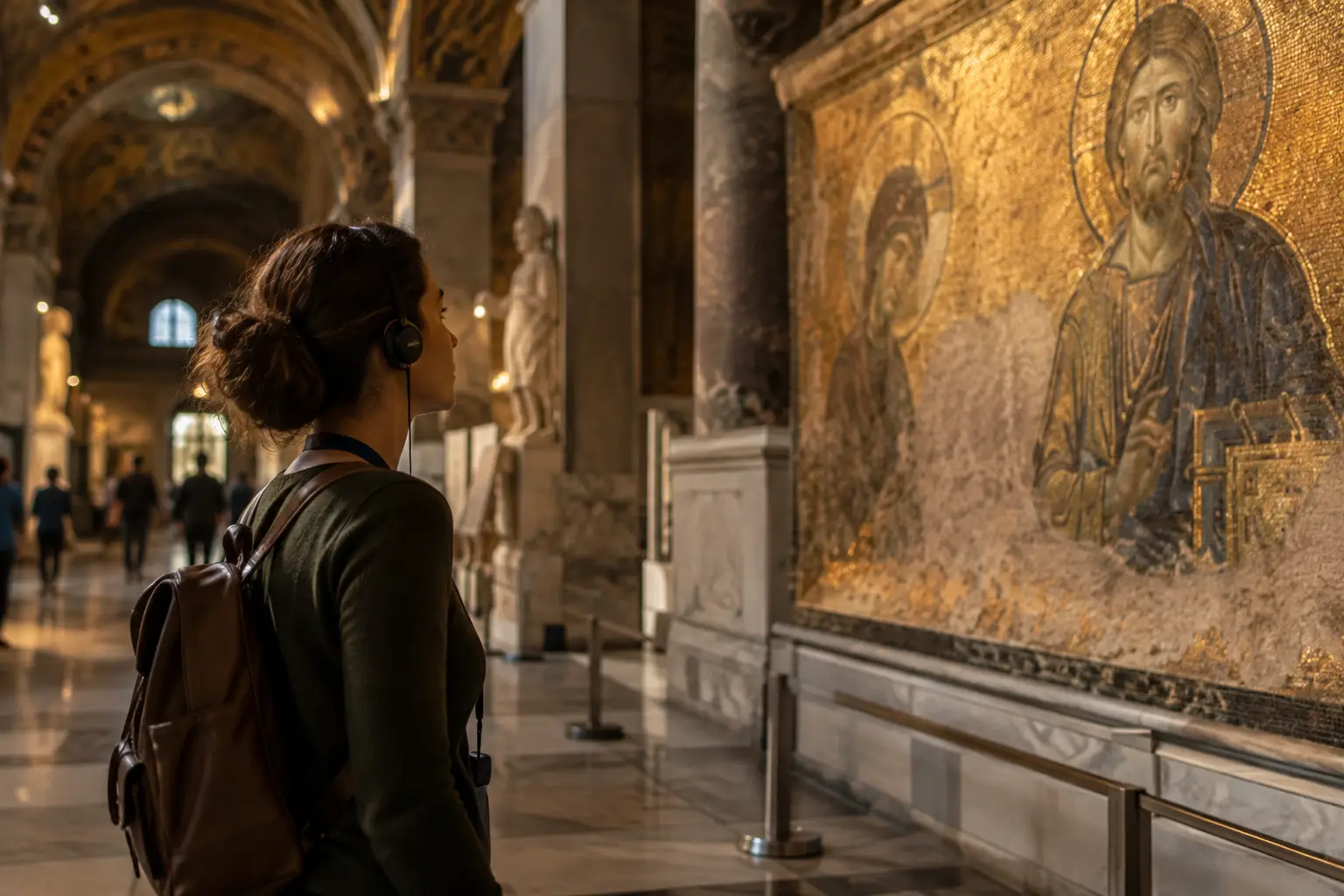
Find the best Istanbul museum audio guides for Hagia Sophia, Topkapi Palace, the Archaeology Museums, and more, with free, offline options at your pace.
At the gate of Hagia Sophia, the line moves, phone screens glow, and the first question is practical: which of the best Istanbul museum audio guides is worth your time? The useful answer changes by museum. Some places need a clear historical thread in your ear. Others are better with a short orientation, then silence and time to look.
Istanbul rewards a selective approach. A long audio tour can turn the city’s most powerful rooms into a checklist. Choose a guide that helps you notice the marble doorways, tiled walls, imperial kitchens, and small carved objects without keeping you on a fixed route.
Start with the museum, not the app
There is no single audio guide that is right for every museum in Istanbul. The main choice is between an official on-site guide, a free phone-based guide, and a human guide. Each solves a different problem.
An official guide usually follows the collection room by room. That is useful when labels are brief, objects are dense, or you want a dependable explanation of a particular exhibit. The downside is pace. You may spend ten minutes looking at one mosaic while the recording is already asking you to move on.
A free guide on your phone works better when you want context before entering, a few stories while walking, and the freedom to skip what does not interest you. Lokali offers free audio and written guides in 50+ languages, with offline downloads, so it suits a day when your signal fades inside thick stone walls or underground galleries. It does not replace a curator-led visit or provide the close reading of every object in a major collection.
A human guide is the stronger choice if you have one short day, travel with children who have questions, or want to connect several sites into one story. You pay for judgment as much as information: which room to enter first, when to pause, what to leave for another trip. For a quiet solo visit, that social commitment may be more than you want.
Hagia Sophia: choose history over long commentary
Hagia Sophia is not a place for forty separate stops. Its force comes from scale: the huge central dome, light sliding over stone, calligraphic roundels suspended above the floor, and layers of Christian and Islamic history visible in one building.
The best audio guide here gives you a chronological frame before you cross the threshold. You need to know why a sixth-century imperial church became an Ottoman mosque, and why details from both eras matter. After that, keep the device in your pocket for a while. Stand beneath the dome and look up. The building explains its ambition better than a constant voice can.
A guide that directs you to a small number of details is more useful than one that narrates every surface. Listen for the imperial door, the apse, the upper galleries if accessible, and the places where plaster, mosaics, marble, and later additions meet. If a recording treats the building as only one faith, one empire, or one date, it is too narrow.
Topkapi Palace: an audio guide earns its place
Topkapi Palace is where audio helps most. The palace is spread across courtyards and pavilions, and its beauty can feel disconnected without a little structure. You move from public ceremony to private rooms, kitchens, gardens, treasury displays, and views over the Bosphorus. A guide can tell you why that sequence mattered.
Look for a guide that explains the palace as a working seat of power, not simply a collection of decorated rooms. The second courtyard is not just a photogenic space. It leads toward administration, food, diplomacy, and controlled access to the ruler. The tiled interiors become more vivid when you understand who was allowed through each door.
This is also one of the places where an official guide may be worth considering if it provides object-level commentary on the treasury or temporary displays. A general city guide can give you the palace story, but it cannot always identify every jewel, weapon, manuscript, or ceremonial object in front of you. Use both approaches if you enjoy collections: broad context first, detailed stops only where curiosity holds you.
Istanbul Archaeology Museums: do not try to hear everything
The Istanbul Archaeology Museums can overwhelm even a patient visitor. Stone sarcophagi, inscriptions, statues, fragments of cities, and objects from across former imperial territories fill the rooms. The temptation is to press play at the entrance and stay on one endless track. Resist it.
Choose three anchors. The Alexander Sarcophagus is an obvious starting point because its carved battle scenes seem to move as you walk around it. Then pick one section that matches your interests, perhaps ancient cities, sculpture, or everyday objects. End with a room that surprises you rather than the one a guide tells you is obligatory.
A good audio guide here explains how to look. It should point out paint traces on sculpture, damage that reveals an object’s long journey, or the difference between a grand tomb and a small domestic vessel. It should not turn the collection into a roll call of rulers and dates. If you leave remembering one face carved in stone and one story of how an object was made, the visit has done its work.
The Museum of Turkish and Islamic Arts: use sound to slow down
Across from the Blue Mosque, the Museum of Turkish and Islamic Arts holds carpets, calligraphy, woodwork, ceramics, and objects made for daily life as well as ceremony. These are quieter galleries than Topkapi, and an audio guide should be quieter too.
This is a museum for close looking. A recording can help you recognize the labor in a carved wooden panel or the geometry in a textile, but it should leave room for you to follow a pattern with your eyes. If you are tired after the crowded historic peninsula, this is a good place to choose a few stops and move slowly.
The museum also shows why labels alone sometimes fail. A carpet can look decorative until you hear how it was woven, used, repaired, and valued. A page of calligraphy can look distant until someone explains the discipline behind the line and the material in the pigment.
Galata, Pera, and modern collections: decide what you need
In the museums north of the Golden Horn, you may need less basic orientation and more choice. Modern art, photography, design, and temporary exhibitions often benefit from a guide only when it adds the artist’s context or helps you understand a local moment in Istanbul’s cultural life.
For a temporary exhibition, the museum’s own audio content can be the better option because it is tied closely to the works on display. For the neighborhood around it, a self-guided audio walk is more useful. Walk uphill through Galata or along Istiklal Avenue with historical context in your ears, then enter the museum ready to give the galleries your full attention.
Do not force an audio guide onto every exhibition. If the work is visual and your response is immediate, reading a few wall texts may be enough. Audio is most valuable when it gives you a door into an unfamiliar period, technique, or social setting.
How to make a free guide work in Istanbul
Download the audio before you leave your accommodation. The underground spaces, thick walls, and crowded courtyards of the old city are poor places to depend on a mobile connection. Bring headphones, but use only one earbud near entrances and busy streets.
Listen to the introduction outside, where you can see the building as a whole. Inside, stop only when a room or object catches your attention. You do not need to complete every track to get value from it. In fact, the best rhythm is often five minutes of listening followed by ten minutes of looking.
Keep written text available too. A name, dynasty, or architectural term is often easier to understand when you see it spelled out. If English is not your first language, choose a guide in the language that lets you think about the object rather than translate every sentence in your head.
What is not worth paying for
Avoid paying for a generic recording that could describe any Ottoman room, any Byzantine dome, or any display case. If the guide never names the room you are standing in or points to a visible detail, it is not doing enough work.
Also skip the audio guide when your visit is very short and the building itself is the reason you came. At Hagia Sophia, fifteen quiet minutes may be better than a hurried hour of commentary. At the Archaeology Museums or Topkapi Palace, the calculation reverses: a little structure can save you from walking out tired and unsure what you saw.
Let the museum set the pace. Istanbul gives you domes, tiled chambers, cedar-scented display cases, ferries crossing the water beyond palace walls, and objects older than the streets outside. A good guide brings one or two of those things into focus, then gets out of the way.