City Sightseeing Tips Without Groups That Work
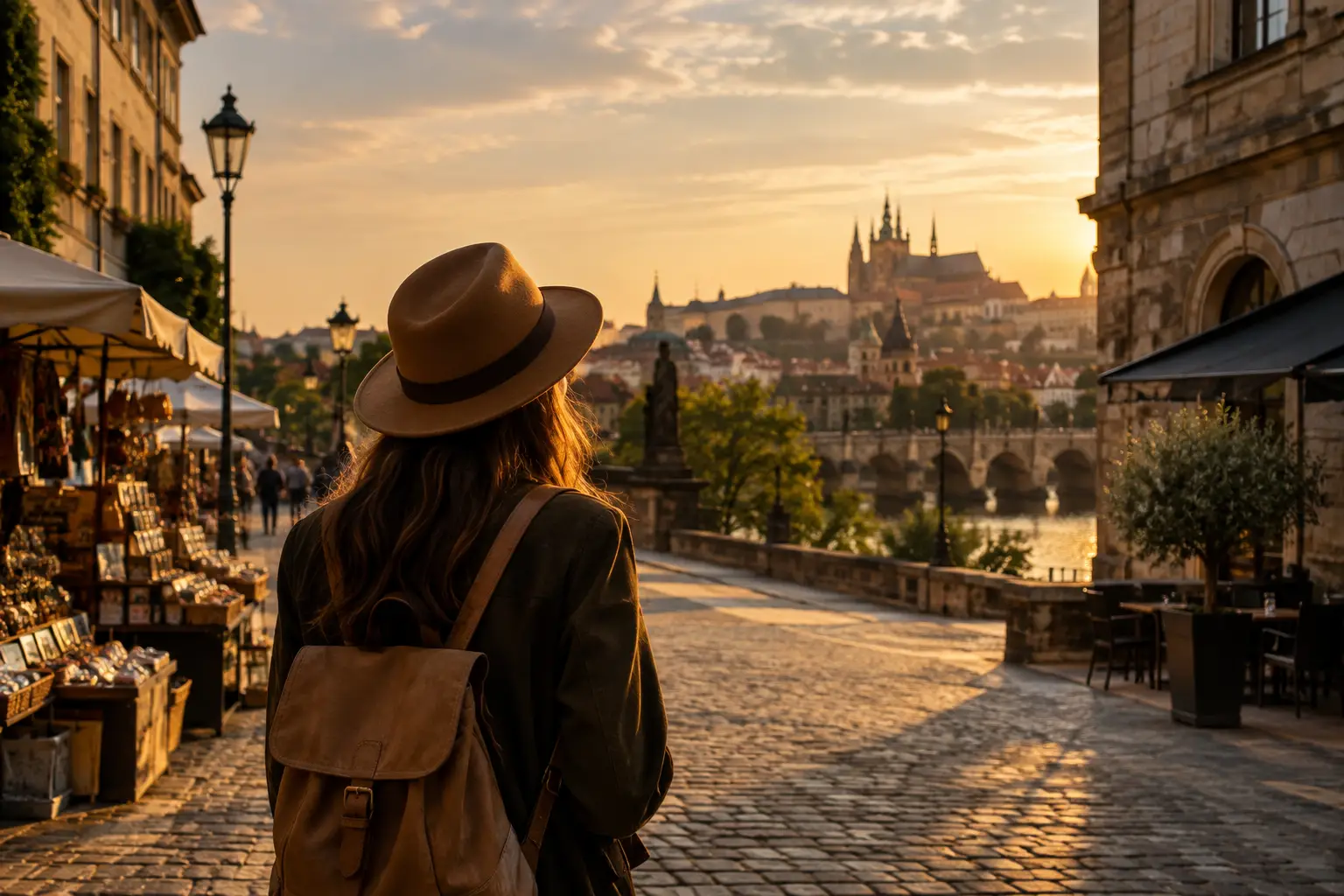
City sightseeing tips without groups for planning routes, reading a place, choosing quiet hours, and keeping the freedom to stop or change course alone.
A group tour reaches the Old Town Square at the same moment as five other groups. Someone raises a flag, the guide speaks over street musicians, and you leave just as a side street begins to look interesting. City sightseeing tips without groups start with a simple decision: treat the city as a sequence of places, not a checklist you need to finish before dinner.
Going alone does not mean wandering without context. It means choosing where the story begins, how long it lasts, and whether a rainy afternoon belongs in a museum or under an awning with coffee. You still need a route, a little history, and a way to notice what is in front of you. You simply do not need to match your pace to twenty strangers.
Build one walk around a real question
Do not begin with a map crowded by pins. Begin with one question that gives the day a shape. In Rome, it might be how an imperial forum became a traffic island, a ruin, and a public stage. In Istanbul, it might be how water moves through the city, from the Bosphorus to cisterns beneath the street. In Mexico City, it could be the layers beneath the Zócalo: ceremonial ground, colonial square, working city.
A question prevents the common independent-travel mistake of walking eight miles and remembering only that there were many important buildings. Pick three anchor stops and leave room between them. A church, market, hill, station, bridge, or square can be an anchor if it helps you understand the district.
For example, a walk in Paris can run from the arcades of Palais-Royal through the passages near Grands Boulevards and end at Canal Saint-Martin. The point is not to cover Paris. It is to see how covered shopping streets, nineteenth-century boulevards, and a working canal fit into one changing city.
Choose the right order, not the shortest route
The quickest line on a map is often the least satisfying one. A good self-guided route changes texture as you walk: a wide avenue after narrow lanes, a crowded market after a quiet courtyard, a high viewpoint after a museum room. These contrasts keep your attention awake.
Start early with the place that needs quiet. A cathedral nave, an old cemetery, a major square, or a waterfront is easier to read before the day becomes loud. Save a dense museum or a shopping street for later, when you want shelter, food, and people around you.
Use public transport for the dull connection rather than treating every mile as part of the experience. Walking forty minutes beside a ring road to prove you have done the city on foot is not independence. It is just poor sequencing. Keep your energy for the section where streets narrow, facades change, and stopping makes sense.
Before leaving your accommodation, save an offline map and download any guide material you want to use. Phone signal disappears in underground stations, stone-walled museums, and the very old quarters where navigation matters most. Lokali provides free narrated and written guides for more than 190 cities in 45 languages, with offline downloads, so you can keep a route and its context in your pocket without searching for a signal.
Let one landmark take longer than expected
Groups turn landmarks into short appointments. You arrive, hear a summary, take a photograph, and move on. Alone, you can give a place the time it asks for.
At the Acropolis, that may mean looking beyond the Parthenon toward the city spread below and considering why the hill mattered before it became an image on postcards. At the Alhambra, it may mean sitting long enough to notice water, plaster, shade, and the repeated geometry of a room. At New York's Grand Central Terminal, it may mean standing at the edge of the concourse to watch the building operate as a station rather than treating it as a backdrop.
This is not an argument for lingering everywhere. Some famous sights give you their essential idea in ten minutes. A large exterior viewed from a busy pavement may not reward an hour of study. Be honest about your interest. Move on when curiosity fades, not because a guide's umbrella has turned the corner.
Use audio as company, not as a command
An audio guide can make a solo walk feel less empty, especially in a museum where labels are brief or written in a language you do not read comfortably. But do not play it continuously. Listen before you enter a room, pause it to look, then continue when you want the next piece of context.
This rhythm matters. If a voice describes every detail while you walk, you may spend the afternoon following instructions instead of seeing the place. Read or listen in short sections, then put the phone away. A city gives you sounds that no guide can reproduce: tram bells in Lisbon, shutters opening in Bologna, the scrape of chairs on a morning sidewalk in Buenos Aires.
There are moments when an official on-site audio guide is worth paying for. A major exhibition with a carefully designed sequence, a complicated archaeological site, or a collection with little public explanation can benefit from specialist interpretation. The Louvre's own guide, for example, offers a focused alternative if you want the museum's selected route. A human guide is also the better choice when you want to ask detailed questions, enter places not open to casual visitors, or understand a subject that needs conversation rather than narration.
What is usually not worth it is renting a generic audio device at every entrance when you only want twenty minutes of context. Decide before you arrive what you actually need from the site.
Make room for the ordinary city
The gap between attractions is where a city becomes lived-in. Do not fill every break by checking the next landmark. Look at what changes from one block to the next: laundry above a lane, a repair shop beside a design store, a school gate at noon, a small shrine, a fruit stall setting up for the afternoon.
Give yourself one practical stop that is not cultural in any formal sense. Buy something simple from a bakery, sit in a public garden, browse a grocery store, or take a tram for three stops and walk back. These pauses are not wasted time. They help you understand scale and routine, and they keep a long day from becoming a march between monuments.
If you are in a city for several days, do not save every major sight for the first morning. Return to one area at another hour. The same square can feel ceremonial at dawn, commercial at lunch, and theatrical after dark. Repetition is one of the advantages of travelling without a fixed itinerary.
Know when solitude becomes inefficient
Independent sightseeing has limits. A neighborhood with no clear pedestrian route, a site spread over a very large area, or a museum with thousands of objects can drain more time than it gives back. In these cases, a printed map, a timed audio route, or a short guided visit can provide useful structure.
You also do not need to invent every route yourself. Use a well-made self-guided walk as a starting point, then edit it. Skip the stop that does not interest you. Add the market you passed earlier. Stop for lunch before you are tired. The route serves the day, not the other way around.
The freedom of seeing a city without a group is not the freedom to do everything alone. It is the freedom to choose your own amount of help, and to leave enough empty space for a street, a room, or an unexpected view to change the plan.