Free audio guide versus rental: choose your pace
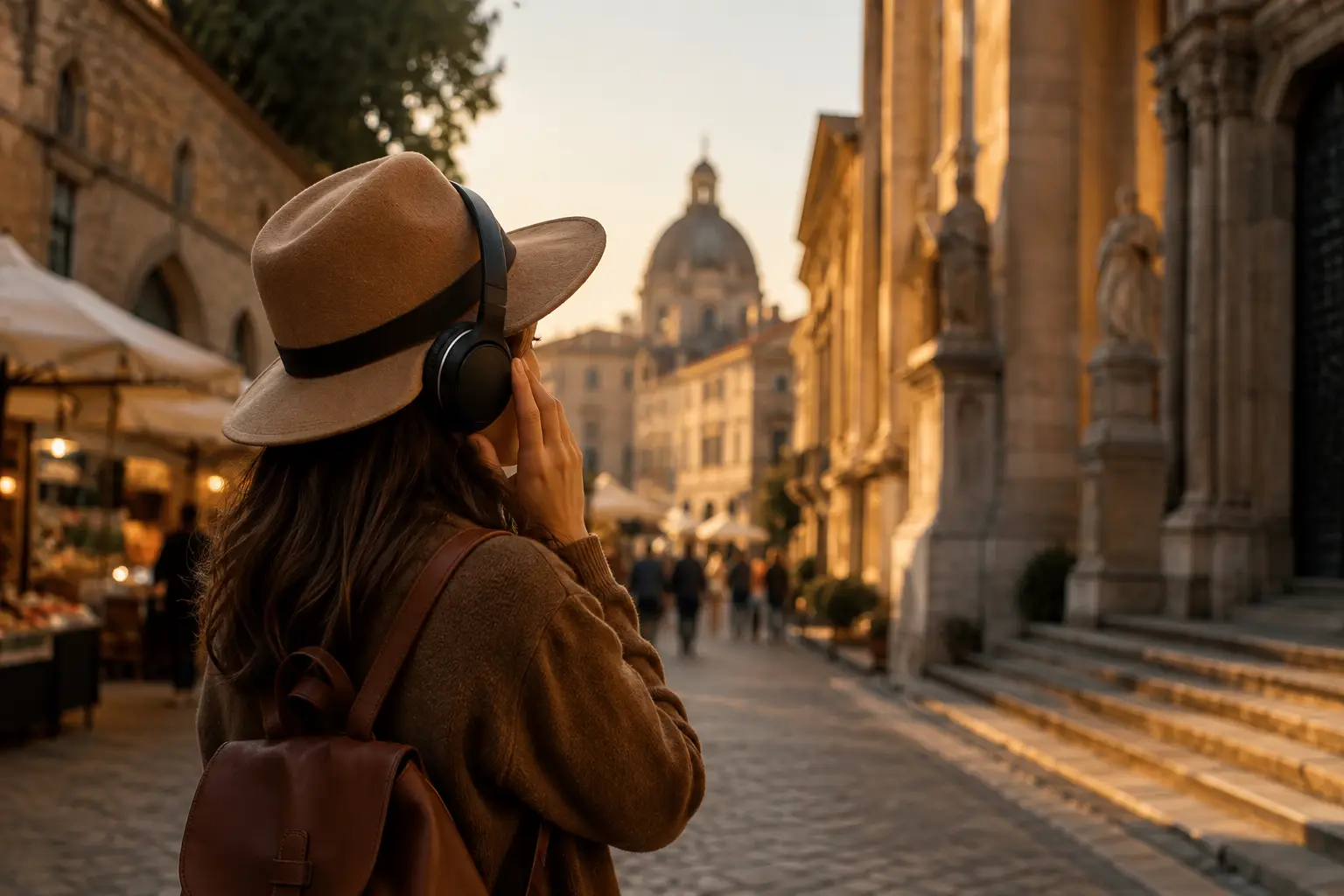
Free audio guide versus rental: compare cost, language, offline access and pace before you stand at a museum desk or begin a city walk on your terms today.
At the Louvre, you have already crossed the courtyard, passed the glass pyramid and found the line moving toward the galleries. Then comes a familiar small decision: use a free audio guide on your phone, or rent the museum device at the desk? The Louvre’s own guide costs €6 and comes in nine languages. That can be fair value for a focused visit. But the free audio guide versus rental choice changes when you want to linger, change direction or keep listening after you leave the building.
The useful answer is not that one option always wins. A rental can be carefully matched to the rooms around you. A free guide can give you more freedom, more languages and no extra charge at every stop. Your day, your device and the kind of attention you want all matter.
What you actually get with a rental
An on-site guide rental is usually designed for one place. It knows the gallery numbers, the route through a palace or the exact viewpoint at a monument. That specificity is its strength. If you have ninety minutes in a large museum and want a clear route from one famous work to the next, the official device can remove decisions.
It also has a simple physical logic. You collect it where you enter, follow its numbered stops, and return it when you leave. For a visitor who does not want to look at a phone screen, that can feel calmer. In a museum where mobile signal is weak or where you arrive with an almost empty battery, a charged rental device has an obvious advantage.
But it is often a narrow tool. It ends at the exit. It may offer only a small set of languages. You can pay again the next day at another museum, another castle or another archaeological site. If you are visiting several places across a week, these small charges turn culture into a row of checkout counters.
The other limitation is pace. Some rentals give you a fixed sequence that makes sense on a floor plan but not necessarily in real life. A crowded room, a closed staircase, a child who needs a break, or a sudden wish to sit in the courtyard can break the route. You are free to pause, of course, but the device is still built around the institution’s order rather than yours.
Where a free audio guide is stronger
A free guide on your phone is most useful when the day spreads beyond one ticket desk. You can listen while walking from a train station into a historic centre, stop for coffee, then pick up the story again beside a fountain, a market hall or a carved church door. The same device holds your map, your notes and the photos you take along the way.
Language is often the decisive point. A major museum may offer several languages, but not yours. A free guide service with wide language coverage can make the difference between catching a few names and understanding why a room, street or monument exists. Lokali, for example, offers guides across cities around the world in 50+ languages, with narrated walks and written text for days when reading suits you better than listening.
Offline use matters more than it first appears. Download a guide before you leave your accommodation or while you have reliable Wi-Fi. Then the story remains available underground, inside thick stone walls and in streets where you would rather not spend time searching for a signal. You also avoid the awkward moment when an audio file stops just as you reach the object it is describing.
A free guide is not only for saving money. It gives you permission to be selective. You may want ten minutes on the construction of a bridge, then no commentary at all while you watch boats pass beneath it. You may want the history of one painting but not a long account of every room. On a self-guided walk, silence can be part of the experience.
The free audio guide versus rental question is really about range
Think of a rental as a close-up lens. It can bring one building into focus. Think of a free guide as a wider frame. It can connect the building to the square outside, the neighborhood behind it and the people who used the place before it became an attraction.
That wider frame is especially useful in cities you do not know. A museum tells you what hangs on its walls. It may not explain why the old port sits where it does, how a former industrial district changed, or which street leads naturally to your next stop. A city guide can provide practical orientation and historical context before you reach the entrance.
For repeat visitors, range often matters even more. You may have seen the headline collection already. This time, you want a walk through a different district, an explanation of a modest monument, or a historical scene that makes an ordinary corner more legible. A good guide can make a former city gate, a tram depot or a river embankment feel less like empty space between major sights.
There is a financial point, too, but it is not the only one. If you have one carefully planned museum visit, a rental may be a modest and sensible expense. If you are moving through several cities, visiting multiple landmarks and taking walks between them, paying separately for each audio device becomes hard to justify when your phone can carry free material throughout the trip.
When the rental is worth paying for
Choose the on-site rental when it offers interpretation you cannot get elsewhere. Some institutions have recordings by curators, close visual descriptions, detailed commentary on a temporary exhibition or a route designed around fragile rooms where phone use is discouraged. In these cases, the guide is part of the visit, not just a convenient narration.
It can also be the better choice when you are sharing one phone, travelling with limited battery power or visiting with someone who finds apps tiring. A dedicated device is simple. There is no need to fit headphones, manage downloads or pass a phone back and forth at every stop.
A human guide beats both options when you want conversation. On a scheduled walk, you can ask why one facade differs from the next, request a slower explanation, or follow a subject that catches your interest. You are paying not only for facts but for judgement and response. That is not something a recording, free or rented, can provide.
What is not worth paying for is a rental that repeats the plaque beside the object, offers only a language you partly understand, or forces you through a generic list of highlights. If the explanation adds no more than a date and a famous name, put the device down and spend time looking.
Set up your own day before you arrive
The least stressful approach is often a combination. Use a free city or landmark guide to understand the setting, save it for offline listening, and keep the official rental as a decision you make at the door. You do not need to decide weeks earlier, before you know your energy level, the weather or the length of the queue.
Bring headphones if you like to listen privately, but do not treat them as compulsory. In busy streets, one ear free helps you stay aware of the traffic, bells, bicycles and conversations that give a place its present-day sound. In a quiet gallery, reading the guide text may feel more natural than having a voice in your ear.
Start with the question that matters: what do you want to understand by the end of the day? If it is one collection, one building or one exhibition, a rental may earn its place. If it is the life of a city, from the station platform to the last square before dinner, a free guide gives you room to follow your own curiosity.