How to Explore the Louvre Independently Without a Tour
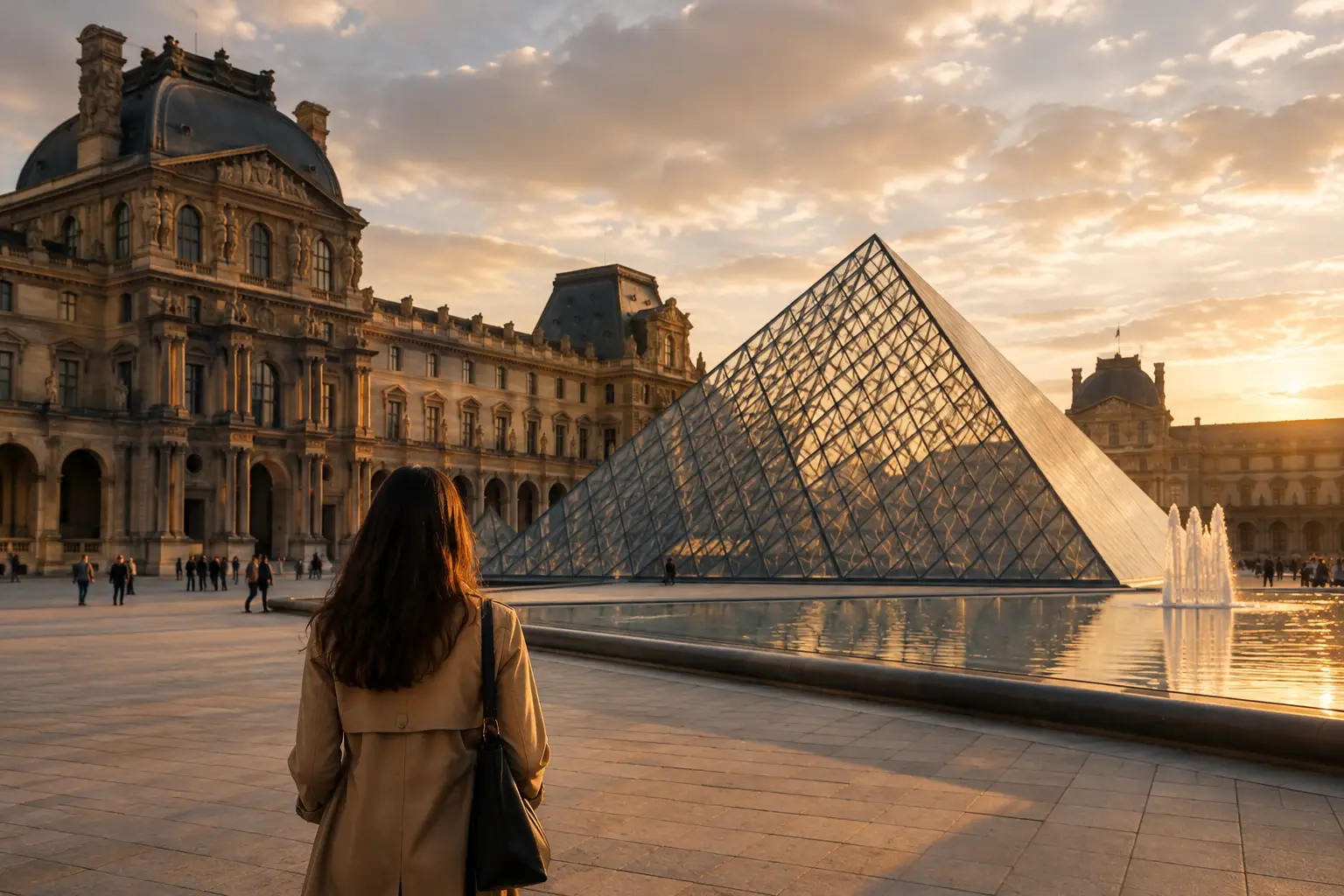
Learn how to explore Louvre independently with a clear route, quieter rooms, practical timing, and free context for the art you choose to see in Paris.
The Louvre is not a museum you finish. It is a former royal palace with long stone corridors, painted ceilings, staircases that split without warning, and enough art to turn a good plan into a tired afternoon. Knowing how to explore Louvre independently means choosing a small part of it on purpose, then leaving while you still notice what is in front of you.
You do not need a scheduled group tour to make sense of the place. You need timed entry arranged in advance, a route that has a reason, and enough context to recognize why a marble figure, a cracked ancient tablet, or a canvas the size of a wall matters.
Start with one question, not a checklist
The mistake is to enter with a list of famous works and treat the museum like a race. The Mona Lisa, Winged Victory of Samothrace, Venus de Milo, Liberty Leading the People, and the Raft of the Medusa are all worth seeing. But collecting them in one sweep can mean spending much of your visit following crowds through the same few rooms.
Instead, choose one question for the day. You might follow the human body in Greek sculpture, look at how power appears in French royal painting, or spend two hours with Italian portraits and religious scenes. A question gives the museum a shape. It also gives you permission to pass rooms that do not fit.
For a first visit, one famous work can be a useful anchor rather than the whole destination. See the Mona Lisa if you want to see it, but do not expect a quiet encounter. The painting is small, protected, and viewed from a distance among a dense crowd. The rooms around it contain other Leonardo works and major Italian paintings that often reward more attention.
How to explore the Louvre independently by wing
The Louvre is broadly divided into the Denon, Sully, and Richelieu wings. They meet around the central spaces, but they do not feel interchangeable. Pick a wing or two rather than trying to cover all three.
The Denon wing holds many of the works people come looking for: Italian painting, large French canvases, the Winged Victory at the top of the Daru staircase, and Liberty Leading the People. It is visually dramatic and usually busy. Choose it if this is your only Louvre visit and you want a clear encounter with the museum’s most familiar images.
The Sully wing is where the building itself becomes part of the visit. Below ground, you can see remains of the medieval Louvre fortress: heavy stone walls and the old moat, preserved beneath the palace. From there, Egyptian antiquities and Greek, Etruscan, and Roman collections offer a different rhythm - carved stone, painted coffins, small domestic objects, and statues made for temples rather than galleries.
The Richelieu wing often feels easier to breathe in. Its French sculpture courts sit under glass roofs, and the apartments of Napoleon III show a dense world of gilt, red fabric, chandeliers, and ceremonial rooms. This is a strong choice if you have already seen the headline paintings, or if you want to understand the Louvre as a palace before it became a museum.
A practical first route is simple: enter, go directly to the work you care about most, then move away from it. From the Winged Victory, for example, continue into nearby Italian galleries rather than returning immediately to the central hall. From the medieval Louvre, continue through Sully’s antiquities. You lose less time retracing your steps and avoid making every decision at a crowded intersection.
Give yourself a realistic amount of museum time
Two to three hours is enough for a focused first visit. Four hours works if you take a break and have a narrow route. More than that can work for a serious art lover, but only if you accept that concentration fades. A museum visit is not improved by seeing the final rooms while hungry and unable to remember the first ones.
Arrive with your entrance time, security procedures, and the museum’s current access information checked on the official Louvre channels. These details change, and the entrance you expect to use may not always be the most practical one. Once inside, take a paper map if available, even if you use your phone. Large interior spaces are one of the few places where a folded map can be faster than a blue dot that struggles to place you.
Plan one pause. The Louvre has cafés and places to sit, but benches near celebrated works fill quickly. A quieter gallery can be the better rest stop. Sit for five minutes in front of something you did not plan to see. The museum becomes less like a task and more like a place.
Use audio selectively, not continuously
An audio guide can give a painting its missing weather: the politics around a coronation scene, the long journey of an Egyptian object, the scandal of a painting shown to the public. But listening to every track turns a self-guided visit into a queue of instructions.
Choose audio for the works that stop you, not for every object in the room. Read the wall label first. Look for a moment. Then listen or read further if the work still holds your attention. That order matters. It lets your own eyes lead.
The Louvre’s own guide is available for €6 in nine languages, which can be worthwhile if you want museum-specific commentary and prefer a device supplied on site. It is less useful if you already have notes or audio on your phone, if your visit is short, or if you only want context for a handful of works.
For broader historical orientation, Lokali offers free written and audio guides on a phone, including offline downloads and more than 50 languages. Use it before entering or between galleries to build the story around what you are seeing. It cannot replace a curator answering your detailed question about a particular object, but it can keep your visit independent and at your own pace.
A human guide is worth considering in a different situation: when you have a specialist interest, little time, or a family group that needs someone to hold attention together. A knowledgeable person can connect objects across rooms and adjust to your questions. For a solo visit where you want to linger, skip, and change direction, independent exploration is usually the better fit.
Let the palace tell part of the story
Do not look only at framed paintings. The Louvre began as a fortress, became a royal residence, and later became a public museum. Those layers are visible in the medieval foundations, the grand staircases, the sculpted façades seen through windows, and the former state apartments.
This changes the scale of the visit. The Venus de Milo is not merely an isolated ancient statue. It stands in a palace that once displayed royal power, in a museum shaped by French collecting, conquest, scholarship, and public display. You do not need to memorize every date to feel the tension between the object and the building around it.
If the crowds around the main route become tiring, change your subject rather than forcing your way onward. Visit decorative arts, Islamic art, or the sculpture courts. These collections are not consolation prizes. They show how people lived with objects: how they drank, dressed, furnished rooms, prayed, traded, and showed status.
Leave space for one unscripted room
The Louvre rewards a little disobedience. Put away the list near the end and turn into a gallery because the light looks different, because a room is nearly empty, or because one painting has an unusually strange face in it. You may remember that work more clearly than the image you came to prove you had seen.
Before you leave, make a note of three things: one work you loved, one question you still have, and one wing you did not reach. That unfinished feeling is useful. It gives your next visit a beginning, rather than asking one afternoon to contain an entire palace.