How to Hear Colosseum History Without a Tour
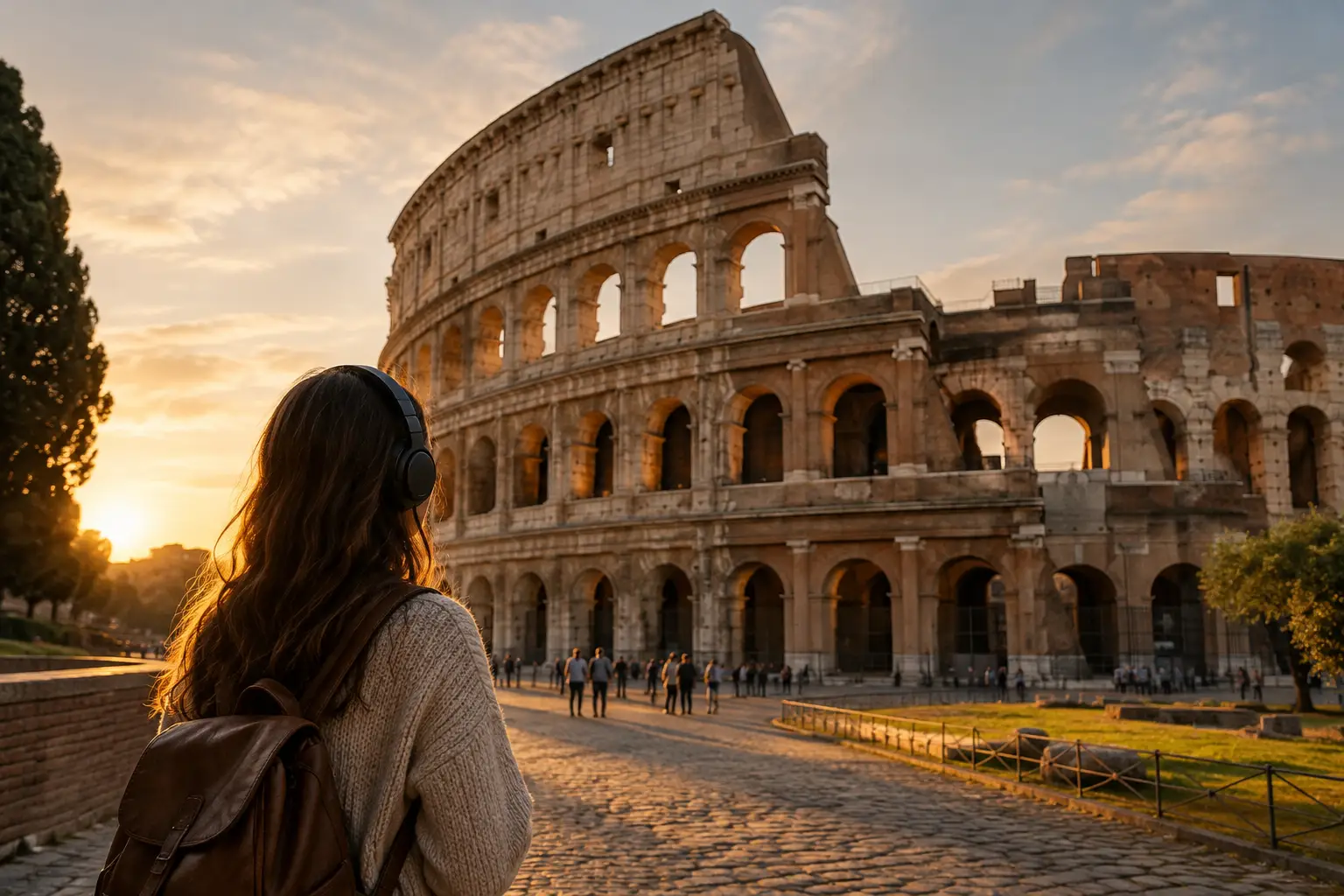
Learn how to hear Colosseum history at your own pace, using free audio, a map, and clear context for the arena, crowds, and ruins for your Rome visit.
At the Colosseum, the hard part is not finding history. It is hearing it through the school groups, the photo stops, and the bare stone. If you want to know how to hear Colosseum history, give yourself a story before you enter: where the crowd sat, what happened below the floor, and why this enormous arena became a ruin.
A scheduled tour can supply that story, but it also sets your speed. A rented on-site audio guide can be useful, though it often gives you another device to carry and another queue to join. Your phone, headphones, and a little preparation let you stop where the view is strongest, replay one detail, or ignore a section that does not interest you.
Start with the building, not the spectacle
From outside, stand far enough back to see the three visible levels of arches. The Colosseum is not a single wall. It is a carefully organized machine for moving a very large public in and out of an event. Its outer stone shell once held numbered entrances, stairways, corridors, and seating routes that separated people by rank.
The building opened in the first century CE, under the Flavian emperors. Its formal name, the Flavian Amphitheater, matters because it shifts the focus away from a vague image of "ancient Rome." This was a new political project. Rome’s rulers gave the city an arena on a vast scale, where public entertainment also displayed imperial wealth, military reach, and control.
Listen for the practical details. The word vomitorium does not mean a room for vomiting, despite the popular story. It means an exit passage, one of the routes that could empty spectators quickly. The crowd did not wander randomly through the arches. It was sorted, directed, and watched.
Choose audio that follows your position
The Colosseum makes more sense when the audio matches what is in front of you. A long general lecture while you stand in a crowded passage can feel like homework. Short sections tied to the exterior, the seating, the arena, and the underground spaces are easier to hold in your mind.
Before you arrive, save an audio guide and a map for offline use. Signal can be uneven inside thick stone walls, and stopping to search for a new track breaks the scene. If you use Lokali, its free landmark guides can be listened to or read on a phone, with offline downloads available in more than 50 languages. Reading can be the better choice when the corridors are loud or you share one pair of headphones.
Keep one ear free near stairs and narrow routes. The site is busy, and the most effective audio guide is useless if you are concentrating on avoiding the next moving group. Use a single earbud, low volume, or pause often.
Outside: hear the arrival
Begin outside the monument rather than pressing play after you have already crossed the entrance. Imagine the approach in imperial Rome, when the arches were faced with pale stone and the arena rose beside the crowded center of the city. The nearby Arch of Constantine belongs to a later period, but it helps show how this area remained a stage for imperial display.
Look at the entrances. A story about gladiators is more memorable once you understand that thousands of spectators passed through these openings, each pushed toward a particular section. The Colosseum was loud before any contest began: sandals on stone, vendors, shouted greetings, officials, animals, and the dense sound of people finding seats.
In the seating tiers: hear the social order
When you reach a point overlooking the arena, do not look only downward. Look up at the curve of seats and across to the people on the other side. The arena placed Romans in a shared public space, but not as equals. The most prestigious seats were closest to the action. Other groups sat higher, farther away, and with less comfort.
This is where a human guide can be worth paying for if you want to ask detailed questions about Roman daily life, politics, or the evidence behind a reconstruction. A good guide can respond to what you notice and change the route for a child, a history student, or someone with limited time. Recorded audio cannot do that.
But an independent visit has its own advantage. You can stay with one idea. Pause at a seat, picture the sightline to the arena, and consider how clearly rank was made visible. The building does not just contain Roman society. It arranges it in stone.
At the arena: hear what is missing
The arena floor is central to the story, but much of what you see now is absence. The wooden floor that once covered the central space is gone in most views. Beneath it, exposed walls and corridors reveal the hypogeum, the underground network added after the arena’s earliest years.
Here, lifts, ramps, cages, equipment, workers, performers, and animals could be prepared out of sight. A trapdoor opening in the floor changed the scene above in seconds. That concealed labor is one of the most useful ways to understand the Colosseum. The public watched a show designed to look immediate. Behind it stood planning, engineering, and many people whose names were not recorded.
Avoid audio that treats every event as a simple story of violence. Gladiatorial combat, animal hunts, executions, ceremonies, and staged displays did take place here, but their meanings changed across centuries. The arena was entertainment, punishment, religious ritual, political theater, and business at once. The uncomfortable parts should not be softened, yet the building becomes less interesting if they are the only parts you hear.
Let the ruins tell the later story
The Colosseum did not freeze when the last spectacles ended. Earthquakes damaged it. Valuable materials were removed or reused. Parts of the structure served later purposes, and generations of Romans lived around a changing monument rather than a protected museum object.
That is why the missing outer wall matters. It is not simply damage to be regretted. It shows that ancient buildings had afterlives. Stone could become a quarry; an arena could become a landmark; a ruin could become an emblem of Rome. If your audio guide jumps straight from emperors to modern visitors, it misses a large part of the building’s life.
Spend a few minutes looking at repairs, uneven surfaces, and breaks in the structure. They make the Colosseum more legible than a perfect digital reconstruction. A ruin lets you see several centuries at the same time.
Build in silence between tracks
Do not try to fill every minute with narration. The Colosseum is one of the places where silence is useful. After a section on the crowd, stop and watch people arrive through the passages. After a section on the underground system, look across the exposed channels without audio. Your own observations give the facts somewhere to land.
A practical rhythm is simple: listen for three or four minutes, put the phone away, then move to the next viewpoint. If a track names an architectural feature, find it before continuing. If it describes the arena at full capacity, look at the curve of seats until you can picture the scale.
Save the detailed Roman history for later if you are tired. You can read about emperors and dates from a café table or on the walk toward the Forum. At the monument, use audio for what only this place can explain: the height of the walls, the steepness of the seating, the strange exposed machinery beneath the arena.
Know when not to use a guide
A full audio tour is not always worth it. If you have only a short visit, choose two questions: how the crowd moved, and what lay below the arena floor. Those ideas give you enough structure to read the building without turning your visit into a race through tracks.
Skip generic recordings that could describe any Roman ruin. The useful details are physical and local: the numbered entrances, the hierarchy of seats, the vanished floor, the underground corridors, and the long centuries after the games. If the narration does not help you see one of these things, pause it.
Leave the Colosseum with one image rather than twenty facts: an ordinary Roman climbing a numbered stairway toward a seat, while below the wooden floor a hidden crew prepares the next sudden appearance. That gap between what the crowd sees and what the building conceals is still there, waiting in the stone.