Istanbul Historical Walking Route for One Day
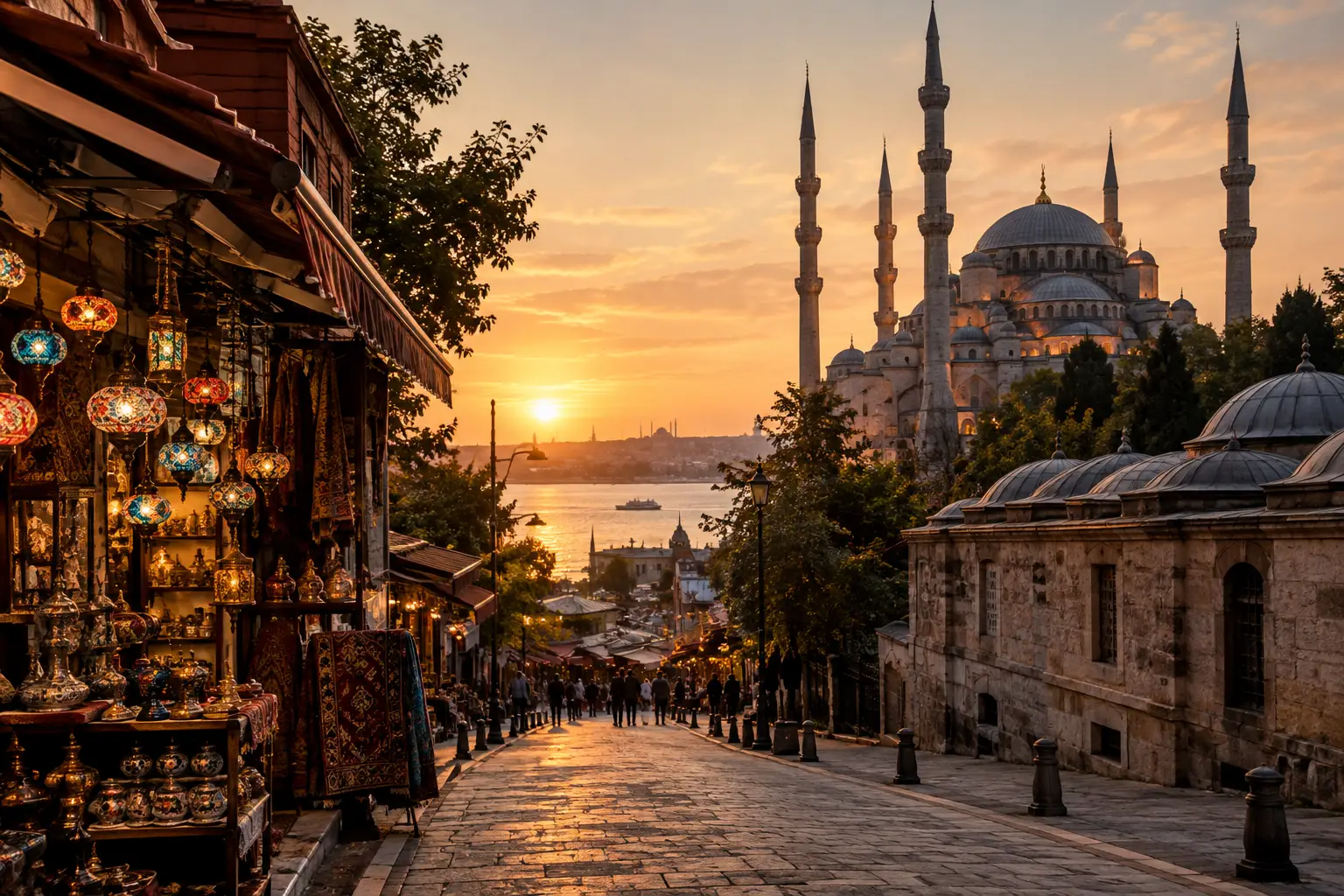
Follow an Istanbul historical walking route from Sultanahmet to Eminönü, with Byzantine stones, Ottoman courtyards, ferry views, and room to pause often.
The stones between Sultanahmet and Eminönü hold more than a thousand years of arrivals, ceremonies, fires, markets, and arguments. This Istanbul historical walking route follows that short, dense stretch on foot, beginning where emperors raced chariots and ending beside ferries crossing the Golden Horn. It is about 4 kilometers without museum detours, but it can easily fill a day.
Start in the morning if you can. The route is not difficult, but Istanbul’s historic peninsula asks for attention: sloping streets, uneven paving, crowds around major landmarks, and many reasons to stop.
An Istanbul historical walking route through old Constantinople
Begin at the Hippodrome
Start at Sultanahmet Square, on the long open space that was once the Hippodrome of Constantinople. It does not look like a stadium now. The racing track lies buried beneath the modern ground level, but its shape still controls the square. Stand along its central line and imagine tiers of spectators rising on both sides, with chariots turning at speed around the spine of monuments.
Three objects make the old arena easier to read. The Egyptian Obelisk arrived here in late antiquity and still stands on its carved pedestal. Nearby, the Serpent Column is worn down to a rough bronze stump, but it began life in ancient Greece before being brought to Constantinople. At the southern end, the Walled Obelisk is plainer, repaired many times, and somehow more revealing for it.
This is a good place to use an audio guide rather than trying to identify every layer from a signboard. Lokali’s free guides can be saved for offline use on the mobile web or Android, useful when you want the story in your own language and do not want to rent a separate device at each entrance. Still, pause without headphones too. The scale of the square is the point.
Walk north toward the Blue Mosque. Its domes and six minarets define the skyline, but do not treat it as a photograph stop only. The mosque sits in an urban landscape shaped by older imperial buildings, narrow lanes, fountains, schools, and former palaces. If you enter, dress and behavior requirements apply, and access can change around worship. If your time is limited, seeing the exterior carefully may be enough.
Cross to Hagia Sophia and the Imperial Gate
A few minutes away, Hagia Sophia faces the square with the weight of several eras visible at once. Its huge dome, buttresses, minarets, and changing outer surfaces tell a story before you step inside. The building began as the great church of Byzantine Constantinople and later became one of the defining monuments of Ottoman Istanbul.
This is where a rushed route can become frustrating. Interior arrangements, visitor circulation, and access rules change more often than the architecture does. Check the situation locally before building your day around a long interior visit. If you do go in, give it proper time. If you do not, walk around the outside toward the eastern garden and look back at the dome from different angles.
Between Hagia Sophia and the next major stop lies the old imperial center. You are walking over the ground of the Great Palace, although little of its enormous footprint is obvious from street level. That absence is part of Istanbul’s character. A coffee shop, tram line, or hotel terrace may sit above an older city that has not disappeared so much as gone underground.
Go below the city at the Basilica Cistern
The Basilica Cistern is one of the route’s strongest contrasts: daylight, traffic, then cool darkness and rows of columns standing in shallow water. It was part of Constantinople’s water system, built to store water for the city. The space feels theatrical because it is theatrical, with reflected lights and carefully framed columns, but its original purpose was practical infrastructure.
Do not force this stop if there is a long line and you have only one day. The cistern is memorable, but the historic peninsula still makes sense without it. On a rainy afternoon or during the hottest part of the day, however, it is a sensible place to spend time.
From here, take the gentle downhill streets toward Gülhane. You can pass the entrance area of Topkapı Palace, the Ottoman court’s principal residence for centuries. The palace deserves several hours if you want its kitchens, courtyards, collections, and views over the Bosphorus. It does not fit neatly into a quick walking route.
Choose based on what you want from the day. Go inside if court life, objects, and palace architecture matter more to you than covering ground. Keep walking if you prefer the city itself: streets, public buildings, ferry noise, and changing neighborhoods.
From palace walls to Eminönü
Walk through Gülhane Park or along its edge toward Sirkeci. The park once formed part of the outer grounds of Topkapı Palace. Today, its trees offer a brief break from stone and traffic, and its paths point downhill toward the water.
At Sirkeci, notice how the mood changes. Sultanahmet is built around monuments and large ceremonial spaces. Sirkeci is about movement. Trams slide through, commuters cross intersections, and the railway history of the district lingers in the old station building. This was the Istanbul end of the Orient Express, a useful reminder that the city’s role as a meeting point did not end with empire.
Continue west toward Eminönü, following the flow of people rather than searching for a perfect quiet street. The New Mosque appears ahead near the water, its domes stacked above the market streets. Despite its name, it is not new in any ordinary sense. It belongs to the Ottoman city of the seventeenth century and was built beside one of Istanbul’s busiest commercial areas.
The Spice Bazaar sits nearby. Its covered passages smell of coffee, dried fruit, soap, pepper, and sweets, though some stalls are more about souvenirs than food. Walk through it if you enjoy markets, but do not assume every purchase is a discovery. Compare goods, take your time, and leave if the pressure to buy makes the place less enjoyable.
Outside, the air changes again. You smell the water, grilled fish, diesel, and roasted chestnuts. Ferries move between the docks, and the Galata Bridge carries a steady stream above the Golden Horn. Sit near the waterfront for a while instead of immediately adding another attraction. This is the point at which the route becomes less about monuments and more about Istanbul as a working city.
Extend the walk only if your feet agree
If you still have energy, cross the Galata Bridge on foot. The view back toward the historic peninsula gives you a clear reading of the day’s route: mosque domes, palace trees, crowded streets, and the water that has always organized the city. The uphill streets beyond the bridge lead into Galata, but that is better treated as a second walk than an obligation.
You can also take a ferry without turning it into a project. A short crossing gives you the skyline from the water and a few quiet minutes among commuters, tea glasses, gulls, and open air. The exact destination matters less than the pause.
This route works because it does not try to collect every famous building. Walk slowly enough to notice a Roman column reused in an Ottoman wall, the call of a ferry horn below a museum garden, and the sudden drop of a lane toward the sea. Istanbul rewards the moments between its landmarks, especially when you leave enough time to stand still.