Pompeii Audio Guide Free: A Smarter Walk
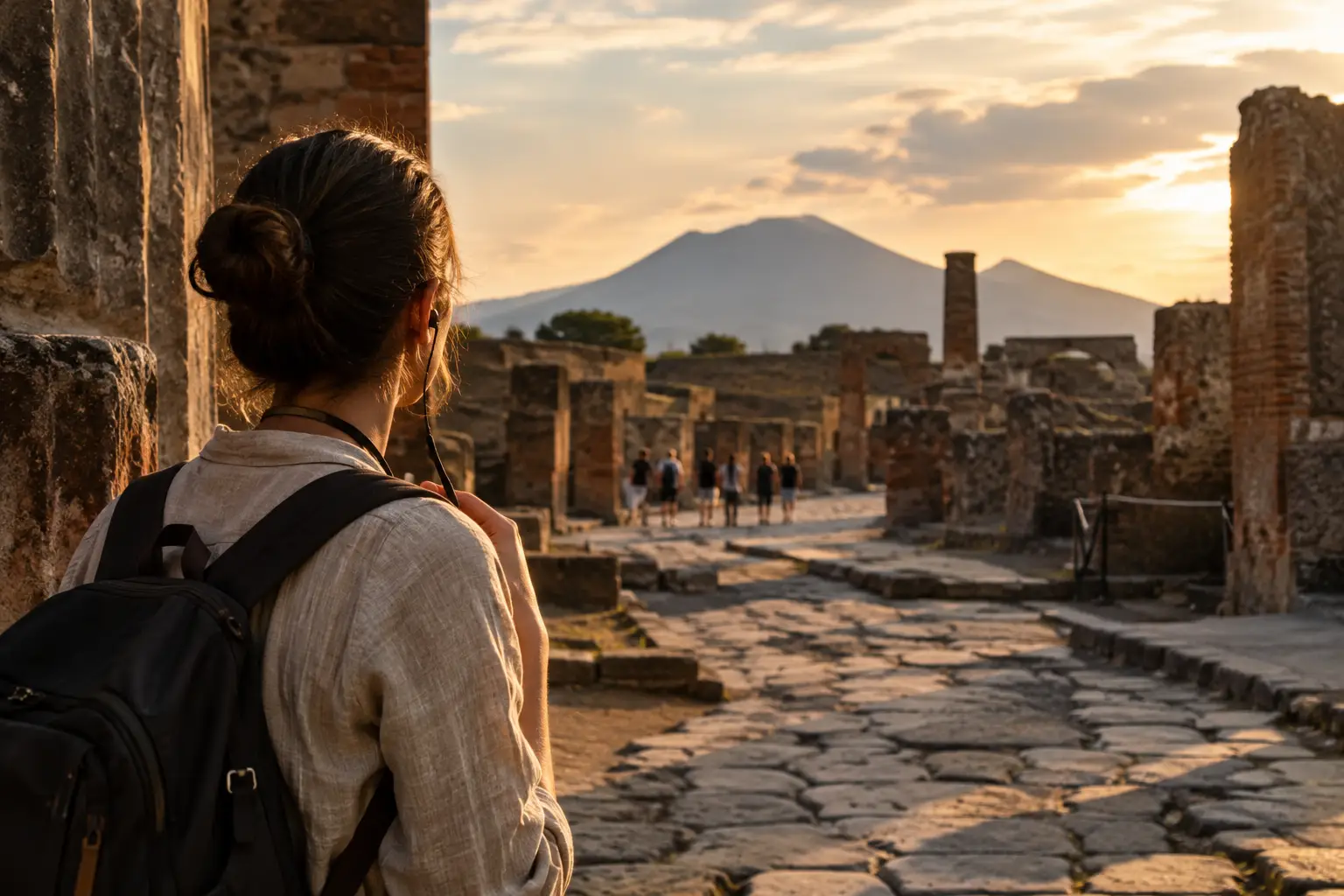
Find a Pompeii audio guide free of charge, plan a smarter route through the ruins, and know when a paid guide is worth your time among ancient streets.
You can find a Pompeii audio guide free of charge and walk at your own speed, without joining a group at the entrance or paying again for commentary after buying admission. The useful question is not simply whether the guide is free. It is whether it helps you make sense of a city whose streets, shops, houses, and public buildings can blur together under a hot Campanian sky.
Pompeii is unusually good for self-guided listening. Much of its power comes from moving through real spaces: the stepping stones in the street, the ruts cut by carts, a bakery oven blackened by use, a painted bedroom opening onto a small garden. A good guide gives these details a human order. It tells you what happened here, what you are looking at, and what to leave for later.
What a free Pompeii audio guide should do
A useful guide does not try to narrate every wall. Pompeii is too large for that, and trying to see everything turns the visit into a race between numbered stops. Choose one that gives you a route, clear orientation, and enough context to recognize why a place matters when you reach it.
Start with the city itself. Pompeii was not a frozen museum before the eruption of Vesuvius in AD 79. It was a working Roman town. Water ran through public fountains. Merchants sold food from street counters. Politicians painted election notices on walls. Wealthy households displayed frescoes beside servants' rooms, kitchens, and storage areas.
That contrast is the story to listen for. The grand Forum matters, but so does the narrow lane beside it. The large villas are memorable, but a small shop with jars set into its counter can explain more about an ordinary lunch than a room full of marble.
A free audio guide should also let you pause. You may spend ten minutes looking at a wall painting, or skip a famous house if a crowd is packed at the doorway. A scheduled group cannot always accommodate either choice.
Download before you reach the gate
Mobile signal can be unreliable among thick stone walls and crowds. Save the audio, map, and written text while you have dependable Wi-Fi, then keep your phone in airplane mode if you want to preserve battery. Bring wired headphones if you have them. They are easier to manage than holding a phone to your ear while checking a map.
Keep the route short at first. A walk of roughly two to three hours with six to ten meaningful stops is more useful than an ambitious plan covering every district. Pompeii rewards attention, and the heat, uneven paving, and distance between houses can make even a modest route feel longer.
If you use Lokali, its Pompeii material can be read or heard on a phone, saved for offline use, and followed at your own pace. The service is free, ad-free, and available through the mobile web and Android app in 50+ languages. But the same rule applies to any guide: download what you need before entering, not while you are standing beside the Forum trying to reconnect.
A route that gives Pompeii a shape
Begin where public life happened
Start in the Forum area. This is not just an open square for photographs. It was the civic stage of the town: a place for trade, administration, religion, and display. Stand still for a moment and look beyond the broken columns. The buildings around the square once told residents where authority sat, where goods moved, and which gods received public attention.
From here, a guide can explain the eruption without making it the only subject. Ash and pumice buried Pompeii, but the reason the site stays with you is that the burial preserved evidence of life in progress. You are not looking at an abstract Roman city. You are walking through one particular town on one particular set of streets.
Follow a street, not only a checklist
Leave the Forum by one of the main streets and notice the pavement. Raised stones helped pedestrians cross during rain and allowed carts to pass between them. Water channels, fountain basins, worn thresholds, and street shrines are easy to miss if you move only from headline monument to headline monument.
This is where audio works especially well. Listen while walking, then stop when the guide directs your attention to a detail. Reading a long paragraph in direct sun is less pleasant. But written text is valuable inside houses, where you may want to reread a description while looking closely at a painting or mosaic.
Choose one house and one everyday site
Give one substantial house time. The House of the Faun, the House of the Vettii, and other well-known residences can reveal how Roman wealth was arranged around courtyards, gardens, dining rooms, and decoration. Access to individual buildings can change because of conservation work, so do not build the entire day around one doorway being open.
Then balance it with an everyday site: a bakery, a bar counter, a laundry, or a small workshop. Pompeii becomes clearer when you see how commerce and domestic life occupied the same streets. Roman society is present in the grand rooms, but it is also present in the worn floor beside an oven.
End in the theater district or at the baths
The theaters and baths give a different scale to the city. They show organized public leisure rather than private display. At the theater, imagine the noise of a crowd before a performance rather than treating the stone seating as a ruin to be ticked off. At the baths, look for the sequence of rooms and think about the practical machinery behind the pleasure: water, heat, attendants, and routine.
If your energy is fading, this is a better moment to stop than to force a final hour of distracted walking. Pompeii does not become more meaningful because you cover every meter.
What free audio cannot replace
A free guide is strongest when you want independence, language choice, and a flexible route. It is less useful if you have one short visit and want someone to answer questions in the moment. A skilled human guide can adjust to your interests, explain a newly opened building, point out a faint inscription, or connect several small details before you have noticed they belong together.
A paid on-site audio rental can also be worth considering if its content is closely tied to a temporary exhibition or a section you care about deeply. Check whether the guide covers the places you actually plan to enter. Paying for a device that repeats basic facts while you follow your own phone map is usually not worth it.
There is another limit: audio cannot tell you whether a house ahead is temporarily inaccessible, whether a route is unusually crowded, or whether you have taken a wrong turn unless the map is current and you keep checking it. Use it as a companion, not as a reason to stop looking around.
Listen for the ordinary details
The most affecting parts of Pompeii are often not the plaster casts or the grandest frescoes. They are the marks of repeated use: a groove at a doorway, a painted sign, a fountain at a junction where neighbors once filled containers. These details make the ancient city less distant.
Leave some silence between stops. Put the headphones away for one street. Hear shoes on basalt, voices from nearby courtyards, and the scrape of a map folding in the wind. Then start the next track when you have a place in front of you, not merely another item on a route.