A Time Machine History Travel Experience
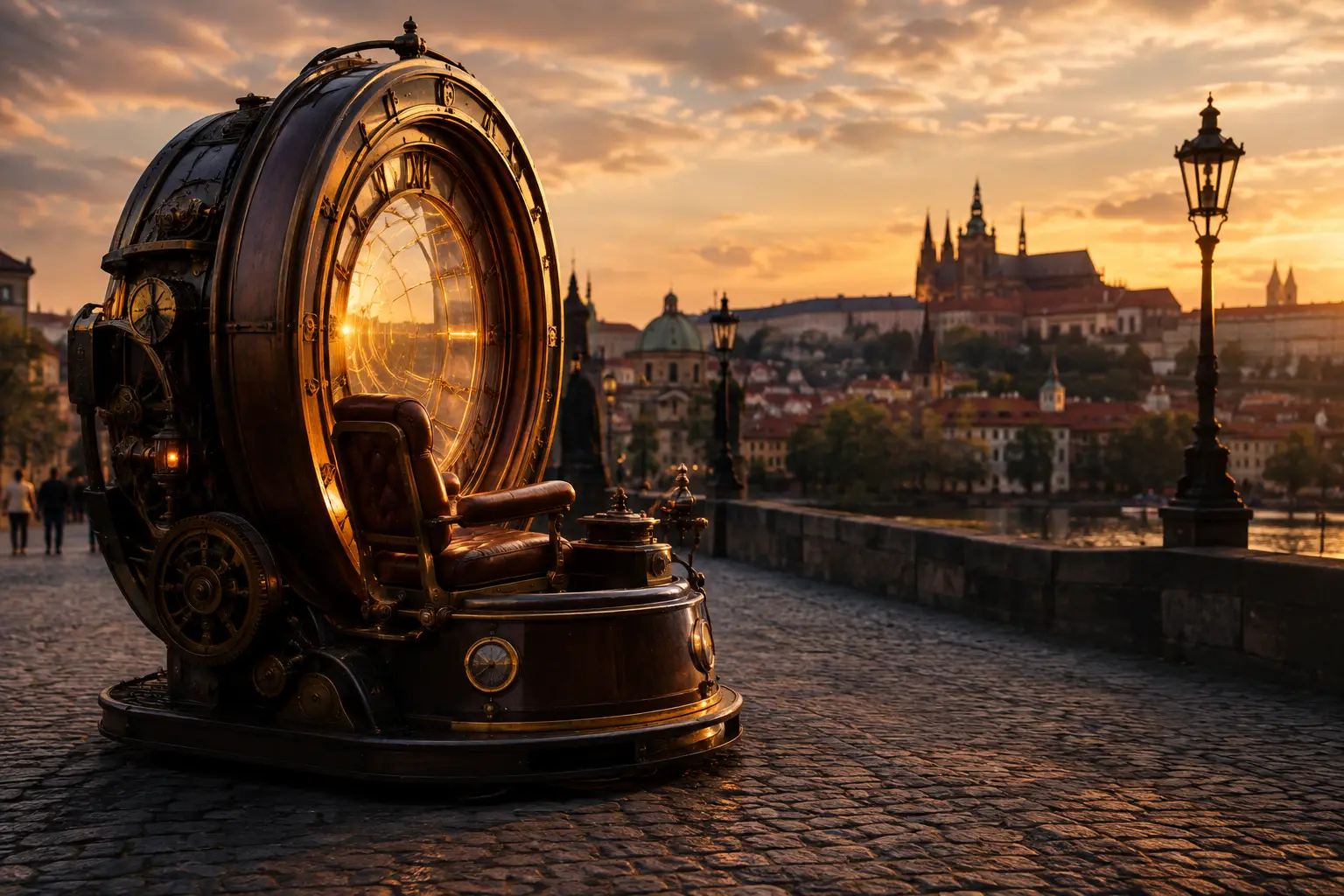
A time machine history travel experience turns monuments into scenes you can follow on foot, with context, calm pacing, and room to look around at ease.
A time machine history travel experience does not ask you to imagine a whole century from a bronze plaque. It gives you one clear moment: a crowd waiting in a square, a ruler arriving through a gate, a market closing before dark. You stand where it happened, look up from your phone, and the stones around you become evidence rather than decoration.
That shift matters when you travel independently. A monument can be beautiful and still feel distant. A historical scene gives you a reason to notice the narrow street beside it, the view from the hill, the doorway that faces the river. You are not collecting facts. You are following an event through the place that still holds its shape.
What a historical time machine scene changes
Most city guides begin with dates, names, and architectural styles. Those details have their place, but they are hard to hold onto when you are standing in bright sun, hearing traffic, and trying to find the next turn. A scene begins somewhere more useful: with pressure, people, and a decision.
Picture a city wall at dawn. Instead of hearing only that it was built in a certain century, you hear why people needed it, who approached it, and what a defender could see from the top. The wall is no longer an isolated object. It is part of a working city, with food coming through the gate, messages moving between towers, and families waiting behind it.
This is especially useful at places that have been rebuilt, restored, or crowded by later buildings. Your eyes see several periods at once. A good historical scene helps you separate them without pretending the past was neat. It tells you what belongs to the defining moment and what arrived afterward.
The result is not virtual reality. You still hear buses and other visitors. That is an advantage. The present city stays present, while the past becomes easier to locate within it.
A time machine history travel experience needs a real place
The strongest scenes begin with something you can physically find. It might be a cathedral door, the edge of an old harbor, a palace balcony, or a section of paving worn smooth by centuries of feet. You listen for a few minutes, then stop and look.
This is different from a long documentary that could play anywhere. If the story makes no use of the street in front of you, save it for the train. On location, every detail should sharpen your attention: the slope that slows an advancing crowd, the bridge that controls the crossing, the tower that watches a route into town.
A useful scene also accepts uncertainty. Some historical moments are well documented; others survive through fragments, later accounts, and archaeology. The best interpretation makes that distinction clear. You do not need false certainty to feel the force of an event.
It also depends on the site. At a compact fortress, a ten-minute scene can make the entire visit clearer. In a large museum, you may prefer several short scenes placed between rooms, so your attention does not drift from the objects in front of you. In a living neighborhood, the scene should leave space for the bakery, laundry, traffic, and ordinary life that now occupy the old setting.
Use scenes to organize a day, not fill every minute
A historical scene works best as an anchor. Listen before you enter a landmark, at the viewpoint where a city opens below you, or while sitting on a bench after the crowds thin. Then walk without audio for a while. The pause lets the place do its own work.
If you are planning a full day, choose two or three moments that explain the city from different angles. One might show its founding or expansion. Another might explain a revolt, a royal ceremony, a fire, a migration, or an artistic movement. A third can bring you into the everyday world of workshops, docks, kitchens, or religious processions.
Do not force every stop into a grand story. A fountain may simply be a good place to rest. A market street may be more interesting for its current rhythm than for its past. History becomes tiring when every doorway is treated as a turning point.
Timing matters too. A scene about public ceremony often lands better in an open square than while you are pushing through a dense crowd at midday. A story about defense makes more sense when you can see the surrounding land. If the weather turns or your energy drops, read the text later. Independence means changing the order without losing the thread.
Why audio helps, and when reading is better
Audio gives your eyes to the city. You can follow a route, watch for bicycles, and notice the carved figures over a doorway while the narration continues. It is also useful when a site has little signage in your language or when the only available on-site guide rental is expensive for a short visit.
But reading is sometimes the better choice. In a crowded gallery, you may want silence. If you are sharing the visit with someone, stopping over a paragraph can be easier than pausing a recording. Written text also lets you return to a name, date, or map point without scrubbing through audio.
Lokali combines narrated walks and written guide text with Time Machine scenes, so you can choose between listening and reading as the situation changes. Its guides cover more than 190 cities in 45 languages and can be saved for offline use, which is practical when mobile signal disappears inside thick walls or underground rooms.
Offline access is not only about signal. It helps you keep your pace. You can begin a scene at the site rather than searching for Wi-Fi, a rental desk, or a group that leaves at a fixed hour. Your phone becomes a small guidebook, not another queue.
Know when a human guide is worth paying for
A self-guided historical scene cannot answer your question in the moment. It cannot notice that you are fascinated by medieval trade, modern architecture, or royal portraits and reshape the next hour around that interest. It also cannot open a normally closed space, introduce you to a craftsperson, or manage the logistics of a complicated group.
A paid human guide can be worth it for a site with difficult access, a specialized subject, or a day when you want conversation rather than solitude. A scheduled walking tour can also be useful when you have just arrived and want quick orientation with no planning.
On the other hand, a fixed tour is often poor value if you already know the city center, want to stay longer at one painting, or dislike being moved along when a place finally becomes interesting. An on-site audio rental can explain a collection well, but it may offer only one language or one narrow route. The right choice depends on whether you need interpretation, interaction, access, or simply a story at your own speed.
Let the scene end in the present
The point of historical travel is not to make a city feel frozen. After a scene ends, look at what replaced the old world. A fortress may now frame apartment blocks. A former trading street may carry delivery scooters. A ceremonial avenue may be where schoolchildren wait for the bus.
Those changes are part of the story. They remind you that history is not trapped behind glass or inside a guidebook. Stand still for one more minute before moving on, and let the street around you complete the scene.