
Photo: Rosser1954 · CC BY-SA 4.0 · Wikimedia Commons
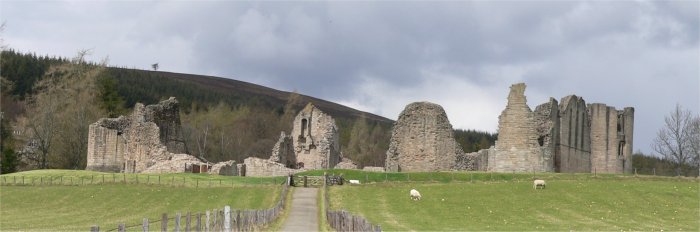
Huntly Castle is a ruined castle in Aberdeenshire, Scotland, UK. Seat of the Gordon Earls and Marquises of Huntly. The free Lokali audio guide runs 6 minutes.
✓ Published October 2026 · how we write these guides
Visitor facts
| Lokali audio guide | 6 min · free |
|---|---|
| Type | Castle |
| Location | Aberdeenshire, United Kingdom |
| Coordinates | 57.4549, -2.7812 |
| Official website | historicenvironment.scot |
| Languages | 50+, in the Lokali app |
The story
Listen first. Somewhere below the trees, water is moving over stones. Two rivers meet here, the Deveron and the Bogie, and their sound follows you across the grass. Ahead of you, a long wall of pale, weathered stone rises out of the lawn. High windows stand open to the sky. There is no roof, no glass, no fire in the hearths. Yet the building still holds its shape, as if the family only left this morning.
This is Huntly Castle, on the edge of the small town of Huntly in Aberdeenshire. For centuries it was the home of the Gordons, one of the most powerful families in the north of Scotland. Their heads became Earls, and later Marquises, of Huntly. From here they controlled a huge stretch of land. Locals gave the Gordon chief a proud nickname: the Cock o' the North.
But the story here starts long before the Gordons. Look for a grassy mound near the ruin. That earth mound is a motte, the base of an early timber castle from the twelfth century. A motte is an artificial hill with a wooden tower on top, a style the Normans brought to Britain. At that time, this whole place had a different name. People called it Strathbogie, after the valley of the River Bogie.
Here is a detail many visitors miss. In the early fourteenth century, Robert the Bruce came to this spot. He was fighting to win the Scottish crown, and he was seriously ill. Tradition says he rested at the castle at Strathbogie before fighting nearby. Later, the family who held the castle turned against Bruce. They lost their lands, and Bruce gave them to a loyal supporter, Sir Adam Gordon. That gift began the long Gordon story here.
Over time, the Gordons built in stone. In the fifteenth century they changed the name of the place from Strathbogie to Huntly. The name came from their older lands in the south of Scotland, near the border with England. So this northern castle carries a southern name. The family grew richer and stronger with each generation. And each generation tried to make the castle grander than the last.
That ambition came at a price. In 1562, the fourth Earl clashed with the forces of Mary, Queen of Scots, at the Battle of Corrichie. He lost, and he died on the battlefield. Later, in the 1590s, another Earl was in open conflict with King James the Sixth. The king's men damaged the castle badly as a punishment. Huntly Castle has been a place of power, but also of sudden falls.
Now walk around to the long south side of the building. This is the palace block, the part of the castle where the family actually lived. Look up to the very top of the wall. You will see a line of large carved letters running along the stone. The letters spell out the names of George Gordon, the first Marquis of Huntly, and his wife, Henrietta Stewart. It is like a signature written across the building, big enough to read from the riverbank.
Just below that inscription, look for the projecting windows. They bulge out from the wall, supported on carved stone. These are oriel windows, a style the Marquis may have seen in France. Inside, they would have flooded the rooms with light. From the outside, they turned a defensive tower house into something closer to a country palace. This was the new message around 1600: the Gordons were not only warriors, they were people of taste.
Now come to the entrance in the tower, and look above the doorway. This is the carved frontispiece, and it is the second great surprise of Huntly. Panels of stone climb up the wall, one above the other. Near the bottom are the coats of arms of the Marquis and his wife. Higher up are royal arms. And near the top, there were once religious images. Historians generally describe this carving as one of the finest heraldic doorways in Britain.
Look closely at the upper panels. Some of the faces and figures are damaged, as if someone struck them away. That is exactly what happened. The Gordons were Catholic, and in the seventeenth century Scotland was split by religious war. Soldiers of the Covenanters, a strict Protestant movement, came here and defaced the religious carvings. They saw them as idols. The marks they left are still in the stone today, part of the doorway's story.
Inside, take your time. You can walk through the remains of kitchens, cellars, and grand rooms on the upper floors. Watch for large fireplaces set high in the walls, where floors have long since vanished. In the basement of the old tower, there is a small, dark prison. Look carefully at the walls there. Over the years, people scratched marks and drawings into the stone. Some may come from prisoners. It is a quiet, human detail in a building made for display.
After the seventeenth century, the Gordons moved to newer, more comfortable houses. The castle slowly fell out of use, and some of its stone was taken for other buildings. Today it is cared for by Historic Environment Scotland. Outside the walls, the parkland, the trees, and the rivers all shape the experience. If you walk back toward the town, you follow an old avenue. It once linked the castle directly to the heart of Huntly.
Before you leave, stand back on the grass and look at the whole south front again. Find the carved letters along the top, then the oriel windows, then the old motte behind you. Three different ages sit in one view: the timber castle, the warrior tower, the proud palace. Listen again for the two rivers meeting below the trees. The family is long gone, but their names are still written in the stone, waiting for the next person to look up.
Key facts
What to look for
Practical tips
Common questions
Is there a free audio guide to Huntly Castle?
Yes — the Lokali app narrates Huntly Castle free of charge in 50+ languages. The guide runs about 6 minutes, covers the history, what to look for on site and practical tips, and works offline once downloaded.
Where is Huntly Castle?
Huntly Castle is in Aberdeenshire, United Kingdom, at 57.4549, -2.7812. Tap the map link on this page for directions from where you are.
What is Huntly Castle known for?
Seat of the Gordon Earls and Marquises of Huntly. Originally called Strathbogie, after the River Bogie valley.
What should you look for at Huntly Castle?
Large carved letters naming the Marquis and Henrietta Stewart. Projecting oriel windows high on the south wall. Carved heraldic panels stacked above the tower doorway.
What should you know before visiting Huntly Castle?
Walk the full south front before going inside. Bring binoculars for the high carvings and inscription.
On the map
Opens directions to Huntly Castle from your location.
More to see in Aberdeenshire



Hear Huntly Castle in your language
The full story, narrated, in 50+ languages. Download it before you go and it plays offline, at your own pace, with no ticket and no tour group.