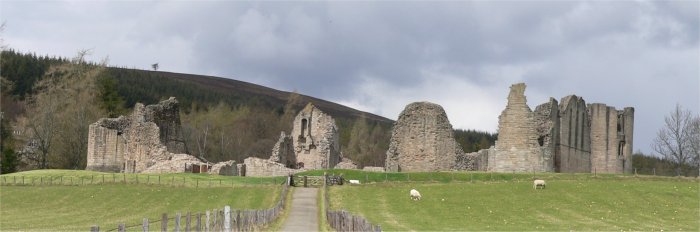
Photo: Van de Beek · CC BY-SA 3.0 · Wikimedia Commons
Kildrummy Castle is a former castle in Aberdeenshire, Scotland, UK. Built in the thirteenth century on a shield-shaped plan. The free Lokali audio guide runs 6 minutes.
✓ Published October 2026 · how we write these guides
Visitor facts
| Lokali audio guide | 6 min · free |
|---|---|
| Type | Castle |
| Location | Aberdeenshire, United Kingdom |
| Coordinates | 57.2348, -2.9046 |
| Official website | historicenvironment.scot |
| Languages | 50+, in the Lokali app |
The story
Listen first. Wind moves through the grass along the old ditch, and somewhere below, water runs over stones. Underfoot the turf is soft, and the pinkish-grey stone of the walls feels rough and cold. Kildrummy Castle sits on a low ridge above a small burn in Strathdon, the valley of the River Don, in the hills of Aberdeenshire. It is a ruin now. But walk slowly, because this ruin once held a royal family, a famous betrayal, and the plans for a rebellion.
Stand back for a moment and look at the shape of the place. The castle is laid out like a shield, or a capital letter D. One long, flat side faces the steep ravine. The curved side faces open ground, where an attacker would most likely come. Round towers once stood along that curve, joined by high curtain walls. This plan belongs to the thirteenth century, when castle builders in Scotland began to think less about one great keep and more about strong walls with towers.
Who built it? That question has no simple answer. Tradition links the early work to the family of the Earls of Mar, the great lords of this district, and some accounts credit a churchman of the powerful Moray family. Historians still debate the details. What is clear is that Kildrummy became the chief stronghold of the earldom of Mar. For centuries, power in this part of northeast Scotland ran through these walls.
Now look for the largest tower, on the far side of the courtyard. It was called the Snow Tower, and it was the great round donjon, the last refuge if the rest of the castle fell. Today only its lower parts remain, but you can still read its size from the curve of the foundations. Imagine it rising several storeys above you, the tallest thing for miles in this quiet valley.
Here is the first surprise. The gatehouse, with its twin towers flanking the entrance, looks strikingly similar to gatehouses in Wales built for the English king Edward the First. Many historians believe Kildrummy's gatehouse was rebuilt or strengthened while English forces controlled the castle around 1300. So the entrance you walk through may carry the fingerprints of an English king who spent years trying to conquer Scotland.
That struggle reached Kildrummy in 1306. Robert the Bruce had just been crowned King of Scots, and almost at once he was defeated in battle. He sent his queen, his daughter, and other women of his family north for safety, and Kildrummy was one of their shelters. His younger brother Nigel Bruce stayed behind to hold the castle. An English army soon arrived and laid siege to these walls.
The defences held. What broke them, according to the story, came from inside. A blacksmith in the garrison, often named as Osbourne, is said to have been promised gold by the English. He set fire to the grain store, and the flames forced the defenders to surrender. Legend adds a grim ending: the English gave him his gold, melted and poured down his throat. Treat that last part as folklore. The fire and the fall, however, are part of the historical record.
The cost was terrible. Nigel Bruce was taken south and executed. The royal women had already left, but they were captured further north and spent years as prisoners of the English. For Robert the Bruce, the loss of Kildrummy was one of the darkest moments of his life. Yet he survived, fought on, and in 1314 won his great victory at Bannockburn.
Here is the second surprise. Kildrummy's most heroic defender was a woman. In 1335, during a new war, Bruce's sister Christian Bruce held the castle against forces loyal to Edward Balliol, a rival claimant to the Scottish crown. She did not surrender. A relief army came to help her, and the campaign ended in the Battle of Culblean, a Scottish victory in the hills not far from here. Few visitors know her name, but these walls remember her stand.
Now walk to the east side of the courtyard and find the chapel. Look at the gable end, where three tall, narrow windows stand side by side. These pointed openings are called lancets, a style of medieval church window shaped like the tip of a spear. Notice something odd: the chapel pushes out through the line of the curtain wall. Builders rarely did this, because it weakened the defences. Faith, it seems, mattered as much as safety.
The castle's last chapter came in 1715. John Erskine, Earl of Mar, gathered supporters here to plan a rising for the exiled Stuart family, the cause known as the Jacobites. The rising failed. Afterwards the castle was abandoned, and over time much of its stone was carried away for other buildings. The ruin you see today is what remained when people stopped needing a fortress here. It is now cared for as a historic monument.
As you wander, use your hands and eyes. Run your fingers over the joints in the masonry and you may notice changes in stone and building style, signs of repair and rebuilding across different centuries. Look down into the ditch on the curved side, still deep enough to show how hard an approach once was. And from the long flat side, look into the ravine, where trees now grow thickly over slopes that once served as a natural wall.
Before you leave, stand quietly in the centre of the courtyard. Turn slowly in a full circle. The towers are low now, the halls are open to the sky, and sheep or birds may be the only sound. Above you the clouds move fast over the Don valley, as they did when Nigel Bruce watched for the English, and when Christian Bruce refused to give way. Take that wind with you as you walk back through the gate.
Key facts
What to look for
Practical tips
Common questions
Is there a free audio guide to Kildrummy Castle?
Yes — the Lokali app narrates Kildrummy Castle free of charge in 50+ languages. The guide runs about 6 minutes, covers the history, what to look for on site and practical tips, and works offline once downloaded.
Where is Kildrummy Castle?
Kildrummy Castle is in Aberdeenshire, United Kingdom, at 57.2348, -2.9046. Tap the map link on this page for directions from where you are.
What is Kildrummy Castle known for?
Built in the thirteenth century on a shield-shaped plan. Chief stronghold of the medieval Earls of Mar.
What should you look for at Kildrummy Castle?
Three narrow lancet windows in the chapel gable. Chapel wall pushing out through the curtain wall. Curved foundations of the great Snow Tower.
What should you know before visiting Kildrummy Castle?
Wear sturdy shoes for uneven turf and grassy slopes. Bring a waterproof layer for changeable Strathdon weather.
When is the best time to visit Kildrummy Castle?
Visit in early morning for quiet and soft light.
On the map
Opens directions to Kildrummy Castle from your location.
More to see in Aberdeenshire


Hear Kildrummy Castle in your language
The full story, narrated, in 50+ languages. Download it before you go and it plays offline, at your own pace, with no ticket and no tour group.