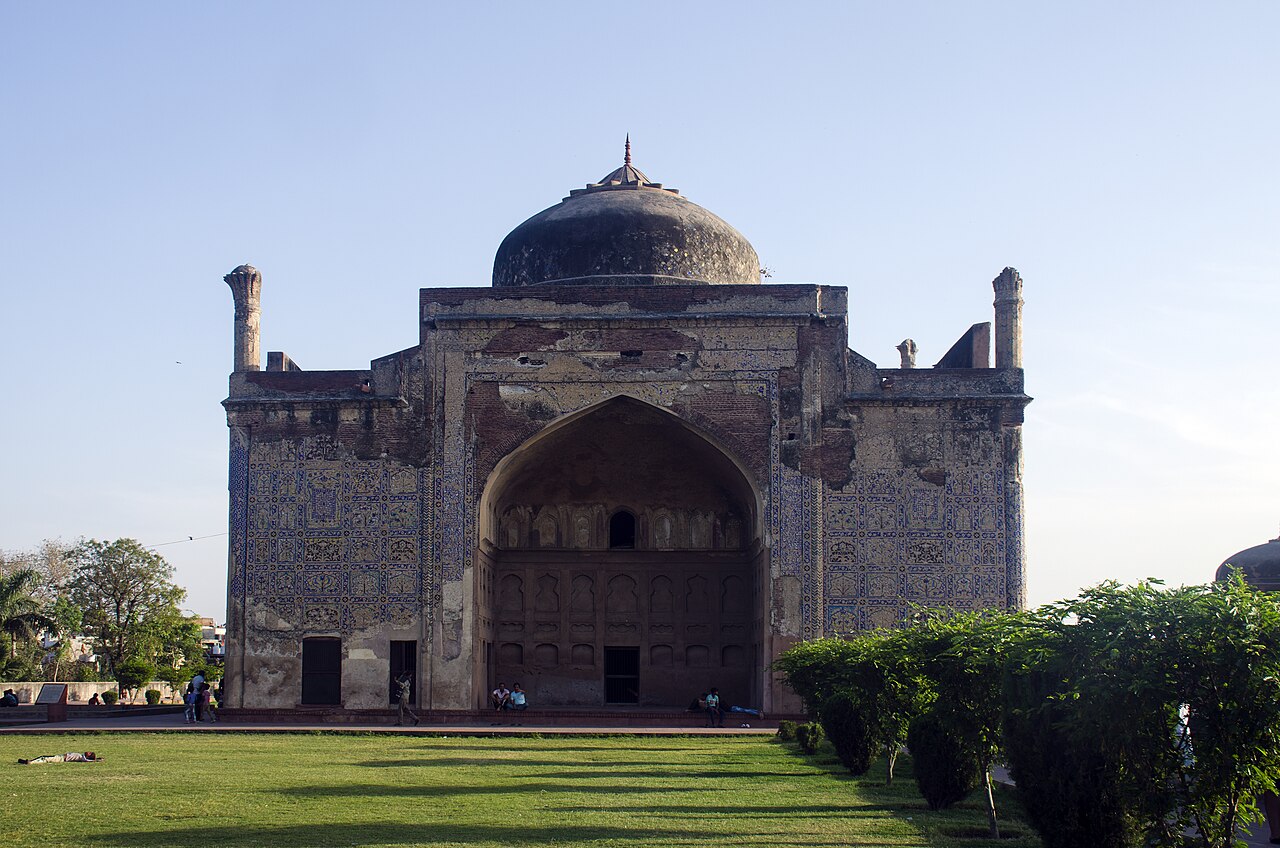
Chini Ka Rauza is a 17th-century tomb of Shah Jahan's prime minister, notable for its glazed tile work and Persian-style architecture. It is in Agra, India. Most visitors spend 30–45 min here. The free Lokali audio guide runs 6 minutes.
✓ Verified August 2026 · how we write these guides
Visitor facts
| Time needed | 30–45 min |
|---|---|
| Lokali audio guide | 6 min · free |
| Type | Mausoleum |
| Best for | Local life |
| Location | Agra, India |
| Coordinates | 27.1915, 78.0256 |
| Languages | 45, in the Lokali app |
The story
Stand on the riverbank and look at the faded blue. Once this whole front shone with color. Glazed tiles in blue, green, orange, and yellow covered the walls from base to dome. Many have fallen away now. But enough remain to show what this building once was. You are at Chini Ka Rauza, on the east bank of the Yamuna River in Agra, a little apart from the busier sights.
The name means the tomb of tiles. Chini refers to the glazed, porcelain-like tiles that gave the walls their shine. This was one of the first buildings in India to be dressed almost entirely in such tilework. The technique came from Persia and Central Asia, far to the northwest. Here, beside an Indian river, it found a new home.
The man buried here was a scholar and a poet, not a king. His name was Afzal Khan. He came from the Persian city of Shiraz, a place long known for its poets and gardens. He served as a minister in the court of the emperor Shah Jahan, the same ruler who built the Taj Mahal. The tomb was raised in the 1630s, in the years when Agra was full of builders.
Look at the surface closely where the tiles survive. Each piece was fired with its color baked into the glaze. These colors do not fade like paint on a wall. They are part of the glass itself, sealed in the heat of the kiln. Craftsmen cut and fitted the pieces by hand to form flowers, vines, and lines of flowing Persian writing across the walls.
Notice the large dome above you. Its rounded shape and tall drum follow Persian models rather than Indian ones. Many tombs in Agra turn toward local style, with wide eaves and carved brackets. This one looks back toward the lands across the mountains. It carried a memory of home for the man it honors, written in tile and curve.
Walk slowly around the whole building. The four sides are not the same, and time has worn them in different ways. On the river side, sheltered a little, you can still find patches of bright turquoise and deep blue. On the other sides, the tiles have flaked away, showing the plain brick beneath. The contrast tells the story of four hundred years of sun, rain, and river wind.
Step inside the central chamber. It is plain, cool, and dim after the glare outside. Look up into the hollow of the dome. Traces of painted plaster remain there, with patterns in blue and faded gold, worn soft by time. Sound behaves strangely in this round space. A whisper near one wall can travel along the curve and reach you on the far side.
This place sees few visitors. It does not sit on the main path that most travelers follow through the city. Because of that, it stays quiet. You may have the whole chamber to yourself for a while. Use that silence. Picture the walls when every tile was whole, and the low sun caught their color and threw it back across the water at evening.
Think about the choice this building makes. A poet from Persia died far from the city of his birth. His tomb was wrapped in the bright tiles of his homeland, as if to bring that home to him. Through the work of skilled hands, a piece of Shiraz was carried to the bank of an Indian river. The building is a kind of letter, written in color rather than words.
Look out toward the water again. The Yamuna runs close by, slow and wide. In the distance, along the same river, stand grander monuments that draw great crowds each day. This one waits apart from them. Its beauty is quieter and more fragile, held now in scattered fragments rather than in whole bright walls.
Before you go, find a single tile that still holds its full color. Study it for a moment. One small square of blue or green, fired centuries ago, still doing its quiet work in the light. Around it, the wall may be bare brick. That contrast sits at the heart of this place: loss and survival, set side by side on the same surface.
Spare a thought, too, for the people who made it. The tile-cutters, the masons, and the painters who lined the dome. We do not know most of their names. Yet their hands are everywhere here, in every fitted piece and every curving line. The poet is named and remembered. The craftsmen speak only through the work they left behind.
Leave the way you came, along the quiet path beside the river. The surviving tiles will catch the light again as you turn for a last look. What remains is enough to imagine the rest. Sometimes a worn and broken thing tells you more than a perfect one. It asks you to finish the picture in your own mind, and to carry it with you.
Key facts
What to look for
Practical tips
Common questions
How long do you need at Chini Ka Rauza?
Plan 30–45 min. That is the time most visitors spend at Chini Ka Rauza. The free Lokali audio guide adds about 6 minutes of narration you can listen to as you walk, so it fits inside your visit rather than adding to it.
Is there a free audio guide to Chini Ka Rauza?
Yes — the Lokali app narrates Chini Ka Rauza free of charge in 50+ languages. It covers the history, what to look for on site and practical tips, and it works offline once downloaded.
Where is Chini Ka Rauza?
Chini Ka Rauza is in Agra, India, at 27.1915, 78.0256. Tap the map link on this page for directions from where you are.
What should you know before visiting Chini Ka Rauza?
Combine this visit with other riverside tombs nearby.
What is Chini Ka Rauza known for?
A tomb on the east bank of the Yamuna.
What is the best time to visit Chini Ka Rauza?
The blue and turquoise tilework is best seen in afternoon light.
On the map
Opens directions to Chini Ka Rauza from your location.
Reference
More to see in Agra


Hear Chini Ka Rauza in your language
The full story, narrated, in 50+ languages. Download it before you go and it plays offline, at your own pace, with no ticket and no tour group.