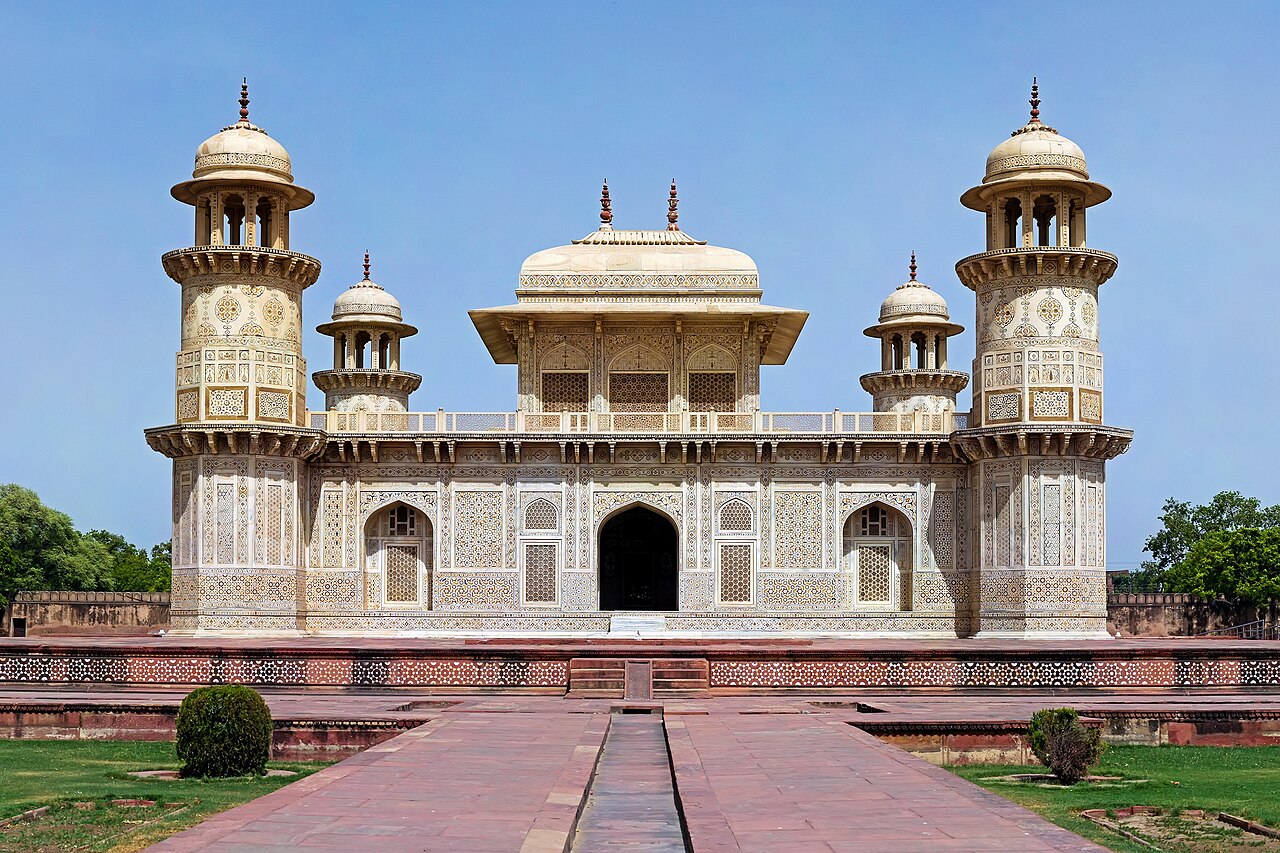
Itimad-ud-Daulah is a marble mausoleum built in the early 17th century for the father of Empress Nur Jahan. It is in Agra, India. Most visitors spend 1–1.5 hours here. The free Lokali audio guide runs 5 minutes.
✓ Verified August 2026 · how we write these guides
Visitor facts
| Time needed | 1–1.5 hours |
|---|---|
| Lokali audio guide | 5 min · free |
| Type | Mausoleum |
| Best for | History |
| Location | Agra, India |
| Coordinates | 27.1906, 78.0331 |
| Languages | 45, in the Lokali app |
The story
This tomb is small enough to take in at a single glance. It sits low and bright on the river bank, its white marble warmed by the afternoon sun. People often call it the Baby Taj, because of what came after it. Step through the red gate, and the whole building stands before you at once, like a carved jewel box set down in the middle of a quiet garden.
The full name is the tomb of Itimad-ud-Daulah. The title means pillar of the state. It belonged to a Persian nobleman named Mirza Ghiyas Beg, who came from far away and rose high in the Mughal court. He served as a minister and a trusted hand to the emperor. He was also the grandfather of the woman who would one day rest inside the Taj Mahal.
His daughter built this tomb for him. Her name was Nur Jahan, and she was the wife of the emperor Jahangir. She held real power at court, more than almost any other woman of her time. She shaped decisions, and even coins were struck in her name. When her father died, she raised this marble tomb in his memory, between 1622 and 1628.
Look closely, because this small building marks a turning point. It was among the first Mughal tombs built fully in white marble, rather than red stone. And it was among the first to be covered in inlaid colored stone, the careful craft called parchin kari. Much of what you will later see and admire at the great Taj Mahal was tried out here first, on a smaller scale.
Walk slowly around the outer walls. Almost every surface is decorated with care. You will see cypress trees, slender wine cups, vases full of flowers, and shapes drawn from old Persian art. These were cut from yellow, orange, brown, and grey stone, and then set into the white marble. From a short distance away, the busy walls look almost like fine painted cloth.
Notice the four short towers, one at each corner of the building. They are round and capped with small domed roofs. They are not as tall or as grand as the towers of the larger tombs nearby. But they give the whole building its neat and balanced shape, like a small jewel resting evenly on four steady legs.
The garden around the tomb is a charbagh, a fourfold garden split by water channels and straight stone paths. The building sits at the center of it, not at the far end as in some later tombs. Water once ran along the narrow channels toward the base. The plan stands for an ordered world, calm and divided into four equal parts.
Step into the cool inner room. The light comes through screens of marble, cut so finely that it falls in soft, shifting patterns across the floor. Inside lie the graves of Mirza Ghiyas Beg and his wife, side by side. The walls are painted and inlaid with flowers, cups, and trees, drawn close and warm around the quiet visitor.
Think about the moment this tomb belongs to. It stands between two different styles. Behind it, in time, lies the heavy red stone of the earlier Mughal years. Ahead of it lies the pure white marble of the Taj Mahal. This building is the bridge between them, the place where the great change can be seen happening in real, solid stone.
The river runs close by, along the eastern bank of the water. For long years this side of the river drew far fewer visitors than the great tomb downstream. That can be a quiet gift to you. Here you may find space and calm, and the time to look closely at the fine work, without a large crowd pressing in around you.
Like its more famous neighbors, this tomb is carefully cared for and repaired. The inlaid stones are checked and gently reset where they have loosened over the centuries. The marble is cleaned of old dust and stain. Such close and patient work keeps the delicate surface alive, so that each small flower stays sharp against the white for the next visitor.
Before you leave, look once more at the whole small building. A daughter built it for her father, in fine and loving detail. It does not try to overwhelm you at all, or to make you feel small. It asks only that you come near and look closely. Sometimes the gentlest things are the very ones that quietly teach us the most.
Key facts
What to look for
Practical tips
Common questions
How long do you need at Itimad-ud-Daulah?
Plan 1–1.5 hours. That is the time most visitors spend at Itimad-ud-Daulah. The free Lokali audio guide adds about 5 minutes of narration you can listen to as you walk, so it fits inside your visit rather than adding to it.
Is there a free audio guide to Itimad-ud-Daulah?
Yes — the Lokali app narrates Itimad-ud-Daulah free of charge in 50+ languages. It covers the history, what to look for on site and practical tips, and it works offline once downloaded.
Where is Itimad-ud-Daulah?
Itimad-ud-Daulah is in Agra, India, at 27.1906, 78.0331. Tap the map link on this page for directions from where you are.
What should you know before visiting Itimad-ud-Daulah?
Pair it with Mehtab Bagh on the same bank.
What is Itimad-ud-Daulah known for?
Built between 1622 and 1628 by Nur Jahan.
What is the best time to visit Itimad-ud-Daulah?
The pietra dura (semi-precious stone inlay) here is finer and more densely packed than at the Taj Mahal.
On the map
Opens directions to Itimad-ud-Daulah from your location.
Reference
More to see in Agra


Hear Itimad-ud-Daulah in your language
The full story, narrated, in 50+ languages. Download it before you go and it plays offline, at your own pace, with no ticket and no tour group.