
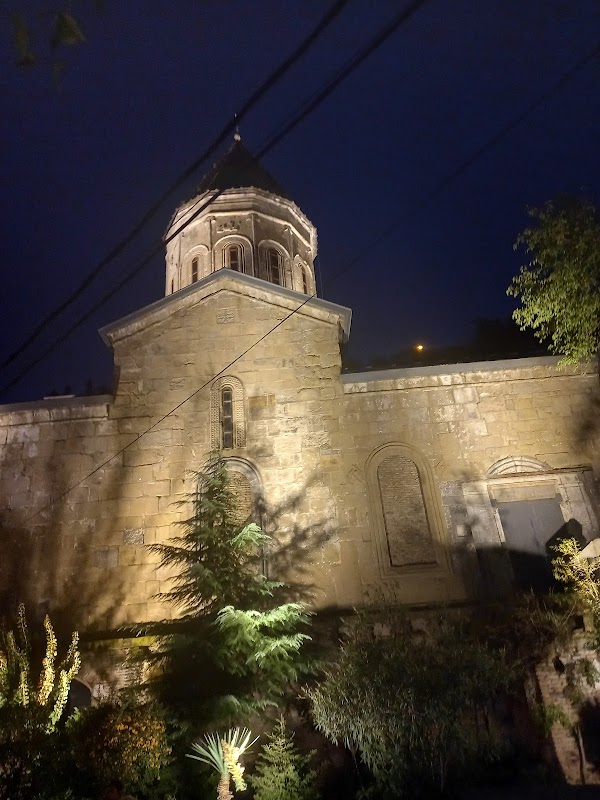
Photo: lori-m · Public domain · Wikimedia Commons
Akhtala Monastery is a cultural heritage monument of Armenia. Fortress walls are linked to the Kyurikid kings. The free Lokali audio guide runs 6 minutes.
✓ Published October 2026 · how we write these guides
Visitor facts
| Lokali audio guide | 6 min · free |
|---|---|
| Type | Monastery |
| Location | Alaverdi, Armenia |
| Coordinates | 41.1506, 44.7641 |
| Languages | 50+, in the Lokali app |
The story
Listen first. Wind moves through dry grass on the edge of a cliff. Somewhere below, a stream runs through a narrow gorge. Under your feet, the path is packed earth and old stone, worn smooth by centuries of pilgrims. Ahead, a heavy wall of grey rock rises from the ground. Behind it waits a church whose walls are covered almost entirely in colour.
You are standing at Akhtala, in the Lori region of northern Armenia, a short drive from the mining town of Alaverdi. This is not only a monastery. It is a fortress and a church together, built on a rocky promontory. Deep ravines fall away on three sides. Only one approach is easy, and that is the side you walked in on. The builders chose this spot for a reason... it was meant to be defended.
Look closely at the outer walls and towers. These defences are older than the main church. They are generally linked to the Kyurikid kings, a local Armenian dynasty that ruled this corner of the Caucasus in the tenth and eleventh centuries. The stone is rough and practical. There is little decoration here. These walls were made to stop armies, not to impress visitors. Walk along them slowly and notice how they follow the shape of the cliff edge.
The name of this place carries two stories. Akhtala is usually explained as a Turkic name, often translated as "white glade" or "white clearing". But the older Armenian name was Pghndzahank. That word means, quite simply, "copper mine". And that tells you something important. For a very long time, people came to these hills not only to pray — they came to dig. The earth here is full of metal.
Here is the first surprise. In the eighteenth century, Greek miners were brought to this region to work the copper and silver deposits. A Greek community settled around Akhtala. For them, this monastery became a place of worship. So in this one valley, you have Armenian builders, Georgian church traditions, and Greek miners, all sharing the same stone floor. Few places in the Caucasus hold so many layers in such a small space.
Now walk toward the main church. It is dedicated to the Holy Mother of God, the Virgin Mary. It was built around the turn of the thirteenth century, during the time of the Zakarian family. The Zakarians were powerful princes who served the Georgian crown and governed much of northern Armenia. From the outside, the church looks calm and balanced. Its facades are smooth, pale stone, with tall, narrow proportions that draw your eyes upward.
There is a detail here that matters for everything inside. One of the Zakarian princes, Ivane, followed the Georgian Orthodox Church rather than the Armenian Apostolic Church. The two churches share much, but they differ in doctrine and in art. Under his patronage, Akhtala followed the Georgian and Byzantine tradition. That choice explains why this church looks so different from most Armenian churches you may have visited. And it is the reason people travel here today.
Step inside, and let your eyes adjust to the dim light. This is the second surprise. Most medieval Armenian churches are bare stone inside, cool and austere. Akhtala is the opposite. Its walls, its pillars, and its apse are covered with frescoes, painted in the early thirteenth century. Deep blues, earthy reds, and soft ochres spread across almost every surface. Many art historians consider them among the finest medieval wall paintings in the whole region.
The painters worked in the Byzantine style. Byzantine art came from the Eastern Roman Empire, centred on Constantinople. It shows saints with large calm eyes, long faces, and flowing robes. Many of the inscriptions next to the figures are in Greek, and some are in Georgian. Look up into the curved apse at the eastern end. There the Virgin Mary sits enthroned, holding the Christ child. Below her, rows of figures continue down toward the altar.
Turn around and face the west wall, the wall above the entrance. Here the painters showed the Last Judgment. This was a common subject in medieval churches. It was placed so that people saw it as they left, as a reminder of what waits at the end of life. Elsewhere you can find scenes from the life of Christ and many standing saints. Take your time. The longer you look, the more faces appear from the darker corners.
You will notice that the paintings are not perfect. Some areas are faded. Some are cracked, and some are lost entirely. Centuries of candle smoke, damp, and neglect have taken their toll. In recent decades, restoration work has helped to clean and stabilise many sections. But the damage is part of the story too. These colours have survived wars, empires, and long periods when no one cared for the building at all.
Akhtala is still a living church, not only a monument. On religious feast days, especially those connected to the Virgin Mary, pilgrims gather here. Armenians, Georgians, and descendants of the old Greek community come together. Candles are lit, and the air fills with the smell of wax and incense. If you visit on a quiet day, you may only hear your own footsteps on the stone. Both experiences are worth having.
Before you leave, walk back out to the edge of the fortress. Look down into the gorge and across the hills. On the horizon you may see signs of modern mining, the same industry that gave this place its oldest name. Copper still shapes life in this valley, as it did a thousand years ago. Then turn once more toward the pale church behind you. Inside those plain walls, the saints keep watch in blue and red... just as they have for eight centuries.
Key facts
What to look for
Practical tips
Common questions
Is there a free audio guide to Akhtala Monastery?
Yes — the Lokali app narrates Akhtala Monastery free of charge in 50+ languages. The guide runs about 6 minutes, covers the history, what to look for on site and practical tips, and works offline once downloaded.
Where is Akhtala Monastery?
Akhtala Monastery is near Alaverdi, Armenia, at 41.1506, 44.7641. Tap the map link on this page for directions from where you are.
What is Akhtala Monastery known for?
Fortress walls are linked to the Kyurikid kings. Old Armenian name Pghndzahank means copper mine.
What should you look for at Akhtala Monastery?
Enthroned Virgin with Christ child in the eastern apse. Last Judgment scene on the wall above the entrance. Greek lettering painted beside the saints' faces.
What should you know before visiting Akhtala Monastery?
Pause inside so your eyes adjust to the dim light. Bring a small torch to study darker corners.
When is the best time to visit Akhtala Monastery?
Visit on a quiet weekday for unhurried viewing.
On the map
Opens directions to Akhtala Monastery from your location.
More to see in Alaverdi


Hear Akhtala Monastery in your language
The full story, narrated, in 50+ languages. Download it before you go and it plays offline, at your own pace, with no ticket and no tour group.