
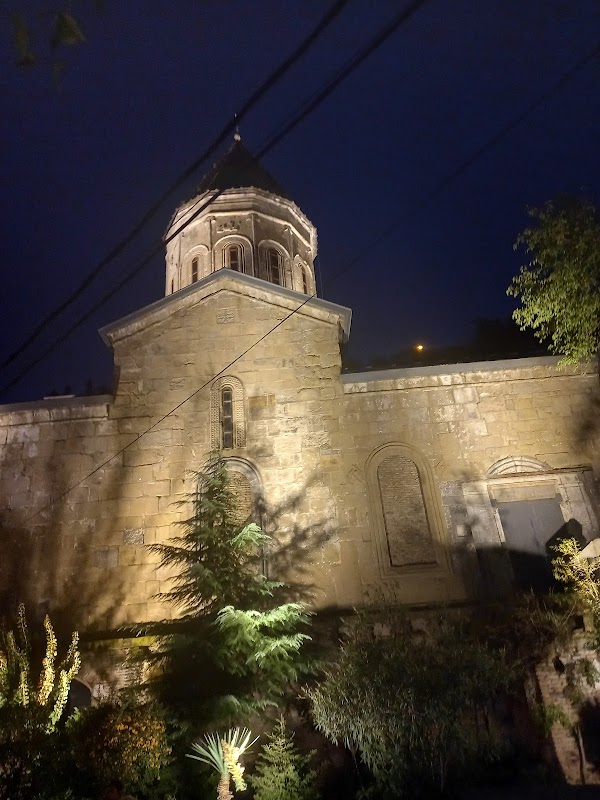
Photo: Vahag851 · CC BY-SA 3.0 · Wikimedia Commons
Sanahin Monastery is a cultural heritage monument of Armenia. Founded in the tenth century under Armenia's Bagratid kings. The free Lokali audio guide runs 8 minutes.
✓ Published October 2026 · how we write these guides
Visitor facts
| Lokali audio guide | 8 min · free |
|---|---|
| Type | Monastery |
| Location | Alaverdi, Armenia |
| Coordinates | 41.0872, 44.6661 |
| Languages | 50+, in the Lokali app |
The story
Start with the floor beneath your feet. Inside these dim halls, the stones are not all plain paving. Many are old gravestones, laid flat and worn smooth by centuries of footsteps. Some still carry faint lines of carved letters. The air is cool, even in summer, and it smells of damp stone and candle wax. Light enters in narrow shafts from openings high in the vaults. Take a moment here before you move on. Let your eyes adjust to the dark.
You are standing at Sanahin Monastery, on a high shelf of land above the Debed River canyon in northern Armenia. The industrial town of Alaverdi lies below, in the deep fold of the gorge. Up here, the setting feels very different. There are walnut trees, village houses, and quiet lanes. Cows sometimes wander past the outer walls. The monastery sits low to the ground, with dark grey basalt walls and conical stone roofs that rise above them.
Sanahin began in the tenth century, during a period when Armenia had its own kings again. The Bagratid dynasty ruled much of the country at that time. Tradition links the founding to Queen Khosrovanuysh, the wife of King Ashot the Third. Her sons later ruled this northern region as the Kiurikian line of kings. Their patronage helped the monastery grow quickly. The oldest church here, dedicated to the Holy Mother of God, dates from that early period.
Here is a story that locals like to tell. The name Sanahin is often explained as meaning something like this one is older than that one. The comparison is with Haghpat, a sister monastery on another plateau across the gorge. According to this popular explanation, Sanahin was proud to be the elder. Linguists are not fully sure that this is the true origin of the name. But it is still a good story, and the two monasteries were in fact founded close together in time.
Look at the shape of the complex from outside. It does not look like a single grand building. Instead, it is a cluster of churches, halls, and chapels pressed together, with shared walls and connecting doorways. Builders added new parts over several centuries. Each generation attached its structure to the older ones. The result feels almost like a small stone village. Moving from room to room, you pass from one century into the next through a single doorway.
The largest church is dedicated to the Holy Saviour. It was built in the second half of the tenth century. On its eastern side, look up for a carved relief of two royal figures holding a model of the church between them. They are the brothers who paid for the building, shown as donors. This kind of image was common in medieval Armenia. It shows the patrons offering the church to God, and it also displays their status to everyone who passes.
Now, a surprise that many visitors miss. Sanahin was not only a place of prayer. It was also one of the most important centres of learning in medieval Armenia. Students studied theology, philosophy, grammar, and medicine here. Manuscripts were copied and decorated with painted illustrations. The scholar Gregory Magistros, an eleventh century nobleman and writer, is closely connected with the school. One long, vaulted hall in the complex is often called the academy, where teachers and students are said to have gathered.
Walk into that academy hall if you can. It is a long, narrow corridor with a stone vault and simple niches along the walls. Tradition says the students sat in these niches during lessons. Nearby stands the library building, a square hall with a high stone roof that narrows toward an opening at the top. Manuscripts were once stored here. The design is very practical. The thick walls kept the books safe, and the central opening let in light and air.
You will also notice the large entrance halls in front of the churches. In Armenian these halls are called gavits. They served as meeting rooms, burial places, and gathering spaces for people waiting before services. Their stone columns and carved capitals show great skill. Some of the most important families of the region chose to be buried in these halls. That is why so many gravestones lie in the floor. The dead were placed close to the church, under the feet of the living.
Step outside and look for the khachkars. A khachkar is a cross-stone, a carved stone slab unique to Armenian art. Each one has a central cross, usually surrounded by very fine geometric patterns and plant shapes. No two are exactly the same. Sanahin has several fine examples standing in its grounds. Get close and follow the patterns with your eyes. The carvers worked the hard stone into lace-like knots. Many khachkars were set up as memorials or to mark a prayer.
The monastery also survived difficult times. Invading armies and earthquakes damaged the region more than once over the centuries. Parts of the complex were rebuilt and repaired. You can see this in places where the stonework changes colour or texture. In 1996, Sanahin and Haghpat were listed together by UNESCO as World Heritage. The listing recognises them as outstanding examples of Armenian religious architecture, and as places where local building traditions mixed with influences from the wider region.
Here is one more surprise, from a very different century. The village of Sanahin was the birthplace of the Mikoyan brothers. One brother, Anastas, became a senior Soviet politician. The other, Artem, co-founded the design bureau behind the MiG fighter jets. A small museum about them stands in the village, and you may see an aircraft on display there. It is a strange contrast. A medieval school of manuscripts sits only a short walk from a monument to supersonic jets.
If you have time, look down into the gorge as you leave. Alaverdi grew around copper mining and smelting, and its industrial buildings still line the valley. In the town below, a medieval stone bridge crosses the Debed River, and it is worth a visit. The contrast between the two levels is part of the experience. Below, there is the noise of the river and the road. Up here, it is quiet, apart from birds and the wind.
Before you go, stand once more by the outer walls. Put your hand on the basalt. It is rough, and it keeps the temperature of the day. Monks, students, and pilgrims walked past these same walls a thousand years ago. Some of them now lie under the floors you just crossed. As you walk back toward the village, listen to the quiet... and look back once at the stone roofs above the trees.
Key facts
What to look for
Practical tips
Common questions
Is there a free audio guide to Sanahin Monastery?
Yes — the Lokali app narrates Sanahin Monastery free of charge in 50+ languages. The guide runs about 8 minutes, covers the history, what to look for on site and practical tips, and works offline once downloaded.
Where is Sanahin Monastery?
Sanahin Monastery is near Alaverdi, Armenia, at 41.0872, 44.6661. Tap the map link on this page for directions from where you are.
What is Sanahin Monastery known for?
Founded in the tenth century under Armenia's Bagratid kings. Listed by UNESCO in 1996 together with Haghpat.
What should you look for at Sanahin Monastery?
Worn gravestones set into the floors of the halls. Donor relief of two royal brothers holding a church. Long vaulted academy hall with niches along its walls.
What should you know before visiting Sanahin Monastery?
Bring a light layer, the stone halls stay cool. Let your eyes adjust before exploring the darkest halls.
On the map
Opens directions to Sanahin Monastery from your location.
More to see in Alaverdi


Hear Sanahin Monastery in your language
The full story, narrated, in 50+ languages. Download it before you go and it plays offline, at your own pace, with no ticket and no tour group.