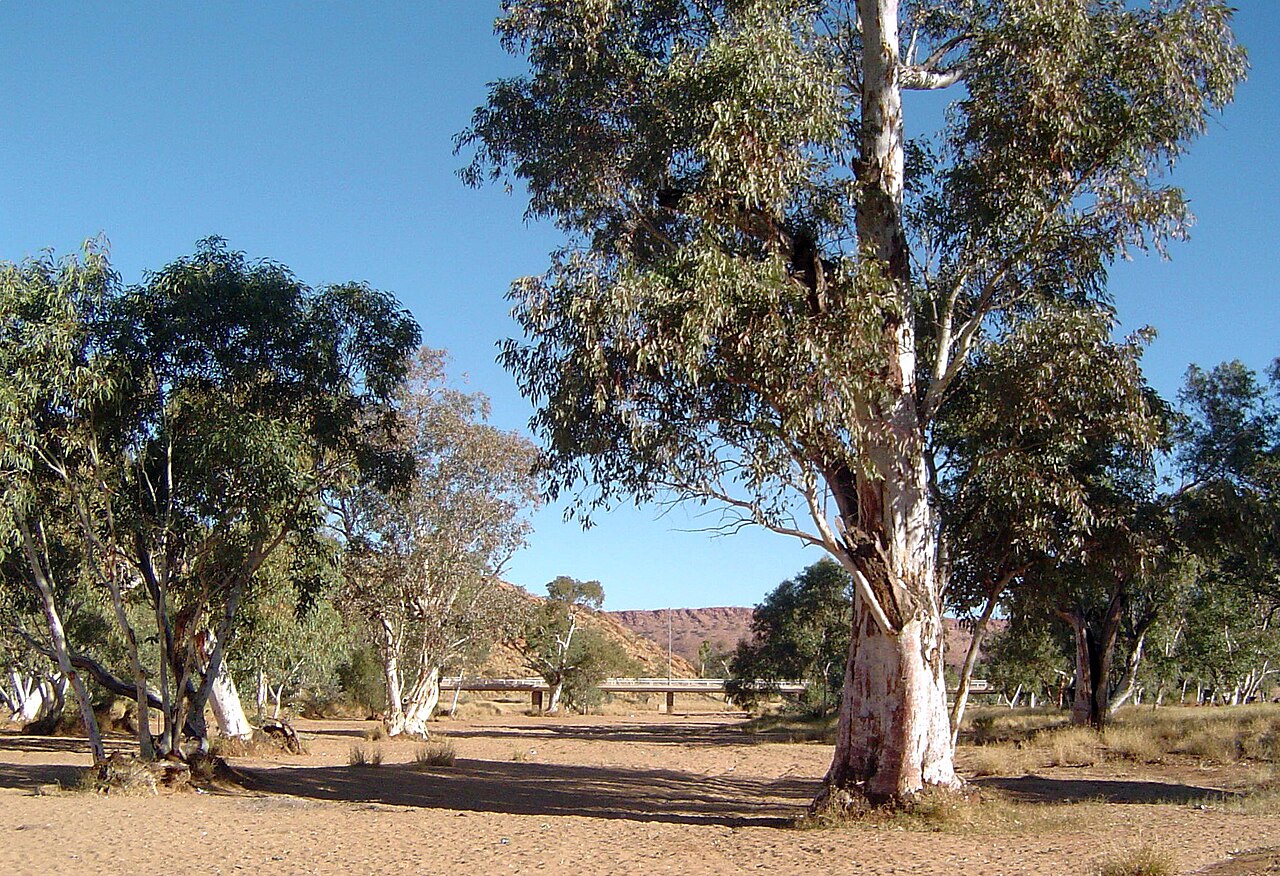
Todd River Dry Bed
23.7017° S · 133.8803° E · Neighborhood
Todd River Dry Bed is the usually dry bed of the Todd River running through Alice Springs town centre, framed by red banks and river red gums. It is in Alice Springs, Australia. Most visitors spend 1–2 hours here. The free Lokali audio guide runs 6 minutes.
✓ Verified August 2026 · how we write these guides
Visitor facts
| Time needed | 1–2 hours |
|---|---|
| Lokali audio guide | 6 min · free |
| Type | Neighborhood |
| Best for | Local life |
| Location | Alice Springs, Australia |
| Coordinates | -23.7017, 133.8803 |
| Languages | 45, in the Lokali app |
The story
You walk down a low, crumbling bank, and your feet sink at once into soft, deep sand. All around you stretches a wide channel, pale and dry under the sun. Great old trees line both edges, throwing down welcome patches of shade. This is, by every map, a river. And yet there is no water at all. Welcome to the Todd, one of the strangest rivers you will ever walk across.
The Todd River runs right through the middle of Alice Springs. But for most of the year, it does not actually run at all. The wide bed is just dry sand, broad and open and pale. You can walk straight out across it without a second thought. Children play here in the afternoons. People take quick shortcuts over it. It is a river you can stand in the very middle of, with perfectly dry feet.
The river takes its name from Charles Todd. He was the man who oversaw the great telegraph line that first brought European settlers to this remote place in the nineteenth century. His wife, Alice, gave her own name to the town itself. He, in turn, gave his name to the river. And so the two names now sit quietly side by side, together on the map of this country.
So why is the river so often dry? The simple answer is that this is true desert country. Rain out here is both rare and uneven. For most of the time, no water flows at all in the Todd. But the river is by no means dead. After heavy rain, far upstream in the high ranges, water can suddenly come rushing down the channel in a flood. For a day or two, the Todd truly runs.
When the water finally does come down, it is a great local event. People go down to the banks to watch the brown river flow past. The dry sand vanishes completely beneath the moving water. Then, within just a few days, the flow sinks away and soaks back into the bed, and the sand quietly returns. The river settles down to sleep again, waiting patiently for the next heavy rain.
The local people of Alice Springs long ago made a fine joke of their dry river, and the joke became famous far and wide. Every single year, they hold a boat race out on the sand. It is called the Henley-on-Todd Regatta. It has been run since 1962. The boats themselves have no bottoms at all. The crews simply lift them up and run along the dry bed on their own two legs.
It is a strange and very funny sight to behold. Crews race madly down the sand inside their bottomless boats, kicking up clouds of dust, laughing and shouting all the way. There is really only one firm rule that the river itself insists upon. If real water should ever happen to arrive, the whole race must be called off. On the very rare occasion this has happened, the regatta was indeed cancelled.
Look carefully along the banks, and you will soon see the true keepers of this river. They are the river red gums. These large, ancient trees can live on for hundreds of years. Their pale trunks twist and lean at strange angles. Their long roots reach far down into the sand, all the way down to the water that hides below, even when the surface above looks completely dry.
These patient trees are the reason the dry river still feels so alive. They give shade to anyone passing through. They give shelter to many small creatures. Birds build their nests up in the high branches. In the early morning and again in the evening, the birdsong along the Todd can grow loud and constant. The trees drink the hidden water below and turn it into green leaves and cool shade above.
Walk the sandy bed in the cool of the early morning, and you will start to see the small signs of life everywhere. Bird tracks crisscross the soft sand. The low light comes in golden through the trees. And the long line of the MacDonnell Ranges rises up beyond, quietly framing the winding course of the river as it makes its way through the heart of the town.
A quiet word of care is worth giving here. Because the river can flood quite suddenly and without much warning, it is wise not to linger down in the bed if heavy rain has fallen somewhere upstream, even under a clear blue sky directly above you. The water can travel a very long way. This is simply the nature of desert rivers. They lie quiet for a long, long time, and then, briefly, they do not.
Stand for a while in the middle of the dry Todd and just feel how strange it all is. A river with no water in it. A bed lined on both sides by ancient leaning trees. A course crossed each year by laughing crowds running in bottomless boats. It is a place that has learned, over long years, to live with whatever little it is given, and somehow to find real joy in it.
Key facts
What to look for
Practical tips
Common questions
How long do you need at Todd River Dry Bed?
Plan 1–2 hours. That is the time most visitors spend at Todd River Dry Bed. The free Lokali audio guide adds about 6 minutes of narration you can listen to as you walk, so it fits inside your visit rather than adding to it.
Is there a free audio guide to Todd River Dry Bed?
Yes — the Lokali app narrates Todd River Dry Bed free of charge in 50+ languages. It covers the history, what to look for on site and practical tips, and it works offline once downloaded.
Where is Todd River Dry Bed?
Todd River Dry Bed is in Alice Springs, Australia, at -23.7017, 133.8803. Tap the map link on this page for directions from where you are.
What should you know before visiting Todd River Dry Bed?
Walk the sandy bed in the cool morning.
What is Todd River Dry Bed known for?
The Todd River is named after Charles Todd.
What is the best time to visit Todd River Dry Bed?
The Reptile Centre and various galleries sit nearby.
On the map
Opens directions to Todd River Dry Bed from your location.
More to see in Alice Springs



Hear Todd River Dry Bed in your language
The full story, narrated, in 50+ languages. Download it before you go and it plays offline, at your own pace, with no ticket and no tour group.