
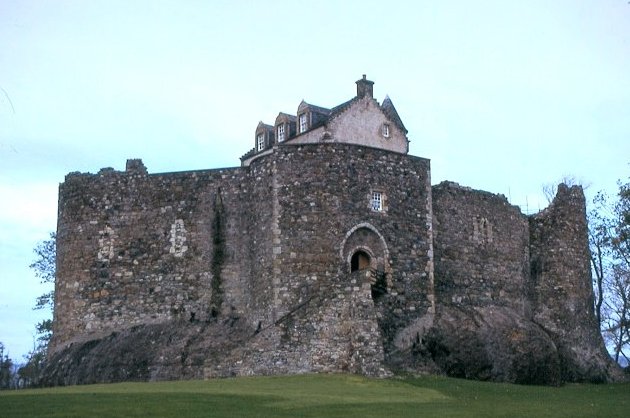
Photo: MHoser · CC BY-SA 4.0 · Wikimedia Commons
Kilchurn Castle is a castle, now ruin, in Argyll and Bute, Scotland, UK. Built by Sir Colin Campbell, first Lord of Glenorchy. The free Lokali audio guide runs 6 minutes.
✓ Published October 2026 · how we write these guides
Visitor facts
| Lokali audio guide | 6 min · free |
|---|---|
| Type | Castle |
| Location | Argyll and Bute, United Kingdom |
| Coordinates | 56.4037, -5.0274 |
| Official website | historicenvironment.scot |
| Languages | 50+, in the Lokali app |
The story
Listen first. Wind moves through the reeds at the edge of the water, and somewhere a curlew calls across the marsh. The path under your feet is soft and damp. Ahead of you, grey stone walls rise from a low spit of land at the head of Loch Awe, with the mountains folded behind them. This is Kilchurn Castle. Even in ruin, it holds the eye like few places in the Highlands.
Kilchurn sits at the northeastern end of Loch Awe, one of the longest freshwater lochs in Scotland. Today you reach it on foot across a strip of grassy ground. For much of its life, though, the castle stood on a small island. The water came right up to its walls. In the early nineteenth century, the level of the loch was lowered, and the island became the peninsula you walked across to get here. So the setting you see is not quite the setting its builders chose.
The story begins in the fifteenth century with the Campbells of Glenorchy, a branch of one of the most powerful families in western Scotland. Sir Colin Campbell, the first Lord of Glenorchy, built the original tower house here around the middle of that century. Before the Campbells, much of this land had been associated with Clan Gregor, the MacGregors. The Campbells would spend generations expanding their reach across these glens, and Kilchurn was one of their early anchors.
Now for a story that locals love to tell. Sir Colin was known by a Gaelic nickname often translated as Black Colin of Rome. According to popular tradition, he was away from home for years on a journey to Rome or on crusade. Legend has it that his wife, Lady Margaret, oversaw the building of the castle while he was gone. It is a good tale... but treat it as folklore rather than documented fact.
Look at the tall, square block on the far side of the courtyard. That is the oldest part of the castle, the original tower house. It once rose five storeys. A tower house like this was a home and a defence in one. The lord and his family lived in the upper rooms. Stores and a guarded entrance sat below. Thick walls, small windows, and a single main door made it hard to attack.
Over the following generations, the Campbells added to the castle. A walled courtyard, called a barmkin in Scotland, wrapped around the tower. Ranges of buildings grew along its sides. Here is the first surprise for many visitors. Late in the seventeenth century, Sir John Campbell, the first Earl of Breadalbane, turned Kilchurn into a barracks. He built long blocks to house soldiers. These are among the oldest surviving barracks buildings on the British mainland.
Why would a Highland lord want his own garrison? These were unsettled decades in Scotland. Rival clans, rebellion, and shifting loyalties to the Crown made armed men valuable. A barracks on Loch Awe gave the Earl a base to control the surrounding country. Walk along the north side of the courtyard and you can still see the shape of those soldiers' quarters, with rows of fireplaces stacked in the walls.
In the eighteenth century, government troops used the castle during the Jacobite rising of 1745. The Jacobites were supporters of the exiled Stuart kings, and the Campbells stood on the government side. After this period, the castle's military value faded. The family moved its main seat elsewhere. Around 1760, lightning struck the castle, and Kilchurn was soon abandoned. Weather, not war, finished its working life.
Here is the second surprise. Look down into the courtyard for a large, tumbled piece of masonry lying on its side. It is the top of one of the castle's turrets. A violent storm brought it down in the late nineteenth century, and it has stayed where it fell ever since. Many accounts link it to the great storm of 1879. It is strange to see a piece of a tower resting on the grass, like a fallen chess piece.
Turn now and face outward. From the upper levels, if they are open, or from the edge of the walls, the view runs down the length of Loch Awe. To the west rises Ben Cruachan, a great mountain mass that dominates this end of the loch. On a still day, the water holds the reflection of the castle almost perfectly. On a wild day, the loch turns slate grey and the wind pushes waves against the shore.
The stone itself is worth a closer look. The walls are built from rough local rubble, set in mortar, with dressed stone around doors and windows. Some corners show careful work. Others are patched and uneven, the marks of many building phases over two centuries. Run your eye along a wall and you can sometimes see where one period ends and another begins, in a change of stone or a shift in line.
Today the castle is cared for by Historic Environment Scotland. Access is seasonal, and the path from the roadside can be wet or even flooded after heavy rain. Many people see Kilchurn first from the road or the railway, a dark shape against the water. Up close, it feels smaller and more human. You can stand in the rooms where people cooked, slept, and kept watch, and imagine the smoke and noise of a full garrison.
Before you go, pause for a moment in the courtyard. Notice the quiet — the wind, the water, perhaps sheep somewhere on the hillside. Look up at the empty window openings, now framing only sky. As you walk back along the path, turn once and look over your shoulder. The castle will sit low against the loch and the mountains, much as it has for more than five hundred years.
Key facts
What to look for
Practical tips
Common questions
Is there a free audio guide to Kilchurn Castle?
Yes — the Lokali app narrates Kilchurn Castle free of charge in 50+ languages. The guide runs about 6 minutes, covers the history, what to look for on site and practical tips, and works offline once downloaded.
Where is Kilchurn Castle?
Kilchurn Castle is in Argyll and Bute, United Kingdom, at 56.4037, -5.0274. Tap the map link on this page for directions from where you are.
What is Kilchurn Castle known for?
Built by Sir Colin Campbell, first Lord of Glenorchy. Original tower house dates to the mid fifteenth century.
What should you look for at Kilchurn Castle?
The fallen turret top lying in the courtyard. Stacked fireplaces in the old barracks walls. The tall original tower house on the courtyard side.
What should you know before visiting Kilchurn Castle?
Wear waterproof boots; the access path is often boggy. Check access status first, as the castle opens seasonally.
When is the best time to visit Kilchurn Castle?
Visit on a calm morning for the stillest water.
On the map
Opens directions to Kilchurn Castle from your location.
More to see in Argyll and Bute



Hear Kilchurn Castle in your language
The full story, narrated, in 50+ languages. Download it before you go and it plays offline, at your own pace, with no ticket and no tour group.