
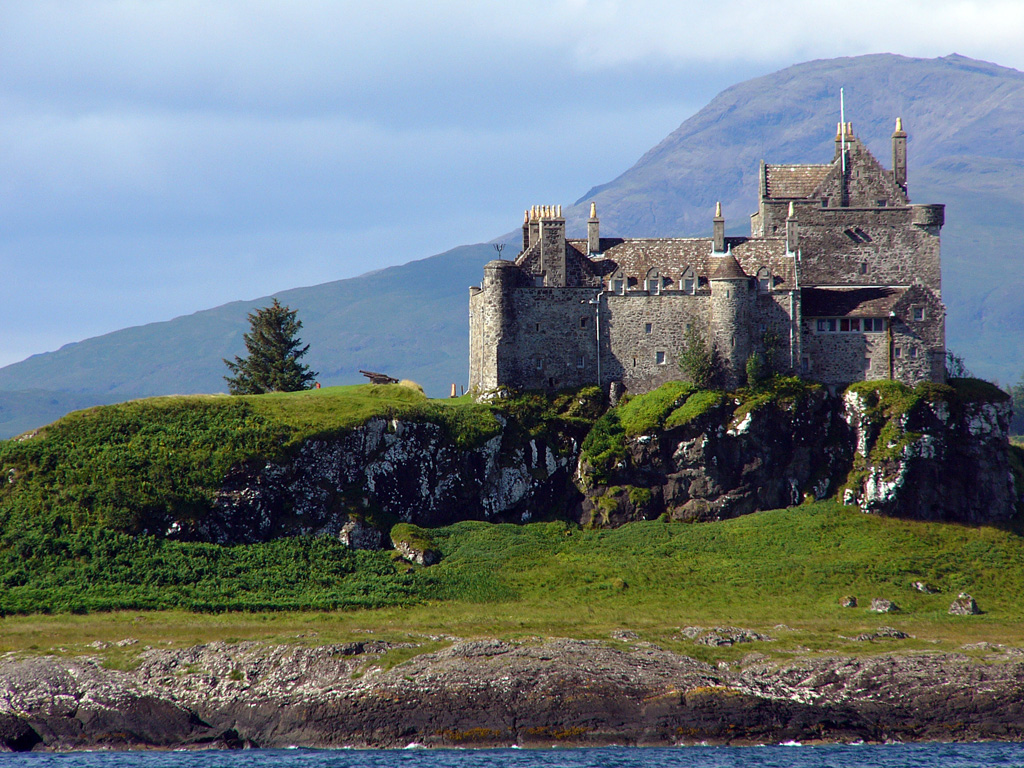
Photo: Anne Burgess · CC BY-SA 2.0 · Wikimedia Commons
Dunstaffnage Castle is a castle in Argyll and Bute, Scotland, UK. Built by the MacDougall Lords of Lorn, thirteenth century. The free Lokali audio guide runs 6 minutes.
✓ Published October 2026 · how we write these guides
Visitor facts
| Lokali audio guide | 6 min · free |
|---|---|
| Type | Castle |
| Location | Oban, United Kingdom |
| Coordinates | 56.4547, -5.4369 |
| Official website | historicenvironment.scot |
| Languages | 50+, in the Lokali app |
The story
Listen first. Wind comes off the water, gulls call over the bay, and somewhere below you the tide moves against the rocks. Under your feet the ground is uneven, part grass and part bare stone. Ahead of you a high wall of grey rubble rises straight out of that rock. It does not feel built on the outcrop. It looks as if it grew from it.
You are a few kilometres north of Oban, on a headland at the mouth of Loch Etive. This is Dunstaffnage Castle, one of the oldest stone castles in Scotland. It dates from the thirteenth century. Before that, this rock was probably already a defended place. From here a lord could watch the sea lanes, the loch and the coast of Lorn all at once.
The builders were the MacDougalls, descendants of Somerled. Somerled was a twelfth century warlord who carved out a sea kingdom along the western coast. His heirs ruled as Lords of Argyll and Lorn. In their world, power travelled by boat. Galleys moved between islands and lochs, and a castle on the water's edge acted as both fortress and harbour gate.
Look closely at the shape of the walls. They do not form a neat square. Instead, the curtain wall follows the edge of the rock beneath it, turning wherever the stone turns. The result is an irregular four-sided plan. The builders used the natural cliff as a foundation, so attackers faced sheer rock before they even reached the masonry. It was a practical design, and it has lasted for centuries.
Round towers stand at the corners. The largest and most solid one faces the landward side, because that was the easiest direction for an enemy to approach. Notice the narrow slits in the walls. They let defenders watch and shoot while staying protected. Here is a detail many visitors miss — at some openings, the stone around the slit is shaped differently. That reflects later changes as weapons moved from bows toward guns.
The MacDougalls made one fateful choice. In the early fourteenth century, they stood against Robert the Bruce, the king who fought to secure Scotland's independence from England. The MacDougalls were tied by family to his rivals. After Bruce defeated them in the mountains near Loch Awe, he came to Dunstaffnage. In 1308 the castle passed into royal hands, and the MacDougalls lost much of their power.
Over the following centuries, the castle changed hands again. It came to the Campbells, the family who rose to dominate Argyll. The Crown appointed a hereditary keeper, known by the title Captain of Dunstaffnage. That title passed from generation to generation. It is an unusual survival. A medieval office of trust, connected to this one building, continued into modern times.
Now turn towards the entrance. The gatehouse looks different from the rest of the walls. It was reworked long after the first building phase, and later a house was built on top of it. People lived up there in more comfortable rooms, looking down over the old courtyard. A fire in the nineteenth century damaged the house. The patched and rebuilt stonework you see is the record of that long, changing domestic life.
The castle also has a place in one of Scotland's most famous stories. After the failed Jacobite rising of 1745 and 1746, Flora MacDonald was held here for a short time. She had helped Prince Charles Edward Stuart, often called Bonnie Prince Charlie, escape his pursuers by disguising him as her maid. She was being taken south as a prisoner. For a few days, these walls held one of the best-known women in Scottish history.
There are older and stranger stories too. Locals say a ghost walks here, a spirit sometimes called the Ell-maid, or a lady in green. Her footsteps are said to bring good or bad news to the household. Another popular tale claims that the Stone of Destiny, the ancient coronation stone of Scottish kings, was kept on this site long ago. These are legends, not documented history. But they show how much this rock has meant to people.
When you leave the castle, walk a short way into the trees. There you will find a ruined chapel, also from the thirteenth century. It is a quiet, roofless building, and the carved windows still show fine stonework. The MacDougalls likely built it at the same period as the castle. Later, the Campbells added a burial aisle beside it. Under the branches, the sounds of the sea become softer.
Back on the rock, climb to the wall walk if it is open. From up there the view explains everything. You can see the water opening towards the island of Lismore and the hills of Morvern. On a clear day the mountains of Mull rise in the distance. Below, small boats move in the bay where galleys once arrived. The geography that made this place powerful has not changed.
Today Historic Environment Scotland cares for the castle. Nearby you may notice modern buildings around the bay at Dunbeg, home to marine science research. It is a quiet connection. Seven centuries ago, people chose this spot because of the sea. Today, people still come here to study it, measure it and learn from it.
Before you go, put your hand on the stone of the outer wall. Feel how cold it is, and how rough. Look at the line where built masonry meets natural rock — sometimes it is hard to tell where one ends and the other begins. Listen again to the wind and the gulls. As you walk back down the path, look over your shoulder. The castle sits low against the sky, still watching the mouth of the loch.
Key facts
What to look for
Practical tips
Common questions
Is there a free audio guide to Dunstaffnage Castle?
Yes — the Lokali app narrates Dunstaffnage Castle free of charge in 50+ languages. The guide runs about 6 minutes, covers the history, what to look for on site and practical tips, and works offline once downloaded.
Where is Dunstaffnage Castle?
Dunstaffnage Castle is near Oban, United Kingdom, at 56.4547, -5.4369. Tap the map link on this page for directions from where you are.
What is Dunstaffnage Castle known for?
Built by the MacDougall Lords of Lorn, thirteenth century. Robert the Bruce took the castle in 1308.
What should you look for at Dunstaffnage Castle?
Curtain wall following the natural shape of the rock. Narrow arrow slits in the thick corner towers. Later house built on top of the gatehouse.
What should you know before visiting Dunstaffnage Castle?
Visit the ruined chapel in the woods after the castle. Wear sturdy shoes for uneven rock and steep steps.
On the map
Opens directions to Dunstaffnage Castle from your location.
More to see in Oban



Hear Dunstaffnage Castle in your language
The full story, narrated, in 50+ languages. Download it before you go and it plays offline, at your own pace, with no ticket and no tour group.