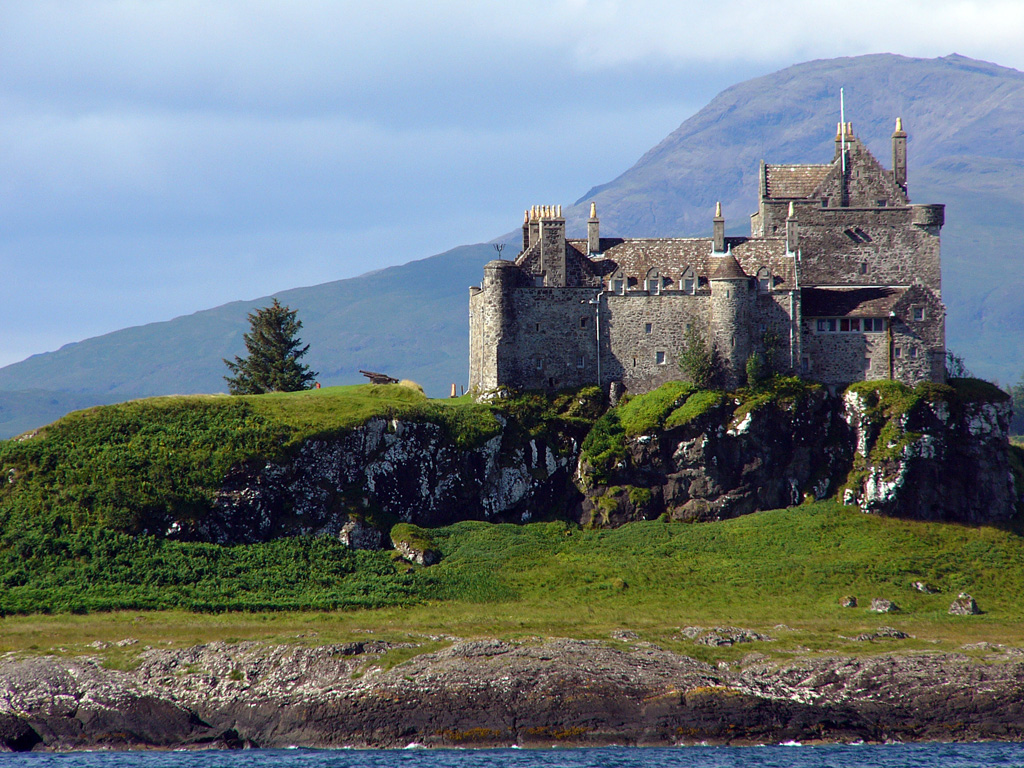
Photo: Philippe Giabbanelli · CC BY-SA 3.0 · Wikimedia Commons
Duart Castle is a castle in Argyll and Bute, Scotland, UK. Seat of the chiefs of Clan Maclean. The free Lokali audio guide runs 8 minutes.
✓ Published October 2026 · how we write these guides
Visitor facts
| Lokali audio guide | 8 min · free |
|---|---|
| Type | Castle |
| Location | Oban, United Kingdom |
| Coordinates | 56.4562, -5.6549 |
| Official website | duartcastle.com |
| Languages | 50+, in the Lokali app |
The story
Listen first. Wind comes off the water, steady and cool, and it carries salt and the faint smell of seaweed drying on the rocks below. Somewhere a gull calls. Under your feet the ground is hard and uneven. This castle does not sit on soft earth. It grips a headland of bare rock, with the sea on three sides. Look up at the walls. They are grey, heavy and almost windowless, and they rise straight from the stone as if they grew there.
You are on the Isle of Mull, at a point of land called Duart. If you came over on the ferry from Oban, you have already seen this view from the water. The castle appears as the boat crosses toward Craignure. It stands alone on its point, dark against the hills. That first glimpse from the sea is no accident. This place was built to be seen, and to see. From here, nothing could move through these waters unnoticed.
The water in front of you is the Sound of Mull. It is a narrow channel between Mull and the mainland. To the east, the Firth of Lorn opens out, and the sea routes run toward Oban and Loch Linnhe. For centuries, the sea was the main road in the Highlands and Islands. Boats carried soldiers, cattle, wine and news. Whoever held this headland could watch the traffic, and could stop it. That simple fact explains almost everything about the castle you see today.
The oldest part of the building is the great curtain wall, the thick outer wall that encloses the courtyard. It dates from around the thirteenth century. Later, probably in the fourteenth century, a massive tower house was added. A tower house is a tall, fortified home, part fortress and part residence. This became the seat of the Macleans, one of the great families of the western islands. In Gaelic tradition, a clan is an extended family that follows one chief. Duart was the home of that chief.
The Macleans rose to power under the Lords of the Isles. These lords ruled much of the western seaboard almost like independent kings. According to clan history, an early Maclean chief married into the family of the Lord of the Isles, and the castle came to the Macleans through that alliance. For generations, the clan held land across Mull and the nearby islands. They fought, made treaties, and feuded with their neighbours. Their greatest rivals were the Campbells, whose power was growing on the mainland to the east.
Now for a story you will hear more than once on Mull. Look out to sea, toward the channel. Between the castle and the island of Lismore there is a small rock that disappears at high tide. Locals call it the Lady's Rock. Legend has it that in the sixteenth century a Maclean chief tired of his wife, who was a Campbell. He left her on that rock to drown as the tide rose. She was rescued by passing fishermen, the tale says, and taken home to her family. Her brother, so the story goes, later took his revenge. It is folklore mixed with history, and it still shapes how people here talk about the two clans.
The seventeenth century brought civil war to Britain, and the Macleans chose the losing side. They stayed loyal to the Stuart kings. In the middle of that century, a Cromwellian warship called the Swan sank in a storm just off this point. The wreck lay hidden for more than three hundred years. In 1979, a diver came across it on the seabed. Archaeologists later studied the site, and objects from the ship are now in museum collections. So the sea in front of you holds part of this story, too.
The Macleans' loyalty cost them dearly. Debts and political defeat weakened the clan, and their great rivals, the Campbells, gained control of Duart in the late seventeenth century. After the Jacobite risings of the eighteenth century, the government used the castle as a garrison for soldiers. The Jacobites were supporters of the exiled Stuart line. Once the threat was over, the soldiers left. Without a family to care for it, the castle slowly fell into ruin. Roofs collapsed. Rain came in. For many decades, it stood as a shell above the sea.
Here is the surprise most visitors miss. The castle you see is not simply a medieval survival. It is also an act of family devotion. In 1911, Sir Fitzroy Maclean, chief of the clan, bought the ruin back. He was already an elderly man. He set about restoring it as a home, and the work brought the walls and roof back to life. He lived on into great old age, well past one hundred. Picture that. A man who had served as a soldier in the nineteenth century, finally bringing his family's lost house home.
As you walk inside, notice how thick the walls are. The window openings narrow as they pass through the stone, like tunnels. That thickness kept out both attackers and the Atlantic weather. Inside, the rooms of the keep hold portraits, clan relics and family objects. Look at the stone stairs as you climb. They are worn smooth in the middle, where countless feet have stepped. Down below, the castle's dungeons are cold and dim, and they feel very different from the rooms above.
If you can, climb to the roof. This is the moment the whole building makes sense. From the top, the view opens in every direction. You can follow the Sound of Mull to the northwest. To the east, on a clear day, the mainland hills stack up in shades of blue and grey. Lismore lies low and green in the water. You may see the Oban ferry crossing, small and white, on the same route boats have used for centuries. Watch for a moment. Nothing on this water escapes your eye.
One more thing worth knowing. Duart is still a family home. It remains the seat of the chief of Clan Maclean. People with the Maclean name, from Canada, Australia, New Zealand and far beyond, travel here to see the house of their ancestors. Emigration in the eighteenth and nineteenth centuries scattered Highland families across the world. For many of their descendants, this headland is the place where the story begins. You may hear accents from several continents in the courtyard today.
Before you leave, stand outside the walls again and face the sea. Feel the wind on your face, the same wind that has hit this rock for as long as there has been a castle here. Look at the patchwork in the stonework, where old walls meet the restoration of the twentieth century. Listen to the water against the rocks below. As you walk back down the path, turn once more. The castle is still watching the Sound... just as it always has.
Key facts
What to look for
Practical tips
Common questions
Is there a free audio guide to Duart Castle?
Yes — the Lokali app narrates Duart Castle free of charge in 50+ languages. The guide runs about 8 minutes, covers the history, what to look for on site and practical tips, and works offline once downloaded.
Where is Duart Castle?
Duart Castle is near Oban, United Kingdom, at 56.4562, -5.6549. Tap the map link on this page for directions from where you are.
What is Duart Castle known for?
Seat of the chiefs of Clan Maclean. Curtain wall dates from around the thirteenth century.
What should you look for at Duart Castle?
Narrow window openings tunnelling through very thick walls. Stone stair treads worn smooth in the centre. The tidal Lady's Rock out toward Lismore.
What should you know before visiting Duart Castle?
Take the Oban ferry to Craignure, then travel onward to Duart. Watch from the ferry deck for the first castle view.
On the map
Opens directions to Duart Castle from your location.
More to see in Oban


Hear Duart Castle in your language
The full story, narrated, in 50+ languages. Download it before you go and it plays offline, at your own pace, with no ticket and no tour group.