
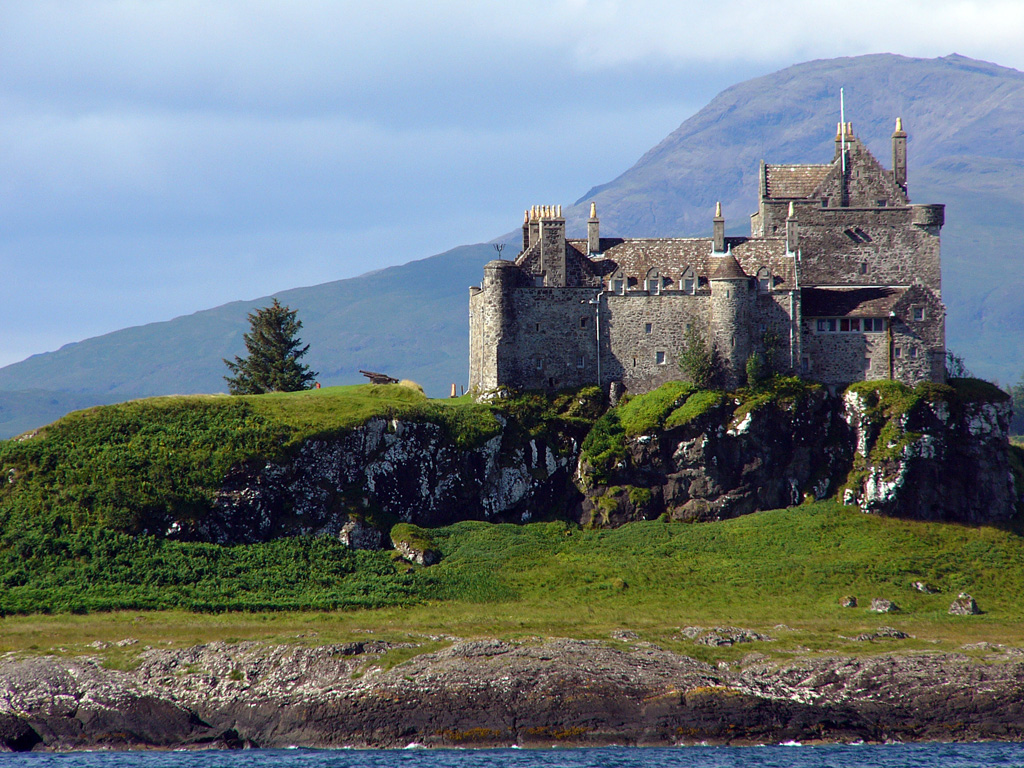
Photo: Tommes · CC BY-SA 3.0 · Wikimedia Commons
Castle Tioram is a castle in Highland, Scotland, UK. Tioram means dry in Scottish Gaelic. The free Lokali audio guide runs 7 minutes.
✓ Published October 2026 · how we write these guides
Visitor facts
| Lokali audio guide | 7 min · free |
|---|---|
| Type | Castle |
| Location | Highland, United Kingdom |
| Coordinates | 56.7846, -5.8291 |
| Official website | tioram.org |
| Languages | 50+, in the Lokali app |
The story
Listen first. The tide is moving somewhere close by, a soft hiss of water over sand and weed. Underfoot, the ground is ribbed and damp, still shaped by the sea that covered it a few hours ago. And ahead of you, on a rocky knoll, a grey wall rises straight out of the stone. That is Castle Tioram, and on most days you can only reach it because the sea has stepped aside.
The name holds the clue. In Scottish Gaelic, the old language of the Highlands and islands, tioram means dry. The little island it stands on is Eilean Tioram, the dry island. It is dry only at low water, when a strand of sand joins it to the mainland. At high tide, Loch Moidart closes around it, and the castle becomes an island fortress again. The people who built here understood that rhythm well.
This is the western edge of Lochaber, a remote part of the Scottish Highlands. Roads arrived late here, and for centuries the sea was the main highway. Boats, not horses, carried chiefs, warriors and trade along this coast. So a castle at the mouth of a sea loch made sense. From these walls, you could watch the water routes towards the Hebrides, the island chain to the west, and see who was coming long before they landed.
Take a moment to look at how the wall fits the rock. It does not sit on a neat, level foundation. It follows the shape of the knoll, bending where the stone bends. That gives the curtain wall, the outer defensive wall, an irregular outline with several sides. Historians generally date the earliest parts to the thirteenth century, a time when powerful sea lords ruled much of this coast. The tower you can see was added later, in the following centuries.
The castle is tied to one family above all, the MacDonalds of Clanranald. For several hundred years, this was the seat of their chiefs. Clanranald was a branch of the great Clan Donald, whose leaders called themselves Lords of the Isles. At their height, those lords controlled the western seaboard and the islands almost like independent princes. Castle Tioram was one of the places where that power showed itself in stone.
One name comes up again and again in the story of this place: Amy MacRuari. She was an heiress of great lands in the west, and the first wife of John of Islay, Lord of the Isles, in the fourteenth century. Their marriage was later set aside, but her son Ranald became the founder of Clanranald. Tradition says Amy strengthened or rebuilt this castle. The detail is hard to prove, but locals still connect her name with these walls.
Now, a surprise that many visitors miss. The castle did not fall to a siege at the end. It was set on fire by its own chief. In 1715, Allan MacDonald of Clanranald left to fight in the Jacobite rising, a rebellion to restore the exiled Stuart kings to the throne. According to the usual account, he ordered Tioram burned behind him, so that government troops could not use it. He was killed later that year at the Battle of Sheriffmuir.
Think about that choice. A chief stands on this shore and watches his family home burn, by his own command. He chose a ruin over a fortress in the hands of his enemies. After that, the clan never moved back. The roof was gone, the rooms were open to the rain, and the slow work of wind and salt began. What stands in front of you today is mostly the shell that survived that fire.
The ruin has had a strange modern life too. In the late twentieth century, a private owner bought the castle and hoped to restore it as a home. The plan led to a long public argument. Some people wanted it rebuilt and lived in again. Others felt the ruin should stay a ruin, protected as it is. The national heritage authorities refused consent for the full restoration, and the debate became one of the best-known cases in Scottish conservation.
That debate matters for you today, because the castle is fragile. In recent years, the interior has been fenced off because of the risk of falling stone. Please respect any barriers or warning signs you see. The best views are from outside anyway. Walk slowly around the base of the knoll, and you get the full height of the walls against the sky. The scale feels very different from the rocks than from the shore.
Look closely at the surface of the stone. In places, you can see patches of old lime render, a rough coating once spread over the walls to protect them from weather. When it was fresh, the castle may have looked pale and smooth, not grey and rugged. Look too at the small openings high in the wall. They were made for defence and light, not for views. Inside, life was cramped, smoky and loud.
The setting around you is part of the experience. Wooded slopes run down to the loch. Seaweed lies in brown ropes across the rocks. On a calm day, the water reflects the tower almost perfectly, and herons or oystercatchers work along the tide line. On a stormy day, rain blows sideways off the sea, and you understand why thick walls were not a luxury here. They were survival.
A practical word before you go further. The tide decides everything at Tioram. The sand strip that brought you here can disappear faster than you expect, and the water in the channel can be cold and strong. Check the tide times before crossing, and keep an eye on the water while you explore. If the sea starts to creep across the sand, it is time to head back to the mainland side.
As you turn to leave, look back once more. The tower stands where it has stood for centuries, on rock that the sea visits twice a day. Listen again for the water over the sand, and notice the light on the wall. It changes every few minutes here. Soon the tide will come in, and the dry island will be an island again, as it has always been.
Key facts
What to look for
Practical tips
Common questions
Is there a free audio guide to Castle Tioram?
Yes — the Lokali app narrates Castle Tioram free of charge in 50+ languages. The guide runs about 7 minutes, covers the history, what to look for on site and practical tips, and works offline once downloaded.
Where is Castle Tioram?
Castle Tioram is in Highland, United Kingdom, at 56.7846, -5.8291. Tap the map link on this page for directions from where you are.
What is Castle Tioram known for?
Tioram means dry in Scottish Gaelic. Earliest walls generally dated to the thirteenth century.
What should you look for at Castle Tioram?
Curtain wall bending to follow the rock beneath it. Patches of old lime render on the stone. Small high openings built for defence and light.
What should you know before visiting Castle Tioram?
Check tide times before crossing the sand strip. Wear waterproof shoes for wet sand and seaweed.
On the map
Opens directions to Castle Tioram from your location.
More to see in Highland



Hear Castle Tioram in your language
The full story, narrated, in 50+ languages. Download it before you go and it plays offline, at your own pace, with no ticket and no tour group.