Manas National Park
26.7167° N · 90.9333° E · National Park
Photo: Pankaj from Bangalore, India · CC BY-SA 2.0 · Wikimedia Commons
Manas National Park is a national park in Assam, India. Declared a wildlife sanctuary in 1928. The free Lokali audio guide runs 7 minutes.
✓ Published October 2026 · how we write these guides
Visitor facts
| Lokali audio guide | 7 min · free |
|---|---|
| Type | National Park |
| Location | Assam, India |
| Coordinates | 26.7167, 90.9333 |
| Official website | manasassam.org |
| Languages | 50+, in the Lokali app |
The story
Listen first. Before you see anything, the grass is already talking. Tall stems brush against each other in the wind, a dry rustle that never quite stops. Somewhere a bird calls. Somewhere further away, water runs over stones. Here in the foothills of the Himalayas, in western Assam, the land is green in layers. There is grass taller than a person, then dark forest, then blue hills rising toward Bhutan.
This is Manas National Park. It is one of the most important wild places in India. It is also one of the most fragile. The park sits where the plains of the Brahmaputra valley meet the first slopes of the mountains. Because of this position, it holds several worlds at once. There are wet grasslands, river islands, mixed forest, and the edges of the hills. Each one has its own animals, its own sounds, and its own kind of light.
The park takes its name from the Manas River. The river comes down out of Bhutan, cold and fast and clear, and flows on to join the Brahmaputra. Many people connect the name to Manasa, the serpent goddess honoured across Assam and Bengal. That link is a popular local explanation rather than settled history. Still, it fits. Snakes, rivers, and monsoon floods are all part of life here, and the goddess Manasa is still worshipped in villages around the region.
Now, a surprise that many visitors miss. Across the river, the forest does not stop at a fence or a wall. It continues into Bhutan as Royal Manas National Park. The two parks together form one large protected landscape across an international border. Elephants, tigers, and birds cross freely. They do not carry passports. When you look north toward the hills, you are looking at a single ecosystem that two countries share and protect.
The history of protection here goes back about a century. In the early twentieth century, this land was a hunting reserve used by local royal families. Then, in 1928, it was declared a wildlife sanctuary. Later it became one of the first tiger reserves under Project Tiger, the national programme India launched in 1973 to save its tigers. Over the decades, Manas has collected many titles. It is a tiger reserve, an elephant reserve, and a biosphere reserve.
In 1985, UNESCO added Manas to its list of World Heritage Sites. The reason was simple. Few places on Earth hold so many rare and threatened species in one area. But the story did not stay peaceful. From the late 1980s, the region went through years of armed conflict. Park buildings were damaged. Poaching rose sharply. Many animals were lost. In 1992, UNESCO placed Manas on its list of World Heritage in Danger.
This is the second surprise, and it is a hopeful one. Manas came back. After peace returned to the region, local people, the Bodo community, forest staff, and conservation groups worked together to rebuild. Many former poachers became forest protectors. Rangers returned to their posts. Animal numbers began to rise again. In 2011, UNESCO removed Manas from the danger list. Very few sites in the world have made that journey back.
One animal tells this story better than any other. The greater one-horned rhinoceros once lived here in good numbers. During the conflict years, poachers killed them all. For a time, Manas had no rhinos. Then, from the mid-2000s, conservationists began to bring rhinos back. Some were moved from other parks in Assam, such as Kaziranga. Some were young orphans raised by hand and slowly returned to the wild. If you see a rhino here today, you are seeing a second chance.
Look out at the grasslands. They are not empty fields. They are home to some of the rarest animals in Asia. The pygmy hog lives here. It is the smallest wild pig in the world, and it was once thought to be close to extinction. The hispid hare hides in the same tall grass. The Bengal florican, a large and shy bird, also depends on these meadows. Most visitors never see these creatures. Simply knowing they are close changes how you look at the grass.
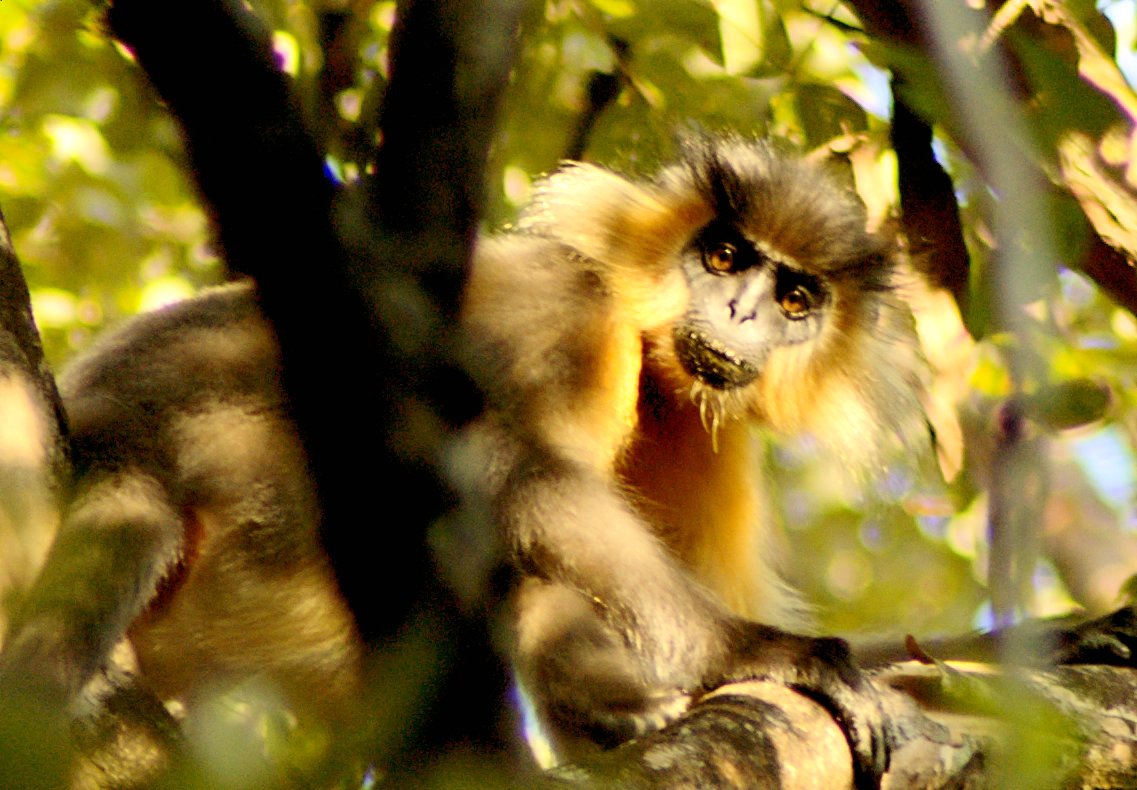
Then there are the animals you are more likely to see. Wild Asian elephants move through the forest in family groups. Wild water buffalo stand in the wet grass with their wide, curved horns. Deer step out at the forest edge in the early morning. On the forest side, watch the treetops for the golden langur. It is a monkey with long, pale golden fur, found only in a small area of Assam and Bhutan. When the sun catches its coat, it can look almost orange against the green leaves.
The tiger lives here too, though it is rarely seen. Clouded leopards move through the forest at night. Birds are everywhere. Hornbills fly over with heavy, rushing wingbeats that you can hear before you see them. Kingfishers wait above the water. In the early morning, the forest fills with calls from every direction. If you stop and stay quiet for a few minutes, you will start to hear how many different voices there are.
The best way to experience Manas is slowly. Most visitors explore in open jeeps along forest tracks, with a guide who knows the land. Near the river, the area around Mathanguri gives you a wide view of the water and the hills of Bhutan beyond. The mornings here can be cool and misty. By midday, the light becomes hard and bright, and many animals rest in the shade. Late afternoon brings soft, golden colours back to the grass.
As you stand here now, take a moment. Feel the air. Notice the smell of damp earth and river water. Look at the line where the grass meets the trees, and where the trees meet the hills. Every part of this view was once at risk. It survived because people chose to protect it. When you leave, listen to the grass one more time. That quiet rustle is the sound of a place that came back.
Key facts
What to look for
Practical tips
Common questions
Is there a free audio guide to Manas National Park?
Yes — the Lokali app narrates Manas National Park free of charge in 50+ languages. The guide runs about 7 minutes, covers the history, what to look for on site and practical tips, and works offline once downloaded.
Where is Manas National Park?
Manas National Park is in Assam, India, at 26.7167, 90.9333. Tap the map link on this page for directions from where you are.
What is Manas National Park known for?
Declared a wildlife sanctuary in 1928. UNESCO World Heritage Site since 1985.
What should you look for at Manas National Park?
Blue hills of Bhutan rising beyond the Manas River. Golden langurs with pale golden fur in the treetops. Grass taller than a person across the open meadows.
What should you know before visiting Manas National Park?
Book jeep safaris through official park counters or lodges. Go out early morning for the most animal activity.
When is the best time to visit Manas National Park?
Go out early morning for the most animal activity.
On the map
Opens directions to Manas National Park from your location.
More to see in Assam

Hear Manas National Park in your language
The full story, narrated, in 50+ languages. Download it before you go and it plays offline, at your own pace, with no ticket and no tour group.