
Royal Manas National Park
26.8994° N · 90.7581° E · National Park
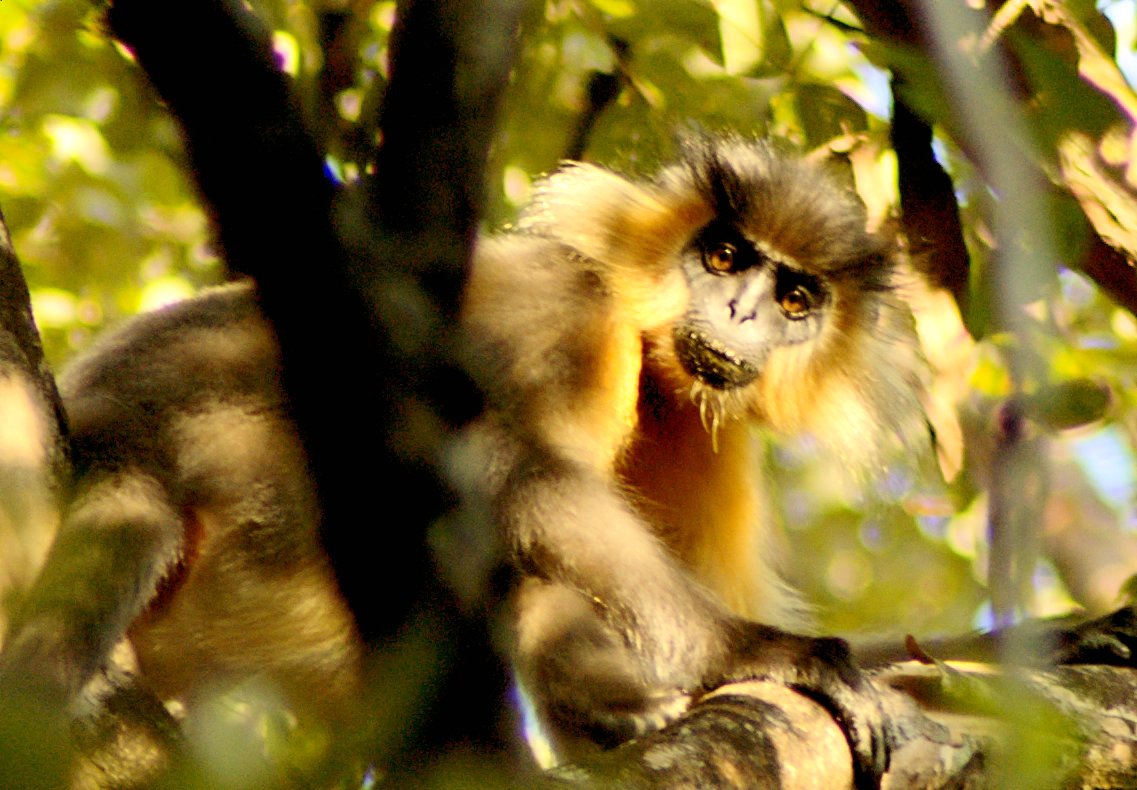
Photo: Sujithkr · CC BY-SA 3.0 · Wikimedia Commons
Royal Manas National Park is a national park in Bhutan. Bhutan's oldest protected area, first declared in the 1960s. The free Lokali audio guide runs 6 minutes.
✓ Published October 2026 · how we write these guides
Visitor facts
| Lokali audio guide | 6 min · free |
|---|---|
| Type | National Park |
| Location | Thimphu, Bhutan |
| Coordinates | 26.8994, 90.7581 |
| Languages | 50+, in the Lokali app |
The story
Listen first. Before you see anything, the forest reaches you as sound. Cicadas rise in a long metallic wave and then fall away. A bird calls from somewhere high in the canopy. Beneath it all runs the steady roar of moving water. The air is warm and heavy, and it smells of wet leaves, river stone and green growth. You are in Royal Manas National Park, deep in Bhutan's southern lowlands.
If you set out from Thimphu, you will feel how far you have come. The capital sits high in a cool mountain valley, among pine forest and prayer flags. Royal Manas lies far to the south, where the Himalayan foothills drop toward the plains of India. The road descends through cloud forest and switchbacks into subtropical heat. The journey takes many hours, but the change in climate is part of the experience.
This park holds a special place in Bhutan's story. It is the country's oldest protected area. It was first set aside as a wildlife sanctuary in the 1960s and was later upgraded to a full national park. Its territory covers roughly a thousand square kilometres of forest, grassland and river valley. For a small mountain kingdom, that is a large share of land kept mainly for wild animals and plants.
Here is something many visitors miss. The forest does not stop at the border. Across the boundary, in the Indian state of Assam, lies another protected area, also called Manas National Park. The two parks meet along the frontier. Together they form one of the largest connected wildlife landscapes in this part of Asia. Elephants and tigers do not carry passports. They move between the two countries along routes much older than any modern map.
The river gives the park its name. The Manas runs down from the high mountains of Bhutan. Here in the lowlands, it widens and turns a clear blue-green over pale gravel bars. In the monsoon season it swells and turns brown with silt. Look at the riverbanks and you may see piles of smooth stones and bleached driftwood. Each flood moves them around. The river shapes this landscape again every year.
The water also holds one of the park's prized residents, the golden mahseer. This is a large river fish with heavy golden scales. Anglers across South Asia know its name. In Bhutan, the fish is valued as a sign of a healthy river. Fishing in the country is strictly controlled. Many Bhutanese avoid taking life for religious reasons, because Buddhist teaching places great weight on compassion for all living beings.
Now turn your attention to the trees. If you are lucky, you may see a flash of cream and gold moving through the branches. This is the golden langur, a long-tailed monkey with a pale gold coat. It lives only in a small region of Bhutan and the neighbouring part of Assam. Few places on Earth offer a chance to see it in the wild. Watch for the long tails hanging down below the leaves.
The park is also home to some of Asia's largest animals. Asian elephants move through the forest in family groups. Bengal tigers live here too, although they are rarely seen. Gaur, a massive wild cattle species, graze at the forest edge. Clouded leopards hunt in the canopy. You are much more likely to find their signs than to see the animals themselves — a footprint in mud, a broken branch or a deep scratch on a tree trunk.
Look up as well as down. Royal Manas is a remarkable place for birds. Hornbills are among the most striking. These large birds have heavy curved bills, and some species carry a casque, a hard helmet-like ridge on top of the bill. When a hornbill flies overhead, you can often hear its wingbeats before you see it. The sound is a loud whooshing, almost like heavy breathing.
This is not an empty wilderness. Small villages exist within and around the park. Families farm, raise animals and gather forest products, much as their ancestors did. Bhutan's approach to conservation tries to include these communities, not remove them. Some villages now host visitors in simple homestays. Over a cup of tea, you may hear how people live alongside elephants that sometimes raid their crops at night.
The park fits into a larger national idea. Bhutan's constitution requires that at least sixty percent of the country remain under forest cover. Protected areas across the kingdom are linked by biological corridors. These are strips of forest that let animals travel between parks. Royal Manas sits at the southern end of this network. A tiger here could, in principle, follow forest paths far toward the high mountains in the north.
Visiting takes some planning. Bhutan's tourism system usually means travelling with a licensed guide, who arranges permits and transport. Inside the park, you might walk forest trails, take a boat on the river or simply sit quietly at a viewpoint. Patience brings the best rewards here. Animals appear on their own schedule, often near dawn or dusk, when the heat eases and the forest wakes up.
Before you leave, stand still for a moment. Feel the humid air on your skin. Listen again to the cicadas, the birds and the river running over stone. Somewhere in the green around you, animals are watching, resting or moving quietly between two countries. As you walk away, notice how the sound of the water fades slowly behind you. The forest will go on with its life long after you have gone.
Key facts
What to look for
Practical tips
Common questions
Is there a free audio guide to Royal Manas National Park?
Yes — the Lokali app narrates Royal Manas National Park free of charge in 50+ languages. The guide runs about 6 minutes, covers the history, what to look for on site and practical tips, and works offline once downloaded.
Where is Royal Manas National Park?
Royal Manas National Park is near Thimphu, Bhutan, at 26.8994, 90.7581. Tap the map link on this page for directions from where you are.
What is Royal Manas National Park known for?
Bhutan's oldest protected area, first declared in the 1960s. Covers roughly a thousand square kilometres of lowland forest.
What should you look for at Royal Manas National Park?
Pale gold langurs with long tails hanging from branches. Blue-green river water running over pale gravel bars. Elephant footprints pressed into mud near the riverbank.
What should you know before visiting Royal Manas National Park?
Plan a full travel day for the drive from Thimphu. Arrange permits in advance through your licensed Bhutanese guide.
When is the best time to visit Royal Manas National Park?
Go out at dawn or dusk for wildlife.
On the map
Opens directions to Royal Manas National Park from your location.
More to see in Thimphu
Hear Royal Manas National Park in your language
The full story, narrated, in 50+ languages. Download it before you go and it plays offline, at your own pace, with no ticket and no tour group.