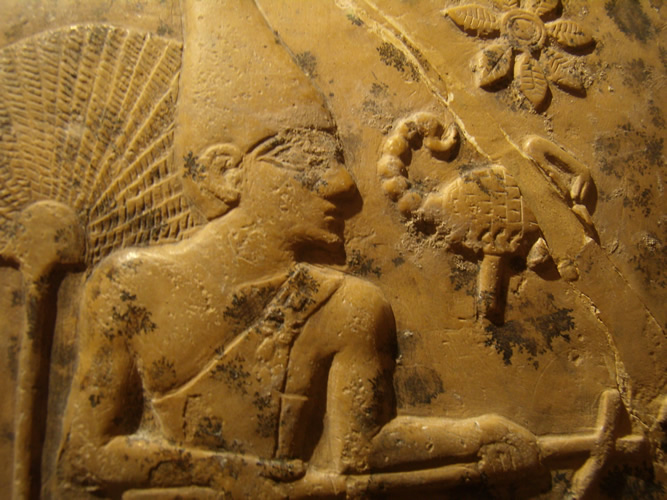
Hierakonpolis
25.0972° N · 32.7794° E · Archaeological Site
Photo: Udimu · CC BY-SA 3.0 · Wikimedia Commons
Hierakonpolis is a religious and political capital of Upper Egypt in Ancient Egypt. Ancient Egyptian name was Nekhen, the falcon city. The free Lokali audio guide runs 7 minutes.
✓ Published October 2026 · how we write these guides
Visitor facts
| Lokali audio guide | 7 min · free |
|---|---|
| Type | Archaeological Site |
| Location | Aswan, Egypt |
| Coordinates | 25.0972, 32.7794 |
| Languages | 50+, in the Lokali app |
The story
The ground here crunches. Under your shoes is a mix of sand, gravel, and broken pottery, thousands of small reddish fragments scattered across the desert edge. Some of these pieces are older than the pyramids. To the east, a green strip of fields marks the Nile. Behind you, the desert runs out toward low cliffs. The light is hard and white, and the wind carries a dry, dusty smell. This is Hierakonpolis, and it is one of the places where ancient Egypt began.
The name you hear today is Greek. Hierakonpolis means "City of the Hawk", or more precisely, the city of the falcon. The ancient Egyptians called it Nekhen. The falcon was Horus, the god most closely tied to Egyptian kingship. For thousands of years, pharaohs were described as living forms of Horus. So the idea of the falcon king, an idea that lasted across the whole of pharaonic history, has deep roots in this patch of desert.
It helps to know what came before the pharaohs. Long before Egypt was one kingdom, the Nile valley held separate communities and rival centres. Archaeologists call this the Predynastic period, meaning the time before the first dynasties of kings. Nekhen grew into one of the largest and most important of these early centres in the south. People lived, worked, and buried their dead here across many centuries. The town spread along the edge of the floodplain and up into the desert wadis, the dry valleys that cut toward the cliffs.
Now for the first surprise. Many visitors know the Narmer Palette, a carved slate slab now in the Egyptian Museum in Cairo. It shows a king wearing the crowns of Upper and Lower Egypt, and it is often linked to the unification of the country. That object was found here. British excavators James Quibell and Frederick Green uncovered it in the late 1890s, in a buried cache of temple objects now known as the Main Deposit. One of the most famous images of early Egyptian kingship came out of this ground.
The same excavations produced other treasures. Among them was a gold falcon head, a striking piece now displayed in Cairo. The excavators also recovered copper statues of the Sixth Dynasty king Pepi the First, an unusually early example of large metal sculpture. These finds tell us something important. Even after the capital of a united Egypt moved north, Nekhen stayed sacred. Kings kept sending gifts to the temple of Horus here for many centuries.
The second surprise is a painting. Quibell and Green also found a tomb with plastered and painted walls, known today as Tomb 100, or the Painted Tomb. Its scenes show boats, animals, and human figures, including a man striking down captives. It is among the oldest known painted tombs in Egypt. The painting itself no longer stays here. It was removed and taken to Cairo, but the tomb was once part of this same landscape.
Look west, toward the mouth of the main wadi, and you may see a large rectangle of mud-brick walls. This is often called the Fort, though it was probably not a military fort at all. It is linked to Khasekhemwy, a king of the Second Dynasty. Many scholars think it was a ceremonial enclosure connected to royal ritual. Its walls are thick, built from sun-dried mud brick, and parts still stand to an impressive height. It is one of the oldest standing mud-brick structures in the world.
Think about that for a moment. Mud brick is simply river mud, mixed with straw or sand and dried in the sun. It is not a material we expect to last. Yet in this dry climate, these walls have stood for close to five thousand years. Rain is rare here, and that rarity is the reason so much survived. The desert acted as a kind of storage room for the past.
Hierakonpolis is still an active research site, and work here continues to change the story. The long-running Hierakonpolis Expedition, an international team of archaeologists, has excavated an elite cemetery out in the desert. There they found burials of wild animals, including elephants, hippopotamuses, crocodiles, and baboons. Some animals seem to have been kept in captivity before death. For a local ruler, owning dangerous animals may have been a way to show power over the wild world.
The expedition has also studied the daily life of ordinary people. Teams have found evidence of large-scale beer production, with big vats set into the ground for brewing. They have found pottery kilns, workshops, and houses. This is the part of history that rarely appears in museum cases. It is the work of bakers, brewers, potters, and labourers, the people who made an early state possible. Much of that story still lies under the surface you are walking on.
That is why it matters how you move here. The scattered sherds, the low mounds, and the faint lines in the sand are all part of the archaeological record. A fragment picked up and carried away loses its meaning, because its position tells researchers something. So the best way to experience this place is slowly, with your eyes. Stay on the paths, follow your guide or the site guardians, and leave everything where it lies.
There is one more connection worth noticing. Across the river, on the east bank, lies Elkab, the ancient town of Nekheb. Its goddess was Nekhbet, the vulture. Together, the falcon of Nekhen and the vulture of Nekheb became protective symbols of southern Egypt. The vulture later appeared on royal crowns and in royal titles. Two towns facing each other across the Nile helped shape the symbols of a whole civilisation.
Before you leave, stand still and look around once more. The fields are still green by the river. The desert is still pale and quiet. The same sun that dried these mud bricks is warming your shoulders now. Nothing here shouts for attention. There are no giant columns or painted halls. But under the gravel and the broken pottery are the early chapters of the Egyptian story. As you walk back, listen to the ground under your feet, and remember how much of it is older than the pyramids.
Key facts
What to look for
Practical tips
Common questions
Is there a free audio guide to Hierakonpolis?
Yes — the Lokali app narrates Hierakonpolis free of charge in 50+ languages. The guide runs about 7 minutes, covers the history, what to look for on site and practical tips, and works offline once downloaded.
Where is Hierakonpolis?
Hierakonpolis is near Aswan, Egypt, at 25.0972, 32.7794. Tap the map link on this page for directions from where you are.
What is Hierakonpolis known for?
Ancient Egyptian name was Nekhen, the falcon city. Greek name Hierakonpolis means City of the Hawk.
What should you look for at Hierakonpolis?
Reddish pottery fragments scattered across the desert surface. Thick mud-brick walls of the Khasekhemwy enclosure. Green Nile fields meeting the pale desert edge.
What should you know before visiting Hierakonpolis?
Arrange access in advance through a local guide or authorities. Visit early in the morning to avoid desert heat.
When is the best time to visit Hierakonpolis?
Visit early in the morning to avoid desert heat.
On the map
Opens directions to Hierakonpolis from your location.
More to see in Aswan


Hear Hierakonpolis in your language
The full story, narrated, in 50+ languages. Download it before you go and it plays offline, at your own pace, with no ticket and no tour group.