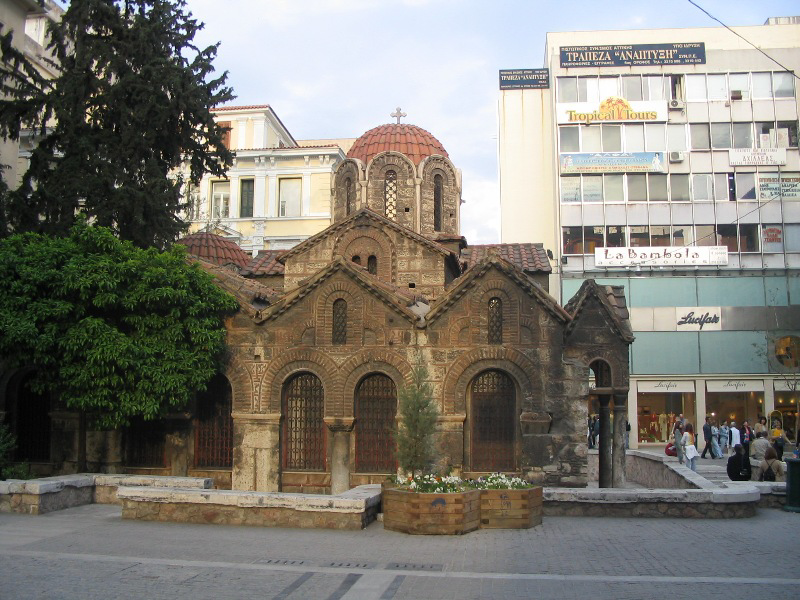
Church of Panagia Kapnikarea
37.9764° N · 23.7286° E · Church
Photo: Don Vincenzo · CC BY-SA 3.0 · Wikimedia Commons
Church of Panagia Kapnikarea is a Byzantine church in Athens, Greece. Main church generally dated to the eleventh century. The free Lokali audio guide runs 7 minutes.
✓ Published October 2026 · how we write these guides
Visitor facts
| Lokali audio guide | 7 min · free |
|---|---|
| Type | Church |
| Location | Athens, Greece |
| Coordinates | 37.9764, 23.7286 |
| Languages | 50+, in the Lokali app |
The story
Stand still for a moment on Ermou Street. Around you, shoppers move past in both directions, carrying bags and talking on phones. Then the pavement simply parts. In the middle of the street sits a small church of honey-coloured stone and red brick, lower than the shops on either side. The ground around it sits slightly below today's street level. You have just found one of the oldest buildings still in daily use in central Athens.
This is the Church of Panagia Kapnikarea. Panagia means the All-Holy One, a Greek title for the Virgin Mary. Scholars generally date the main church to the eleventh century, during the Byzantine period. That makes it many centuries older than every shop window around you. When it was built, Athens was a small provincial town. The great days of the ancient city were long gone, and the modern capital did not yet exist.
Look at the walls closely. The builders used a technique called cloisonné masonry. Each block of cut stone sits inside a frame of thin red bricks, like a picture inside a border. The effect is a soft, stitched pattern of cream and red across the whole surface. It was common in Byzantine Greece, and you will see it on other old churches in Athens. Here, at eye level and in full daylight, you can study it better than almost anywhere else.
Now raise your eyes to the dome. It sits on a many-sided drum, pierced by narrow arched windows. Below it, the roofs step down in a cross shape. This is the classic cross-in-square plan of Byzantine churches. Inside, four columns support the dome, and the space branches into four short arms. From the street, you can read the plan from the roofline alone. The dome marks the centre, and the arms reach out beneath it.
The name Kapnikarea is a small puzzle, and no one can solve it with certainty. One popular explanation links it to kapnikon, a Byzantine tax on households, sometimes called the hearth or smoke tax. According to this story, a tax collector paid for the church. Another theory connects the name to a type of costly gold-woven cloth. Both ideas circulate widely. Neither is proven, so treat them as possibilities rather than settled history.
The church you see is not one single building from one moment. Over the centuries, people added to it. A covered porch with columns now stands at the west entrance. On the north side, a small chapel is attached to the main body. These later additions have a slightly different character. Walk slowly around the outside and try to spot where the older walls end and the newer work begins. The joins are often visible in the masonry.
Here is something many visitors walking past never learn. This church came close to disappearing. In the 1830s, Athens became the capital of the new Greek state. Planners laid out straight modern streets, and Ermou Street ran directly through this spot. Demolition was a real possibility. The church survived, and accounts often credit the intervention of King Ludwig of Bavaria, father of Greece's first king. Whatever the full story, the street was built around it instead.
That decision explains the strange shape of the street today. Ermou runs in a straight line, then splits around the church, then joins again. The church acts like a stone in a river. People flow around it all day. It also explains why the church sits lower than the pavement. The ground level of the city has risen over the centuries. The church kept its original footing while Athens slowly built up around it.
Today the church is connected to the University of Athens, and it remains an active place of Orthodox worship. You may see people stop in for a minute between errands. Some light a thin candle in the sand tray near the entrance. Others cross themselves as they pass, without breaking their stride. This small gesture is a quiet surprise for many visitors. In the middle of a shopping street, the building still does the job it was built for.
If the doors are open, step inside. The light drops immediately, and the noise of the street fades. The walls are covered in painted images of saints and scenes from the Gospels. Many of these paintings are not medieval. They date from the twentieth century and are widely attributed to Fotis Kontoglou, a Greek painter who worked to revive the traditional Byzantine style. His figures have long faces, calm eyes and deep, earthy colours.
That revival matters. In the nineteenth and early twentieth centuries, many Greek churches were painted in a Western European style, with soft realism and shading. Painters like Kontoglou argued for a return to the older Byzantine tradition. In this tradition, an icon is not a portrait. It is a window toward the sacred, with flat gold backgrounds and simplified forms. So inside this medieval building, you also see a modern artistic argument about Greek identity.
Please remember that this is a working church. Speak quietly inside. Dress modestly, with shoulders covered. Avoid photography during a service, and give space to anyone praying. Outside, you can take your time. The small square around the church offers a rare pause on a very busy street. Stand at different corners and watch how the building changes. From one side it looks compact and solid. From another, the dome seems to float above the crowd.
Before you move on, look once more at the brick frames around the stones. Think of the hands that set them, nearly a thousand years ago. Then look up at the glass shop fronts that tower over the roof. Both belong to Athens. As you walk away along Ermou, notice how quickly the church drops out of sight behind the crowd. It has stayed in this spot through every version of the city, and it is still here.
Key facts
What to look for
Practical tips
Common questions
Is there a free audio guide to Church of Panagia Kapnikarea?
Yes — the Lokali app narrates Church of Panagia Kapnikarea free of charge in 50+ languages. The guide runs about 7 minutes, covers the history, what to look for on site and practical tips, and works offline once downloaded.
Where is Church of Panagia Kapnikarea?
Church of Panagia Kapnikarea is in Athens, Greece, at 37.9764, 23.7286. Tap the map link on this page for directions from where you are.
What is Church of Panagia Kapnikarea known for?
Main church generally dated to the eleventh century. Built on a Byzantine cross-in-square plan.
What should you look for at Church of Panagia Kapnikarea?
Stone blocks framed by thin bands of red brick. Arched windows in the many-sided drum of the dome. Columned porch added at the west entrance.
What should you know before visiting Church of Panagia Kapnikarea?
Visit early morning before Ermou Street fills with shoppers. Cover shoulders before stepping inside the church.
When is the best time to visit Church of Panagia Kapnikarea?
Visit early morning before Ermou Street fills with shoppers.
On the map
Opens directions to Church of Panagia Kapnikarea from your location.
More to see in Athens


Hear Church of Panagia Kapnikarea in your language
The full story, narrated, in 50+ languages. Download it before you go and it plays offline, at your own pace, with no ticket and no tour group.