
Photo: Jebulon · CC0 · Wikimedia Commons
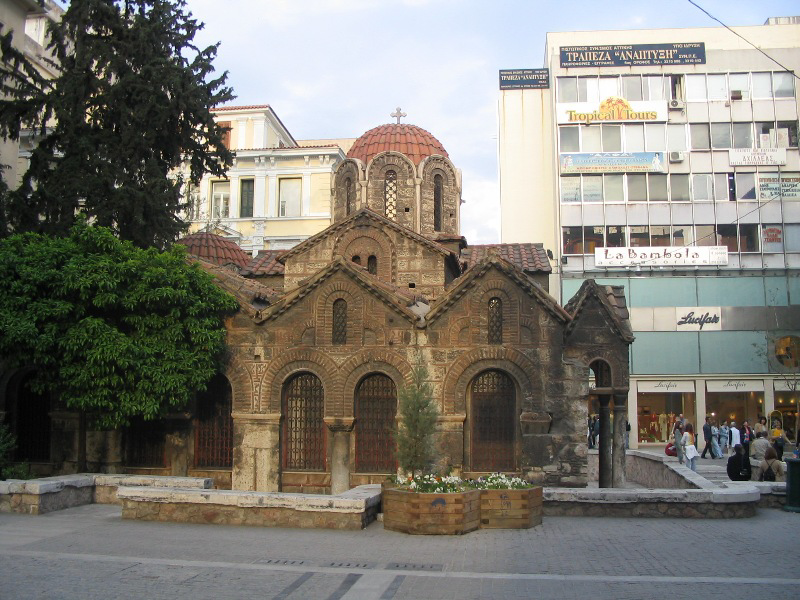
Little Metropolis is a medieval church of reused marble blocks beside the Metropolitan cathedral of Athens, Greece. Dedicated to Panagia Gorgoepikoos, the Virgin quick to hear. The free Lokali audio guide runs 7 minutes.
✓ Published October 2026 · how we write these guides
Visitor facts
| Lokali audio guide | 7 min · free |
|---|---|
| Type | Church |
| Location | Athens, Greece |
| Coordinates | 37.9751, 23.7300 |
| Languages | 50+, in the Lokali app |
The story
Put your hand flat against the outer wall of this small church. The stone is cool and smooth, and under your palm you can feel the edge of a carved block. Above it sits another carving, and another beside that. They do not match. Some show animals, some show plants, some show human figures. This tiny building is wrapped in fragments of older worlds, set into its walls like pages from different books.
You are standing at the Little Metropolis, in the heart of Athens. It sits right beside the large Metropolitan Cathedral, and the contrast is the first thing most people notice. The cathedral is broad, tall and nineteenth century. The little church at its shoulder is low, compact and much older. Many visitors walk straight past it to photograph the bigger building. That is a mistake. The smaller church holds one of the most unusual stone collections in the city.
The church has more than one name, and each one tells you something. It is dedicated to the Virgin Mary under the title Panagia Gorgoepikoos. In Greek, that phrase means roughly the All-Holy One who is quick to hear. It describes a Virgin who answers prayers fast. The church is also linked to Saint Eleftherios, an early Christian martyr. Locals simply call it the Little Metropolis, because of its famous neighbour.
Now let your eyes adjust to the shape of the building. It follows a plan known as the cross-in-square. Imagine a square, with a cross drawn inside it, and a dome rising where the arms of the cross meet. This was a favourite design of the Byzantine world — the eastern Christian empire that ruled from Constantinople for roughly a thousand years. Here the plan is small and tight. The dome sits on a slender drum, and the whole church feels almost like a model of a larger one.
When was it built? Here, scholars honestly disagree. Many date it to the late twelfth or early thirteenth century, in the final Byzantine era of Athens. Others argue for a later date. What everyone agrees on is the material. The church is built almost entirely of marble, and much of that marble was already old when the builders picked it up.
This is the first surprise. The builders did not cut fresh stone for the outer walls. Instead, they gathered carved pieces from ancient temples, Roman monuments and earlier Christian buildings around the city. Archaeologists call this reused material spolia, from the Latin word for spoils. Athens was full of ruins in the Middle Ages, and good marble lay everywhere. The builders fitted these pieces together like a puzzle, and the result is a wall that covers many centuries at once.
Walk slowly to the west side, where the main entrance is. Look up above the doorway. A long horizontal band of carving runs across the wall there. It is an ancient frieze, and many scholars read it as a calendar of Athenian festivals. Figures and signs follow one another across the stone, marking the months and the religious feasts of the ancient city. Think about that for a moment. A Christian church carries, above its door, a calendar of pagan celebrations.
Here is the second surprise, and it is easy to miss. Look closely at some of the older reliefs, and you will find small crosses carved into them. These crosses were added later, cut directly into the ancient decoration. They acted like a signature of ownership. The message was simple — this old stone now belongs to a new faith. In some places a cross sits right beside a pagan figure, and the two share the same block of marble.
Why would Christian builders put pagan art on a church at all? There is no single answer. Part of it was practical, because carved marble was valuable and easy to find. Part of it may have been about meaning. Some historians suggest the builders admired the skill of the ancient carvers. Others see it as a statement of victory over the old gods. You can decide for yourself as you walk around the walls.
As you circle the church, notice the variety of the carvings. You may spot animals facing each other, birds, rosettes, vine scrolls and geometric patterns. Some pieces are deeply cut and crisp. Others are worn soft by weather, so the shapes are only shadows now. The marble also changes colour from block to block. Some stones are warm and honey-toned, others pale grey. This patchwork is not damage. It is the original design.
The church has had more than one life. Over the centuries Athens passed from Byzantine rule to Frankish lords, then to the Ottoman Empire, and finally to the modern Greek state. Through all those changes, this small building survived. After Greek independence in the nineteenth century, it was used for other purposes for a time, before it returned to religious use. When the great cathedral rose next door, the little church took on its affectionate nickname.
If the door is open, step inside quietly. The interior is small and dim, and your voice will seem loud. It is very different from the crowded painted interiors of many Greek churches. Here the space feels simple and close. Light falls from the windows of the dome, and you can sense how tightly the four arms of the cross fit together. Remember this is still a place of worship, so modest clothing and a soft voice are welcome.
Step back out into the square and listen. You will hear footsteps on paving, pigeons, conversations, perhaps a church bell from next door. All around you is modern Athens, with shops, offices and traffic only a short walk away. The Acropolis is not far from here, and some of the marble in these walls may once have stood on monuments in the old city below it. The past here is not behind glass. It is built into the street.
Before you leave, take one more look at the west wall. Find the long calendar frieze again, and then find one of the small carved crosses. Hold both in view together. In one small building you can see ancient Athens, Byzantine Athens and the living city of today. As you walk away, glance at the walls of other old buildings you pass. Once you have seen reused stone here, you may start to notice it everywhere.
Key facts
What to look for
Practical tips
Common questions
Is there a free audio guide to Little Metropolis?
Yes — the Lokali app narrates Little Metropolis free of charge in 50+ languages. The guide runs about 7 minutes, covers the history, what to look for on site and practical tips, and works offline once downloaded.
Where is Little Metropolis?
Little Metropolis is in Athens, Greece, at 37.9751, 23.7300. Tap the map link on this page for directions from where you are.
What is Little Metropolis known for?
Dedicated to Panagia Gorgoepikoos, the Virgin quick to hear. Also dedicated to the early Christian martyr Saint Eleftherios.
What should you look for at Little Metropolis?
The long calendar frieze above the west entrance. Small Christian crosses carved into ancient pagan reliefs. Paired animals facing each other on carved panels.
What should you know before visiting Little Metropolis?
Walk a full circle around the outside before going in. Visit in soft morning light to read shallow carvings.
When is the best time to visit Little Metropolis?
Visit in soft morning light to read shallow carvings.
On the map
Opens directions to Little Metropolis from your location.
More to see in Athens


Hear Little Metropolis in your language
The full story, narrated, in 50+ languages. Download it before you go and it plays offline, at your own pace, with no ticket and no tour group.