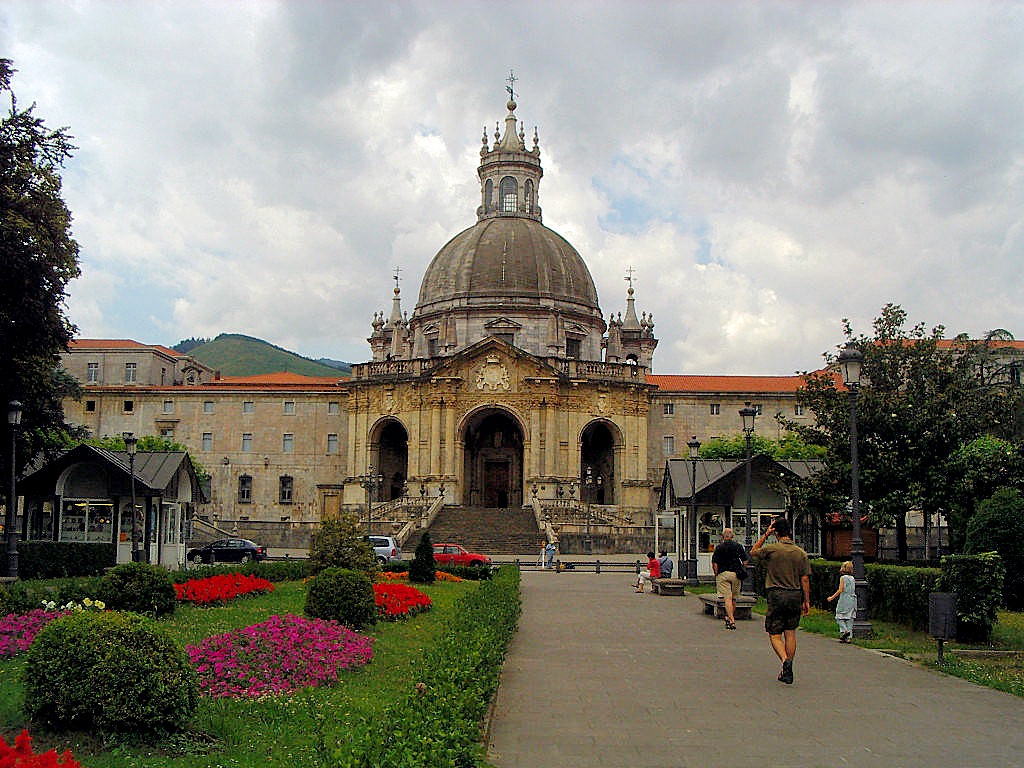
Photo: Wikimedia Commons contributor · CC BY-SA 3.0 · Wikimedia Commons
Sanctuary of Loyola is a cultural property in Azpeitia, Spain. Ignatius of Loyola was born here in 1491. The free Lokali audio guide runs 7 minutes.
✓ Published October 2026 · how we write these guides
Visitor facts
| Lokali audio guide | 7 min · free |
|---|---|
| Type | Monument |
| Location | Azpeitia, Spain |
| Coordinates | 43.1744, -2.2824 |
| Languages | 50+, in the Lokali app |
The story
Listen for a moment. Water runs somewhere below, the Urola river moving through its green valley. Above you, a great grey dome rises out of the hills. The air here often smells of wet grass and cut stone. Mist clings to the slopes of the mountains around you. This is the Sanctuary of Loyola, between the towns of Azpeitia and Azkoitia, in the Basque province of Gipuzkoa. It is a very large Baroque church in a small rural valley. That contrast is the first thing most visitors feel.
The reason this sanctuary exists is a single family house. Inside the complex, wrapped by the later buildings, stands the old tower-house of the Loyola family. In 1491, a boy was born there. He was the youngest of many children of a minor Basque noble family. His name was Íñigo López de Loyola. The world now knows him as Ignatius of Loyola, founder of the Jesuits. Everything you see, the dome, the colonnades, the long wings, was built to honour that one house.
Before you go inside, look closely at the tower-house itself. It has two very different halves. The lower walls are rough, heavy stone, built like a small fortress. The upper part is made of warm red brick, with decorative patterns. That change in material carries a story. In the late Middle Ages, Basque noble families fought long, bitter feuds over land and power. The Crown punished some of these families by ordering their towers cut down.
According to the traditional account, the Loyola tower lost its upper floors this way. The family later rebuilt the top in brick, in the Mudéjar style, a Spanish building tradition shaped by Islamic craftsmanship and its love of geometric brickwork. So the house you see is really two eras stacked on top of each other. The stone shows the age of feuding clans. The brick shows a family that recovered its standing. It is a small lesson in Basque history, written in building materials.
Now the turning point. As a young man, Íñigo was a soldier and a courtier, not a saint. He cared about honour, fine clothes and military glory. In 1521, he was defending the city of Pamplona against a French army. A cannonball struck him and badly injured his legs. The French soldiers, impressed by his courage, carried him home. He came back to this tower, in great pain, to recover. He spent many months in bed.
Here comes a detail many visitors miss. Ignatius asked for books of romance and chivalry to pass the time. The house did not have any. Instead, he was given a life of Christ and a collection of stories about the saints. He read them slowly, again and again. He began to notice how different thoughts left him feeling. Dreams of glory left him empty. Thoughts of following the saints left him calm and hopeful. That simple observation later grew into his famous method of prayer.
The room where this change took place is now called the Chapel of the Conversion. It sits on an upper floor of the tower-house. Walking through the old rooms, you move from one quiet space to the next. The floors creak. The ceilings are low and wooden. Compared with the grand church outside, it feels very human and very small. Many visitors find this the most moving part of the whole visit. It is a family home first, a shrine second.
In 1522, after his recovery, Ignatius left this valley. He travelled to the monastery of Montserrat and then to the town of Manresa, both in Catalonia. Today a long-distance pilgrimage route, the Ignatian Way, follows his footsteps from Loyola towards Manresa. Years later, in Rome, he and a small group of companions founded the Society of Jesus. The Pope approved it in 1540. Jesuits went on to build schools and universities across the world. Some of that global story begins in this quiet valley.
So how did a family tower gain a basilica? Ignatius was declared a saint in 1622. Later in that century, the Spanish queen, Mariana of Austria, acquired the Loyola house and gave it to the Jesuits. A grand building project followed. The design is linked to the Italian architect Carlo Fontana, who worked in Rome. That is why the sanctuary feels so Roman in spirit. Construction took many decades and continued well into the eighteenth century.
Step back and look at the basilica. Its plan is circular, crowned by a large dome. Around the drum of the dome, windows let light fall into the centre of the church. A broad staircase and an entrance porch lead up to the doors. Notice the stone. Much of it is local grey stone from these hills, so the building matches the colour of the land. On a cloudy Basque day, the dome and the sky can look almost the same shade.
Inside, the mood changes completely. The circular space pulls your eyes upward. Coloured marbles, gilded altars and carved decoration surround you. This is late Baroque at its most decorative, a style designed to make visitors feel wonder. Stand in the centre and turn slowly. The space is built so that everything points to the middle and to the dome above. Sound behaves differently here too. Footsteps and quiet voices rise and echo under the curve of the dome.
The sanctuary is still a living place. Jesuits live and work here, and pilgrims come from many countries. You may hear Spanish, Basque and many other languages around you. Basque, called Euskara, is one of the oldest languages in Europe, unrelated to its neighbours. You will see it on local signs. The feast of Saint Ignatius falls on 31 July, and it is an important day for Azpeitia. On that day the valley fills with people, music and celebration.
Before you leave, walk out into the gardens and look back. From a little distance, you can see the whole idea of the place. A modest stone and brick house sits inside a vast Baroque frame, like a jewel in a setting. Behind it, green mountains close the valley. Cows may graze nearby, and church bells mark the hours.
Take a final moment here. Listen again for the river. Notice the grey dome against the hills, and the small brick tower within it. A wounded soldier once lay in that house, reading the only books he could find. As you walk away, look back once more at that red brick top. It is still the heart of everything around it.
Key facts
What to look for
Practical tips
Common questions
Is there a free audio guide to Sanctuary of Loyola?
Yes — the Lokali app narrates Sanctuary of Loyola free of charge in 50+ languages. The guide runs about 7 minutes, covers the history, what to look for on site and practical tips, and works offline once downloaded.
Where is Sanctuary of Loyola?
Sanctuary of Loyola is in Azpeitia, Spain, at 43.1744, -2.2824. Tap the map link on this page for directions from where you are.
What is Sanctuary of Loyola known for?
Ignatius of Loyola was born here in 1491. Cannonball wound at Pamplona in 1521 led to his conversion.
What should you look for at Sanctuary of Loyola?
Rough stone lower walls of the old tower-house. Red Mudéjar brickwork on the tower's upper floors. Chapel of the Conversion in the upper rooms.
What should you know before visiting Sanctuary of Loyola?
Visit the tower-house rooms before entering the basilica. Bring a rain layer for sudden Basque valley showers.
On the map
Opens directions to Sanctuary of Loyola from your location.
More to see near Sanctuary of Loyola

Hear Sanctuary of Loyola in your language
The full story, narrated, in 50+ languages. Download it before you go and it plays offline, at your own pace, with no ticket and no tour group.