
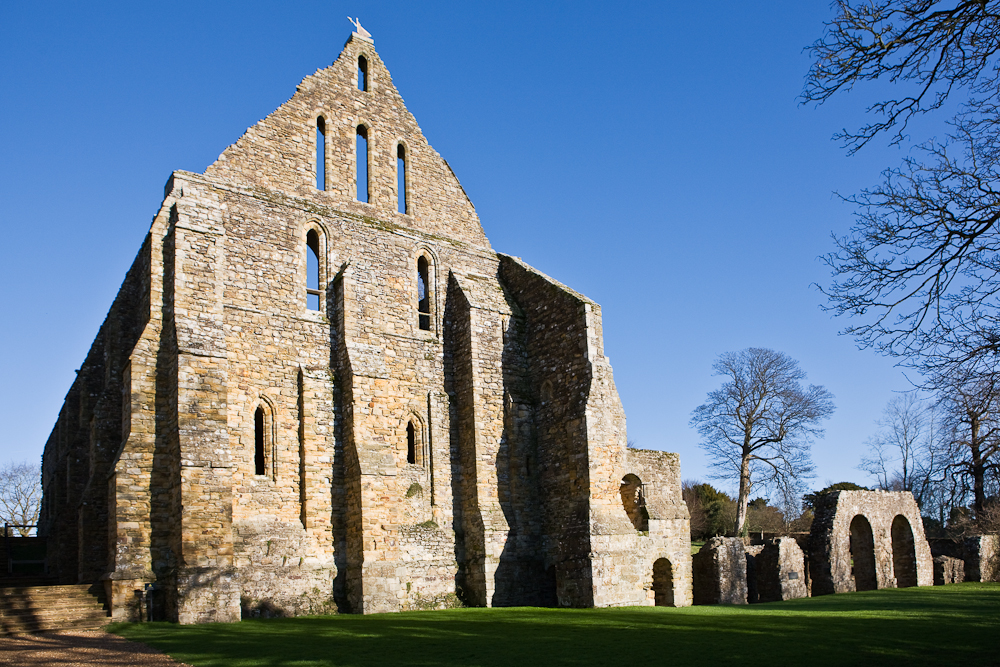
Photo: Antony McCallum · CC BY-SA 3.0 · Wikimedia Commons
Bodiam Castle is a 14th-century moated castle near Robertsbridge in East Sussex, England, UK. Built by Sir Edward Dalyngrigge, a Hundred Years' War knight. The free Lokali audio guide runs 6 minutes.
✓ Published October 2026 · how we write these guides
Visitor facts
| Lokali audio guide | 6 min · free |
|---|---|
| Type | Castle |
| Location | Battle, United Kingdom |
| Coordinates | 51.0023, 0.5435 |
| Official website | nationaltrust.org.uk |
| Languages | 50+, in the Lokali app |
The story
Listen first to the water. Ducks paddle across the moat, and now and then a large fish breaks the surface with a soft splash. The castle sits in the middle of this still green water like a stone box. Its walls drop straight into their own reflection. On a calm morning you see two castles, one standing and one upside down, and the line between them is hard to find.
This is Bodiam Castle, in the Rother valley of East Sussex, a short drive from the town of Battle. It was built in the late fourteenth century by Sir Edward Dalyngrigge. He was a knight who had made his fortune fighting in France during the Hundred Years' War, the long struggle between the English and French crowns. In 1385 he received a royal licence from King Richard the Second to fortify his manor house.
The official reason was defence. French raiders were attacking the south coast in those years, and the River Rother was then navigable much further inland than it is today. A castle here could, in theory, guard the valley. That is the story written on the licence. Yet historians have argued about it for decades... and the argument is part of what makes Bodiam interesting.
Look at the shape as you walk around the moat. The plan is almost a perfect square. There is a round tower at each corner, and a square tower in the middle of each wall. The largest of these is the gatehouse on the north side. Everything is symmetrical and tidy. It looks exactly like a child's drawing of a castle — and that neatness is the first clue that this building was also about appearances.
Here is the debate in simple terms. Some scholars see a real fortress, ready for war. Others notice that the walls are fairly thin for serious siege warfare, and that the moat and the surrounding ponds were arranged to make the castle look grander from the approach. In their view, Bodiam was a statement of status. A newly rich knight was telling the world that he had arrived. The truth may well be a mixture of both.
Now walk towards the gatehouse. The path once reached the castle by a series of bridges and an island, turning the visitor so that the side of their body faced the walls. Defenders on the towers could watch every step. Above the gate, look up for the carved coats of arms. These were badges of family and loyalty, and they announced whose house you were entering.
Inside the gate passage, stop and look up again. The vaulted ceiling has small openings in it. These are often called murder holes. From above, defenders could drop missiles on anyone who forced their way in, or pour water to put out fires set against the gates. Here is the first detail most visitors miss. Bodiam still has a wooden portcullis, the heavy grid gate that slid down in grooves. It is thought to be one of the oldest surviving portcullises in England.
Pass through and the surprise comes quickly. The castle is a shell. The outer walls stand almost to their full height, but the inside is open to the sky. Grass covers the courtyard. Around the edges you can trace the outlines of rooms — a great hall, kitchens, private chambers, a chapel. Fireplaces hang high up on the walls, with no floors left beneath them. Look for them and try to picture the rooms that once held them.
So what happened to the interior? After Dalyngrigge's time, the castle passed through several families. During the seventeenth century, in the period of the English Civil War, the castle was partly dismantled, and much of its inside was removed or left to decay. For a long time afterwards Bodiam was a picturesque ruin, covered in ivy. Artists came to paint it and travellers came to stare at it.
The second surprise is how close Bodiam came to disappearing. In 1829 the castle was bought by John Fuller, a local landowner and politician known to many as Mad Jack. He is said to have bought it partly to stop it being pulled down. Later owners carried out repairs. Then, in 1916, it was bought by Lord Curzon, a former Viceroy of India. He restored the walls and the moat, and on his death in 1925 he left the castle to the National Trust.
If the towers are open, climb one of the spiral staircases. The steps are narrow and worn into shallow dips by centuries of feet. Keep one hand on the central column. At the top, the battlements open onto wide views of the valley. You can see water meadows, hedges, and the line of the river. On the right day, you might hear the whistle of a steam train on the heritage railway that runs nearby.
As you walk back around the grounds, notice the low concrete structure near the castle. It is a pillbox, a small gun post built during the Second World War when Britain prepared for a possible invasion. It is a strange pairing — a medieval tower and a twentieth century bunker, both built to face the same fear of attack from across the Channel, more than five hundred years apart.
Before you leave, find a quiet spot on the grass by the moat. Look back at the gatehouse and the corner towers in the water. Watch the light move across the sandstone, which turns from grey to soft gold as the sun shifts. A knight built this to be seen, and people are still looking. Listen once more to the ducks and the small splash of a fish... and let the castle stay in the water behind you as you walk away.
Key facts
What to look for
Practical tips
Common questions
Is there a free audio guide to Bodiam Castle?
Yes — the Lokali app narrates Bodiam Castle free of charge in 50+ languages. The guide runs about 6 minutes, covers the history, what to look for on site and practical tips, and works offline once downloaded.
Where is Bodiam Castle?
Bodiam Castle is near Battle, United Kingdom, at 51.0023, 0.5435. Tap the map link on this page for directions from where you are.
What is Bodiam Castle known for?
Built by Sir Edward Dalyngrigge, a Hundred Years' War knight. Royal licence to fortify granted by Richard the Second, 1385.
What should you look for at Bodiam Castle?
Carved coats of arms above the main gatehouse entrance. Murder holes in the vaulted ceiling of the gate passage. Fireplaces hanging high on walls with no floors beneath.
What should you know before visiting Bodiam Castle?
Arrive early on a calm day for clear moat reflections. Wear shoes with grip for the worn spiral staircases.
When is the best time to visit Bodiam Castle?
Arrive early on a calm day for clear moat reflections.
On the map
Opens directions to Bodiam Castle from your location.
More to see near Bodiam Castle


Hear Bodiam Castle in your language
The full story, narrated, in 50+ languages. Download it before you go and it plays offline, at your own pace, with no ticket and no tour group.