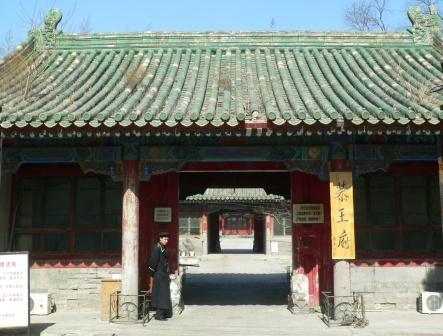
Photo: User zh:User:用心阁 on zh.wikipedia · CC BY-SA 3.0 · Wikimedia Commons
Prince Gong's Mansion is a building in Beijing, China. First built for Heshen, Qianlong Emperor's favourite official. The free Lokali audio guide runs 7 minutes.
✓ Published October 2026 · how we write these guides
Visitor facts
| Lokali audio guide | 7 min · free |
|---|---|
| Type | Palace |
| Location | Beijing, China |
| Coordinates | 39.9366, 116.3799 |
| Official website | pgm.org.cn |
| Languages | 50+, in the Lokali app |
The story
Start with the gate. Before you pass through, listen for a moment. Behind you are the narrow lanes of the Shichahai district: bicycle bells, rickshaw drivers calling out, the low hum of a city of millions. Ahead are grey brick walls, red lacquered doors, and a sudden hush. Once you step inside Prince Gong's Mansion, the noise of Beijing fades quickly. The walls do more than mark a property line. They were built to hold a whole private world.
This is a wangfu, a princely mansion, the kind of residence the Qing dynasty granted to its highest nobles. Hundreds of these compounds once stood across the city. Most were demolished, divided up, or swallowed by later buildings. This one survives as one of the largest and most complete examples of its kind. It has two parts. In front are the formal residential courtyards. Behind them is a large garden of rocks, water, and pavilions.
The first owner was not a prince. In the late eighteenth century, this land belonged to Heshen, the favourite official of the Qianlong Emperor. Heshen rose from a modest guard post to become one of the most powerful men in the empire. He was also one of the most corrupt. He built this residence on a scale that pushed hard against the rules about who could live in such grandeur.
His luck ended with his patron's life. Qianlong died in 1799. Within weeks, the new Jiaqing Emperor had Heshen arrested. Heshen was ordered to take his own life, and the state seized his fortune. Popular accounts claim his wealth exceeded the imperial treasury's yearly income for many years. Treat that figure as a story rather than exact accounting. Still, the fall was real and sudden. The house you are standing in became evidence in one of the most famous corruption cases in Chinese history.
After Heshen, the compound passed to a member of the imperial family. Then, in 1851, the Xianfeng Emperor gave it to his younger half-brother, Yixin, known as Prince Gong. That is the name that stayed. Prince Gong became a central figure in a troubled period. In 1860, Anglo-French forces occupied Beijing, and he was left in the capital to negotiate with them. Later he helped lead the government's first office for dealing with foreign powers. He was, in a sense, the Qing court's diplomat at a time when China was being forced to face the wider world.
As you walk through the front courtyards, notice the order of things. Buildings face south. Halls sit on a central axis, with side wings arranged symmetrically on either side. This is the logic of the siheyuan, the traditional Beijing courtyard house, expanded to an aristocratic scale. Each gate you pass through takes you a little deeper into private space. Guests of lower rank stopped earlier. Family members went further in.
Look up at the roofs. Their grey tiles are a quiet detail that carries real meaning. In imperial Beijing, glazed yellow tiles were reserved for the emperor. Princes used other colours and materials according to strict rules. Rank was written into every roofline, every number of bays, and every decorative beam. A visitor in the nineteenth century could read a household's status before anyone spoke.
At the back of the residential section, a long two-storey building stretches across the full width of the compound. Locals often say it holds ninety-nine and a half rooms, because one hundred was thought too perfect for anyone but the emperor. That is a traditional saying, so take it as folklore. What you can check yourself are the windows. Walk along the facade and compare their shapes. They are not all the same.
Now pass into the garden. Here the straight lines give way to winding paths, artificial hills, and water. Chinese gardens of this type were designed as journeys. Each turn frames a new view, like moving from one painting to the next. Rock formations stand in for mountains, and ponds stand in for lakes. The idea was to hold a landscape within the walls of a city home.
Watch for bats. In Chinese, the word for bat sounds like fu, the word for good fortune. So bats appear across the garden as a symbol of blessing, in carvings, in painted beams, and in architectural shapes. One pond is often described as shaped like a bat. Once you start looking, you may find the motif in places you would never expect.
The garden's most famous treasure sits inside a small grotto beneath an artificial hill. It is a stone tablet carved with a single character, fu, meaning blessing. Tradition holds that the calligraphy came from the hand of the Kangxi Emperor, who reigned in the late seventeenth and early eighteenth centuries. Visitors often reach out to touch it for good luck. Expect a queue here. Many people come to this mansion mainly for this one stone.
There is one more story worth knowing, and it is a literary one. Some scholars have suggested that this garden inspired the Grand View Garden in Dream of the Red Chamber, the great eighteenth-century Chinese novel about an aristocratic family in decline. That link is a theory, not proven fact. But it is easy to understand the idea. A rich household, a garden of hidden pavilions, and a sudden fall from favour sound very much like the world of that novel.
In the twentieth century, the compound had several lives. It was used by a Catholic university and later by various institutions, and it was later restored and opened fully to the public. Today it serves a different purpose. It is a place where people can see how the Qing elite lived, worked, and showed their status. The halls are quieter now than when servants moved between them.
Before you leave, stop in a corner of the garden and look back toward the halls. Notice the grey brick, the red pillars, and the green of the trees against the old roof tiles. Listen to how the city still feels far away. Heshen built this house for display. Prince Gong lived here while his country faced great change. Now it belongs, in a small way, to everyone who walks through its gates.
Key facts
What to look for
Practical tips
Common questions
Is there a free audio guide to Prince Gong's Mansion?
Yes — the Lokali app narrates Prince Gong's Mansion free of charge in 50+ languages. The guide runs about 7 minutes, covers the history, what to look for on site and practical tips, and works offline once downloaded.
Where is Prince Gong's Mansion?
Prince Gong's Mansion is in Beijing, China, at 39.9366, 116.3799. Tap the map link on this page for directions from where you are.
What is Prince Gong's Mansion known for?
First built for Heshen, Qianlong Emperor's favourite official. Heshen was ordered to take his life in 1799.
What should you look for at Prince Gong's Mansion?
Kangxi's carved fu character stone hidden inside a grotto. Bat motifs carved and painted throughout the garden. Different window shapes along the long rear building.
What should you know before visiting Prince Gong's Mansion?
Arrive early to avoid the long queue at the grotto. Combine your visit with a walk around nearby Houhai Lake.
When is the best time to visit Prince Gong's Mansion?
Arrive early to avoid the long queue at the grotto.
On the map
Opens directions to Prince Gong's Mansion from your location.
More to see in Beijing


Hear Prince Gong's Mansion in your language
The full story, narrated, in 50+ languages. Download it before you go and it plays offline, at your own pace, with no ticket and no tour group.