
Photo: FANG Chen · CC BY-SA 2.0 · Wikimedia Commons
Shichahai is a park. It is near Beijing, China. Three linked lakes: Qianhai, Houhai, and Xihai. The free Lokali audio guide runs 7 minutes.
✓ Published October 2026 · how we write these guides
Visitor facts
| Lokali audio guide | 7 min · free |
|---|---|
| Type | Park |
| Location | Beijing, China |
| Coordinates | 39.9380, 116.3871 |
| Languages | 50+, in the Lokali app |
The story
Start with the water. Stand at the edge of the lake and listen for a moment. There is the soft knock of a wooden boat against the stone embankment, the creak of an oar, and a bicycle bell somewhere behind you. Willow branches hang low enough to brush the surface. The air smells faintly of damp stone and, depending on the hour, roasting chestnuts or charcoal. This is Shichahai, a chain of lakes in the old heart of Beijing.
Shichahai is not one lake but three, linked together like beads on a string. The southernmost is Qianhai, the Front Lake. North of it lies Houhai, the Back Lake, the largest of the three. Further northwest is Xihai, the West Lake, the quietest and least visited. Together they run through a district of low grey courtyard houses, only a short walk from the Forbidden City. In a city of wide avenues and towers, this is a place built at a human scale.
The name itself carries a small puzzle. In Chinese, Shichahai is usually translated as the Sea of Ten Temples. Beijing locals have long called lakes "seas", so the word sounds grander than the water really is. The ten temples are harder to pin down. Some accounts say ten temples once stood around the shore. Others say the number was never meant to be counted exactly. Either way, several old temples do still survive in the lanes nearby, tucked between houses and shops.
Here is the first thing most visitors miss. These lakes were once part of a working waterway. During the Yuan dynasty, the Mongol dynasty that ruled China in the thirteenth and fourteenth centuries, this water was connected to the Grand Canal. The Grand Canal was a long artificial river that carried grain and goods from the south. Boats unloaded their cargo right here, in the middle of the capital. The engineer Guo Shoujing designed the water supply that made this possible. Today the barges are gone, and pleasure boats float where grain ships once waited.
If you walk to the narrow neck between the Front Lake and the Back Lake, you will find Yinding Bridge, the Silver Ingot Bridge. It is small and low, made of stone, and easy to cross without noticing. Yet it was once famous. The view from this bridge toward the Western Hills was counted among the classic scenic views of old Beijing. On a clear day, especially after rain or wind has cleared the air, you can still see the faint blue line of the hills beyond the rooftops.
Round the shore of Houhai and you enter the hutongs. A hutong is a narrow lane lined with siheyuan, the traditional courtyard houses of Beijing. Their grey brick walls are plain from the outside. The life is behind the gates. Look for the stone blocks on either side of old doorways. Their shape and carving once showed the rank of the family inside. Round drum shapes often suggested a military family, while square ones were linked to civil officials.
One of the lanes near the Silver Ingot Bridge is called Yandai Xiejie, Tobacco Pouch Slanting Street. It is one of the few diagonal streets in a city laid out on a strict grid. Its curving shape is said to resemble a long tobacco pipe. In the Qing dynasty, the last imperial dynasty, shops here are said to have sold pipes and smoking goods. Today it is lined with snack stalls, small craft shops, and cafés, and it is often crowded in the afternoon.
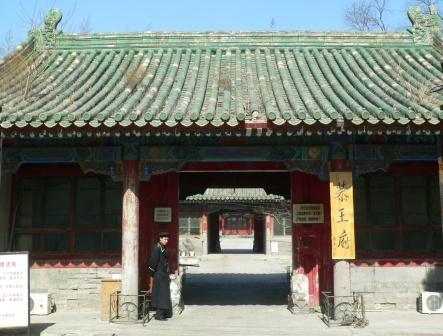
The lakeside was also a favoured place for the powerful. A short walk from Qianhai is Prince Gong's Mansion, one of the grandest surviving princely residences in Beijing. It was first built for Heshen, a high official of the Qianlong Emperor in the eighteenth century, who became notorious for his enormous wealth. On the north shore of Houhai stands the former residence of Soong Ching-ling, widow of Sun Yat-sen and an important figure in modern Chinese history. Both are open to visitors and need separate tickets.
Now for the second surprise. Shichahai changes completely with the seasons. In summer, lotus plants spread across parts of the Front Lake, and paddle boats move slowly between them. In deep winter, when the ice is thick enough, sections of the lakes become open-air skating rinks. Families push each other on chair sleds, and children slide across the same water that once carried grain boats. And some hardy local swimmers break the ice and swim through the coldest months.
The human texture here matters as much as the buildings. Early in the morning, older residents gather along the shore. Some practise tai chi, a slow martial art done as exercise. Some play the erhu, a two-stringed Chinese fiddle. Others walk birds in covered cages, then hang the cages in the trees so the birds can sing together. Later in the day, pedicab drivers wait at the corners, offering rides through the lanes.
When the sun goes down, the lakes take on a different character. Since around the early 2000s, the shore of Houhai has filled with bars and restaurants. Red lanterns light up the water, live music spills out of open doorways, and the reflections move with every passing boat. Some people love this energy. Others prefer the calmer evening at Xihai, where the shore is darker and the sound is mostly frogs and the wind.
At the northern end of the lakes, near the Drum Tower, look for Wanning Bridge. It is a modest stone bridge, but its history goes back to the Yuan dynasty. During restoration work, old carved stone water creatures were found along its banks. They stand as small guardians at the water's edge, and few people stop to look at them. Nearby, the Drum and Bell Towers rise above the rooftops. They once kept time for the entire city.
Before you leave, find a spot on the stone edge of the lake and simply watch for a while. Notice the line of the willows, the grey roofs beyond, the light on the water. A cyclist rings a bell. An oar dips and lifts. This water has been part of Beijing's daily life for more than seven centuries, first for trade and now for rest. As you walk back into the lanes, listen for the sounds fading behind you.
Key facts
What to look for
Practical tips
Common questions
Is there a free audio guide to Shichahai?
Yes — the Lokali app narrates Shichahai free of charge in 50+ languages. The guide runs about 7 minutes, covers the history, what to look for on site and practical tips, and works offline once downloaded.
Where is Shichahai?
Shichahai is near Beijing, China, at 39.9380, 116.3871. Tap the map link on this page for directions from where you are.
What is Shichahai known for?
Three linked lakes: Qianhai, Houhai, and Xihai. Name usually translates as Sea of Ten Temples.
What should you look for at Shichahai?
Low stone arch of the Silver Ingot Bridge. Carved stone blocks beside old courtyard doorways. Diagonal curve of Tobacco Pouch Slanting Street.
What should you know before visiting Shichahai?
Visit early morning to see tai chi and bird walkers. Choose Xihai for a quieter evening walk.
When is the best time to visit Shichahai?
Come in deep winter to try skating on the ice.
On the map
Opens directions to Shichahai from your location.
More to see in Beijing


Hear Shichahai in your language
The full story, narrated, in 50+ languages. Download it before you go and it plays offline, at your own pace, with no ticket and no tour group.