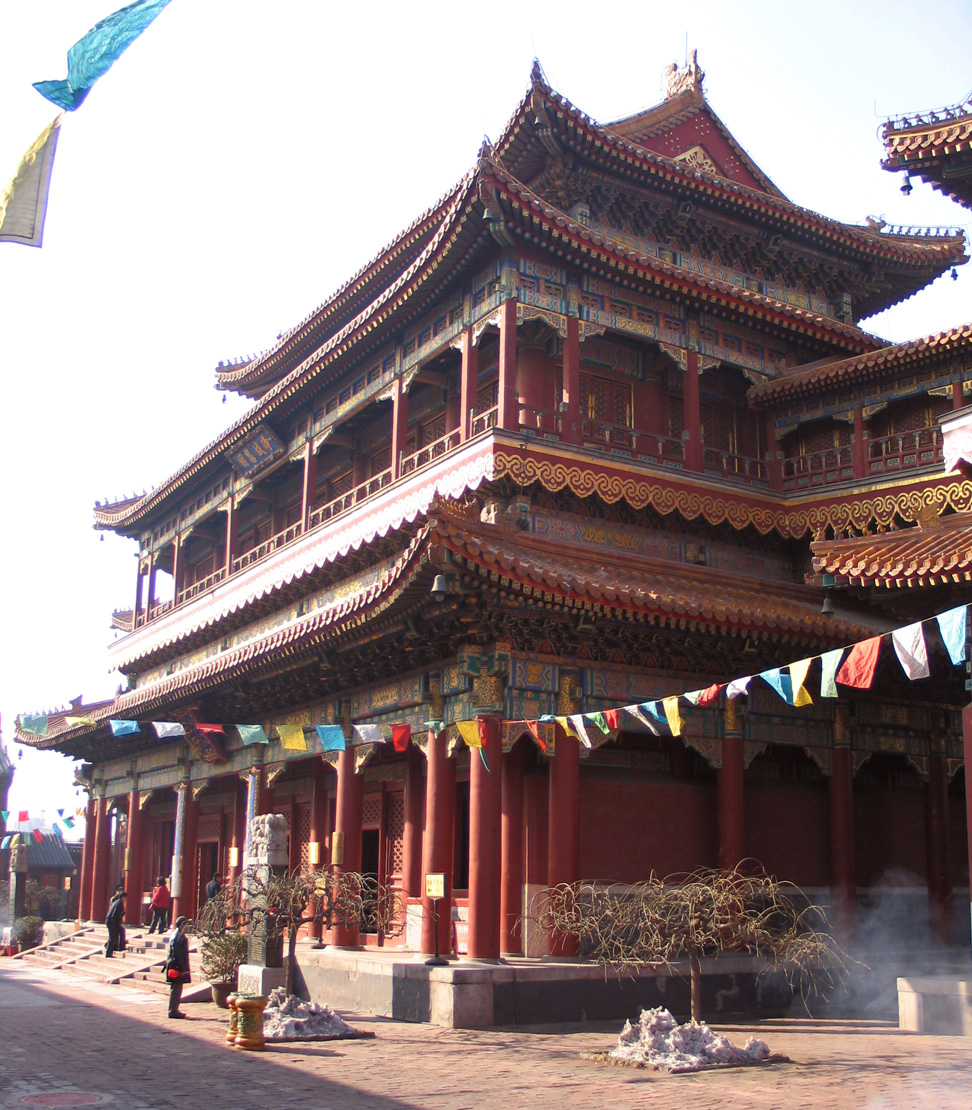
Photo: Shakti · CC BY-SA 3.0 · Wikimedia Commons
Yonghe Temple is a tibetan lama temple in Beijing. Built in 1694 as Prince Yong's residence. The free Lokali audio guide runs 7 minutes.
✓ Published October 2026 · how we write these guides
Visitor facts
| Lokali audio guide | 7 min · free |
|---|---|
| Type | Palace |
| Location | Beijing, China |
| Coordinates | 39.9471, 116.4109 |
| Official website | yonghegong.cn |
| Languages | 50+, in the Lokali app |
The story
The first thing you notice is the smoke. Thick, sweet incense drifts across the courtyard in slow grey ribbons. Under the smoke there is a low murmur of voices, the clack of shoes on worn stone, and now and then the deep note of a bell. Look up, and the roofs shine a warm imperial yellow against the Beijing sky. Welcome to Yonghe Temple, which many visitors know simply as the Lama Temple.
Before we go further, here is the first surprise. This place did not begin as a temple at all. In 1694, the Kangxi Emperor of the Qing dynasty gave these grounds to one of his sons as a princely residence. That son was Prince Yong. Years later, he took the throne as the Yongzheng Emperor. So the halls around you were once a home: rooms for family, servants, and the daily business of a Manchu prince.
When a prince became emperor, his old home could not simply become an ordinary house again. Tradition held that a place touched by an emperor was too elevated for common use. Part of the residence became a palace, and the rest became a site for Buddhist practice. After the Yongzheng Emperor died in 1735, his son, the Qianlong Emperor, made a decisive change. In 1744, he turned the complex into a full lamasery, a monastery for Tibetan Buddhist monks.
That word, lama, needs a short explanation. In Tibetan Buddhism, a lama is a teacher, someone trusted to guide others in practice. The monks here belonged to the Gelug school, the tradition associated with the Dalai Lama. The Qing emperors were Manchu, not Han Chinese. They ruled a huge empire that included Mongols and Tibetans, and many of those peoples followed Tibetan Buddhism. A major lamasery in the capital was an act of faith, but it was also an act of politics.
As you walk north, notice how the temple is laid out. It follows a single straight axis, like a spine running from south to north. Each courtyard leads to a gate, and each gate leads to a larger hall. The buildings rise as you go, so the journey itself feels like an ascent. Chinese palace design works this way, and the temple keeps the rhythm of its royal past.
The first major building is the Hall of the Heavenly Kings. Four large guardian figures stand along the sides, one for each direction of the world. They keep evil away from the sacred space beyond. In the centre sits a cheerful, round-bellied Buddha, the laughing figure many people recognise. Walk behind him, and you will find a warrior guardian facing the other way, watching the inner courtyard. Most visitors hurry past him... but he is the one protecting the rest of your walk.
In the courtyard ahead, look for a square pavilion that shelters a large stone stele, a carved standing tablet. Here is the second surprise. The text on it is written in four languages: Chinese, Manchu, Mongolian, and Tibetan. It records an essay by the Qianlong Emperor about Tibetan Buddhism and how the court should manage it. Four scripts on one stone tell you clearly who this empire was trying to speak to.
The essay also connects to a famous object kept at the temple: a golden urn. The Qing court introduced a system of drawing lots from such urns to help confirm the reincarnations of high lamas. One urn was sent to Lhasa in Tibet, and one was kept here in Beijing. It was a quiet but powerful tool. Whoever controlled the lottery had a hand in choosing spiritual leaders.
Now you reach the main halls, one after another. The Hall of Harmony and Peace holds statues of Buddhas of the past, present, and future. Further on, the Hall of the Wheel of the Law serves as a large assembly hall for monks. Inside, look for a carved mountain covered with tiny figures of arhats, enlightened followers of the Buddha. Lean close, and you will see small faces and robes cut into the wood. Each one is different.
Then comes the highest building on the axis, the Pavilion of Ten Thousand Happinesses. Step inside, and let your eyes travel upward. A standing statue of Maitreya, the Buddha of the future, rises through several floors. The figure is carved from a single trunk of white sandalwood. It stands about eighteen metres above the floor, with more of the trunk said to extend below ground. It holds a Guinness World Record as the tallest statue of its kind carved from one piece of wood.
The story of that tree reaches far beyond Beijing. According to the usual account, the Seventh Dalai Lama sent the sandalwood as a gift to the Qianlong Emperor. Moving a trunk that size across mountains and plains must have taken enormous effort. The pavilion was built around the statue, so the figure was in place before the walls closed in. Stand at his feet for a moment. His gaze points over your head, toward the door and the courtyard you just crossed.
This is not only a museum. Monks still live and practise here, and many people come to pray. You will see visitors holding incense sticks to their foreheads and bowing in each direction. Others kneel on cushions in front of the halls, or turn prayer wheels in a slow circle. Move quietly, and keep to the side when someone is praying. Photography inside the halls is generally not allowed, so the courtyards are where your camera belongs.
When you leave, the streets nearby carry the temple outward. Small shops sell incense, prayer beads, and Buddhist images. Across the road, a quieter lane leads to the Confucius Temple and the old Imperial Academy, where scholars once studied for state examinations. Two very different traditions sit almost side by side. Pause at the gate before you go. Breathe in the smoke once more, listen for the bell, and notice how the yellow roofs hold the light as the city moves around them.
Key facts
What to look for
Practical tips
Common questions
Is there a free audio guide to Yonghe Temple?
Yes — the Lokali app narrates Yonghe Temple free of charge in 50+ languages. The guide runs about 7 minutes, covers the history, what to look for on site and practical tips, and works offline once downloaded.
Where is Yonghe Temple?
Yonghe Temple is in Beijing, China, at 39.9471, 116.4109. Tap the map link on this page for directions from where you are.
What is Yonghe Temple known for?
Built in 1694 as Prince Yong's residence. Prince Yong later ruled as the Yongzheng Emperor.
What should you look for at Yonghe Temple?
Yellow glazed roof tiles marking imperial rank. Warrior guardian behind the laughing Buddha, facing inward. Four scripts carved on the stele pavilion tablet.
What should you know before visiting Yonghe Temple?
Arrive early in the morning to avoid heavy crowds. Take the subway to Yonghegong station, Lines 2 and 5.
When is the best time to visit Yonghe Temple?
Arrive early in the morning to avoid heavy crowds.
On the map
Opens directions to Yonghe Temple from your location.
More to see in Beijing


Hear Yonghe Temple in your language
The full story, narrated, in 50+ languages. Download it before you go and it plays offline, at your own pace, with no ticket and no tour group.