
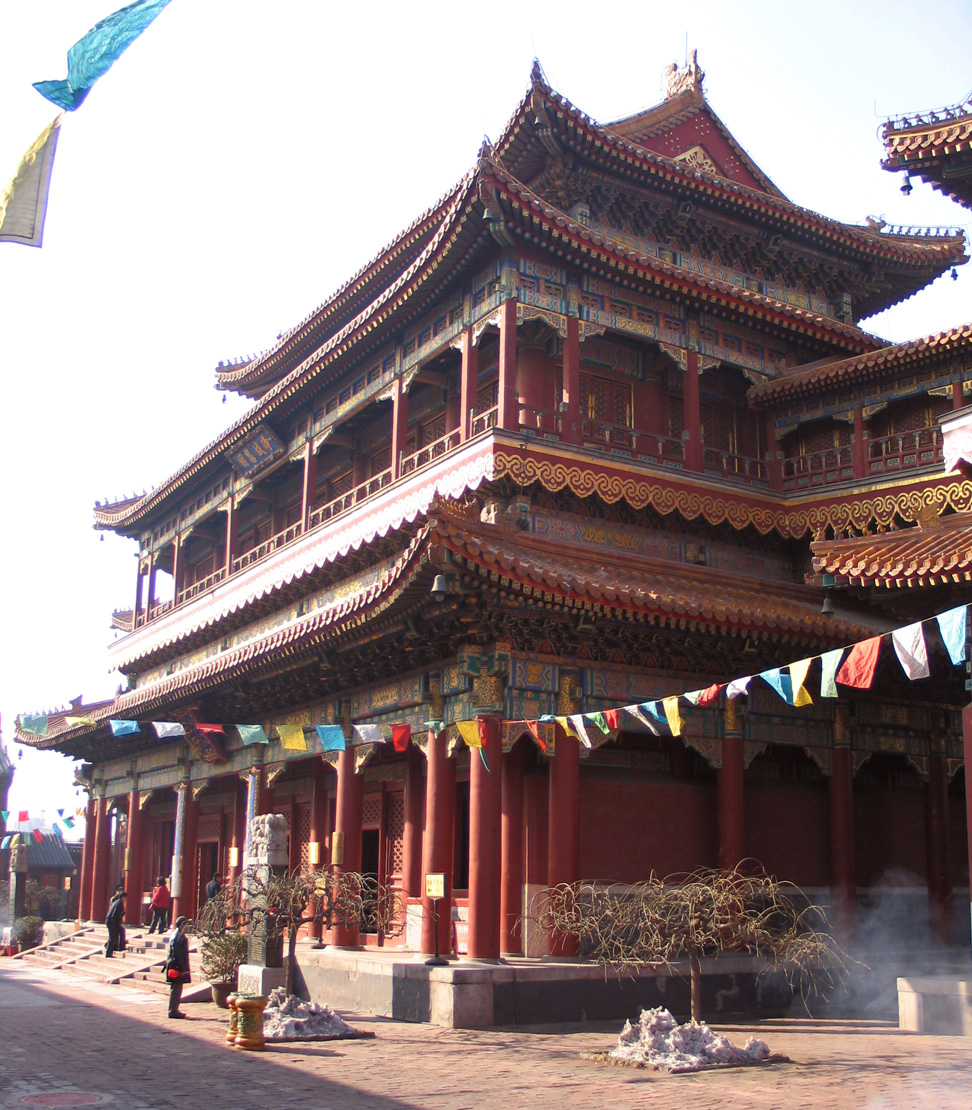
Photo: David290 · CC BY-SA 4.0 · Wikimedia Commons
Temple of Earth is a building in Dongcheng District, China. Built under the Ming dynasty's Jiajing Emperor, sixteenth century. The free Lokali audio guide runs 7 minutes.
✓ Published October 2026 · how we write these guides
Visitor facts
| Lokali audio guide | 7 min · free |
|---|---|
| Type | Temple |
| Location | Beijing, China |
| Coordinates | 39.9514, 116.4097 |
| Official website | dtpark.com |
| Languages | 50+, in the Lokali app |
The story
Listen for a moment. Beyond the old walls, Beijing's traffic hums like a distant river. Inside, the sound drops away. You hear sparrows, the scrape of a broom on stone, perhaps the slow click of a mahjong tile from a bench under the trees. The ground underfoot is wide, flat paving, worn smooth by centuries of feet. This is the Temple of Earth, called Ditan in Chinese. It is one of the quietest imperial spaces in the capital, and one of the least crowded.
To understand this place, start with a simple idea. In old Chinese cosmology, heaven was round and the earth was square. Heaven was linked with yang, the bright and active force. Earth was linked with yin, the dark and receptive force. Emperors believed they stood between the two. Their duty was to keep both in balance, through ritual performed at exactly the right time and in exactly the right way. This temple was built to honour the earth half of that pair.
The temple dates from the Ming dynasty, in the sixteenth century, under the Jiajing Emperor. Before his reign, heaven and earth were worshipped together at a single site in the south of the city. The emperor changed that. He separated the rites and built new altars around Beijing. Heaven kept its place in the south. Earth received this site in the north. The sun was given an altar in the east, and the moon an altar in the west. Together, the four altars framed the imperial city like points on a compass.
So here is the first surprise. Most visitors to Beijing go to the Temple of Heaven, with its famous round blue-roofed hall. Very few realise that it has a partner. This temple is the other half of the same ritual system. Where Heaven is round, Earth is square. Where Heaven faces south, Earth sits in the north. Many details you see here are deliberate opposites of what stands across the city.
Walk toward the heart of the grounds, and you reach the main altar. It is called the Fangze Altar, which means roughly the Square Marsh or Square Pool. It is low, square, and built in two tiers. There is no tall hall on top, no grand roof. The emperor performed the rite here in the open air, under the sky, standing on the earth he was honouring. The plainness is the point. This is an altar that stays close to the ground.
The name, Square Pool, comes from a water channel that runs around the altar. Water belongs to yin in the old system, so a ring of water suited an altar to the earth. Look along the edges and you can follow the line of this channel. It turns the altar into a kind of island. In ritual terms, it marked a boundary between ordinary ground and sacred ground.
Now look at the colour of the tiles on the walls around you. They are yellow. Yellow was the colour of the earth in Chinese thought, and it was also the colour reserved for the emperor. At the Temple of Heaven, blue dominates, the colour of the sky. Here, yellow takes its place. Even the colour of a roof tile carried meaning in this world.
The second surprise is hidden in the numbers. At the Temple of Heaven, the builders used odd numbers, which were linked with yang and with heaven. At this altar, the design favours even numbers, linked with yin and with earth. Steps, stones, and divisions were planned with this in mind. You cannot see it at a glance. But as you walk across the paving, you are walking across a kind of mathematical prayer.
The great ceremony took place once a year, at the summer solstice. This was the longest day, when yang was at its peak and yin began to return. It was the right moment to honour the earth. The emperor came in procession, after days of fasting and purification. Musicians, officials, and attendants filled the grounds. Offerings were made not only to the earth itself, but to great mountains, rivers, and seas. On the altar, look for stone bases carved with mountain and wave shapes, linked with those offerings.
Near the altar stands a smaller hall, the Hall of the Imperial God of Earth. Spirit tablets were kept here between ceremonies. These were wooden tablets that represented the deities. On the day of the rite, they were carried out to the altar, and afterwards returned with care. The emperors stopped performing these ceremonies after the end of imperial rule in the early twentieth century. The temple grounds were later opened to the public as a park.
Today, the park belongs to the neighbourhood. In the morning, you may see people practising tai chi, the slow Chinese martial art. Others walk backwards along the paths for exercise, or sing together in small groups. Someone may be writing poetry on the pavement with a large brush dipped in water. The characters fade as they dry. During the Spring Festival, the Chinese New Year, the park hosts a popular temple fair, with food stalls, crafts, and performances.
If you are here in autumn, look up. The park is known for its ginkgo trees. In late autumn, their fan-shaped leaves turn a clear, buttery gold, and then fall all at once. For a short time, the paths are covered in a yellow carpet that matches the tiles on the walls. Photographers come for this moment. Locals come too, simply to walk through it.
Before you leave, stand for a moment near the square altar. Feel how low it sits, and how wide the sky looks above it. Then turn your attention to what is around you right now. The light on the yellow tiles. The old trees. The sound of the city just beyond the wall. Emperors once stood here to ask the earth for a good harvest. Now you are simply standing on it. As you walk out, notice how quickly the noise of Beijing returns.
Key facts
What to look for
Practical tips
Common questions
Is there a free audio guide to Temple of Earth?
Yes — the Lokali app narrates Temple of Earth free of charge in 50+ languages. The guide runs about 7 minutes, covers the history, what to look for on site and practical tips, and works offline once downloaded.
Where is Temple of Earth?
Temple of Earth is near Beijing, China, at 39.9514, 116.4097. Tap the map link on this page for directions from where you are.
What is Temple of Earth known for?
Built under the Ming dynasty's Jiajing Emperor, sixteenth century. Square altar reflects the belief that earth is square.
What should you look for at Temple of Earth?
Yellow glazed tiles topping the walls around the altar. Water channel running around the edge of the altar. Low two-tier square altar with no hall on top.
What should you know before visiting Temple of Earth?
Come early morning to see locals practising tai chi. Visit in late autumn for golden ginkgo leaves.
When is the best time to visit Temple of Earth?
Visit during Spring Festival for the traditional temple fair.
On the map
Opens directions to Temple of Earth from your location.
More to see in Beijing


Hear Temple of Earth in your language
The full story, narrated, in 50+ languages. Download it before you go and it plays offline, at your own pace, with no ticket and no tour group.