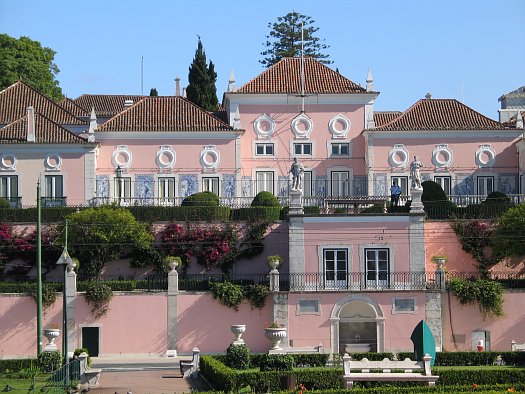
Photo: Wikimedia Commons contributor · CC BY-SA 2.0 · Wikimedia Commons
Belém Palace is a building in Santa Maria de Belém, Lisbon District, Portugal and official residence of the President of the Portuguese Republic. Official residence of the President of Portugal. The free Lokali audio guide runs 6 minutes.
✓ Published October 2026 · how we write these guides
Visitor facts
| Lokali audio guide | 6 min · free |
|---|---|
| Type | Palace |
| Location | Belém, Portugal |
| Coordinates | 38.6980, -9.2006 |
| Official website | presidencia.pt |
| Languages | 50+, in the Lokali app |
The story
Stand still for a moment on the wide square in front of the palace. Feel the small, uneven stones under your feet. This is Portuguese pavement, called calçada, set by hand in black and white. Ahead of you, a long facade glows in a soft shade of pink. Behind you, traffic hums along the riverside road. Beyond it, the Tagus moves slowly toward the Atlantic. The light here is wide and bright, and it carries the faint smell of salt.
This is Belém Palace. Today it is the official residence and workplace of the President of the Portuguese Republic. That fact surprises many visitors. They expect a head of state to live behind high walls and heavy gates. Instead, the palace sits openly on a public square, a short walk from cafés, tram stops and tour buses. Portugal's highest office works in the middle of an ordinary Lisbon afternoon.
The building did not begin as a seat of power. It started as a private residence for noble families, in an area that was then outside the city. Belém was a place of quintas, which are country estates with gardens and orchards that slope toward the water. The river was the main road. Wealthy families could arrive by boat and enjoy cooler air than in the crowded centre of Lisbon.
In the early eighteenth century, the estate passed to the crown. King John the Fifth bought it in the 1720s. He was a monarch with great ambitions and a large flow of gold from Brazil. Under royal ownership, the palace grew and changed. The kings used it as a summer retreat and a place for relaxation, close to the river and the open sky.
Now comes a moment that shaped all of Lisbon. On the morning of 1 November 1755, a massive earthquake struck the city. Fires and a tsunami followed. Much of central Lisbon was destroyed, and many thousands of people died. Historical accounts say the royal family was away from the centre, in Belém, that day. Their absence from the main royal palace by the river likely saved their lives.
That royal palace in the centre was lost. King Joseph the First was deeply shaken by the disaster. Many accounts say he became afraid of living under stone roofs. For years, the court lived in a large wooden complex on the hill of Ajuda, not far from here. Belém Palace survived the earthquake in reasonable condition, and it became even more important to the royal household in the years after.
Look at the palace again with that story in mind. It does not look like a fortress or a grand baroque statement. It is long, low and calm. The architecture is restrained, with regular windows and a pale, warm colour. It feels more like a refined country house than a monument to power. That modest scale is part of its character, and part of why it suits a republic.
In 1910, Portugal ended its monarchy and became a republic. In the decades that followed, the palace became linked with the presidency. Over the twentieth century, Portugal lived through the First Republic, a long dictatorship known as the Estado Novo, and then the Carnation Revolution of 1974, which restored democracy. Through all these changes, this building remained a symbol of the state. Different leaders worked here, under very different political systems.
If you want to see inside, there is a way. The Museum of the Presidency of the Republic is located within the palace grounds. It tells the story of Portugal's presidents through objects, documents, official gifts and personal items. Visitors often find the gifts the most interesting part. They come from many countries and show how diplomacy works through ceremony and small gestures. Guided visits to some rooms of the palace may also be possible on certain days.
The square in front of you also has a story. In the centre stands a monument to Afonso de Albuquerque. He was a Portuguese commander in the early sixteenth century, and he served as governor of Portuguese India. His statue rises on a tall column, with carved scenes around the base. It is a reminder that Belém was the departure point for the sea voyages that took Portuguese ships to Africa, India and Brazil.
Here is a detail many visitors miss. Next to the palace stands the old Royal Riding School. For many decades, it housed the National Coach Museum, with its gilded royal carriages. In 2015, most of the collection moved to a modern building across the street. The old riding hall still stands beside the palace. Its painted ceilings and elegant galleries show how the royal court spent its leisure hours here.
Keep your eyes on the guards at the gate. They come from the National Republican Guard, known in Portugal by the letters GNR. Their uniforms are formal, and their movements are precise. At certain times, there is a changing of the guard. On special occasions, the ceremony is larger, with horses and a band. Even an ordinary change is worth a few minutes of your attention, especially if you have children with you.
Before you leave, turn slowly in a full circle. To one side, the palace stands in its quiet pink. Nearby, the white stone of the Jerónimos Monastery catches the light. Toward the river, you can sense the open water that once carried ships to the far side of the world. And somewhere close, people are queuing for warm custard tarts. Power, faith, empire and everyday pleasure all share this one small corner of Lisbon.
As you walk away, listen to the pavement under your shoes, and notice how the pink facade changes as the sun moves. The president may be working behind one of those windows right now. Life on the square goes on as usual, at the pace of a slow river.
Key facts
What to look for
Practical tips
Common questions
Is there a free audio guide to Belém Palace?
Yes — the Lokali app narrates Belém Palace free of charge in 50+ languages. The guide runs about 6 minutes, covers the history, what to look for on site and practical tips, and works offline once downloaded.
Where is Belém Palace?
Belém Palace is in Belém, Portugal, at 38.6980, -9.2006. Tap the map link on this page for directions from where you are.
What is Belém Palace known for?
Official residence of the President of Portugal. King John the Fifth bought the estate in the 1720s.
What should you look for at Belém Palace?
The soft pink colour of the long main facade. GNR guards in formal uniform at the palace gate. Afonso de Albuquerque statue on its tall column.
What should you know before visiting Belém Palace?
Pair your visit with Jerónimos Monastery a short walk away. Check ahead for days when palace rooms open to visitors.
When is the best time to visit Belém Palace?
Arrive early to watch the guard change without crowds.
On the map
Opens directions to Belém Palace from your location.
More to see in Belém


Hear Belém Palace in your language
The full story, narrated, in 50+ languages. Download it before you go and it plays offline, at your own pace, with no ticket and no tour group.